



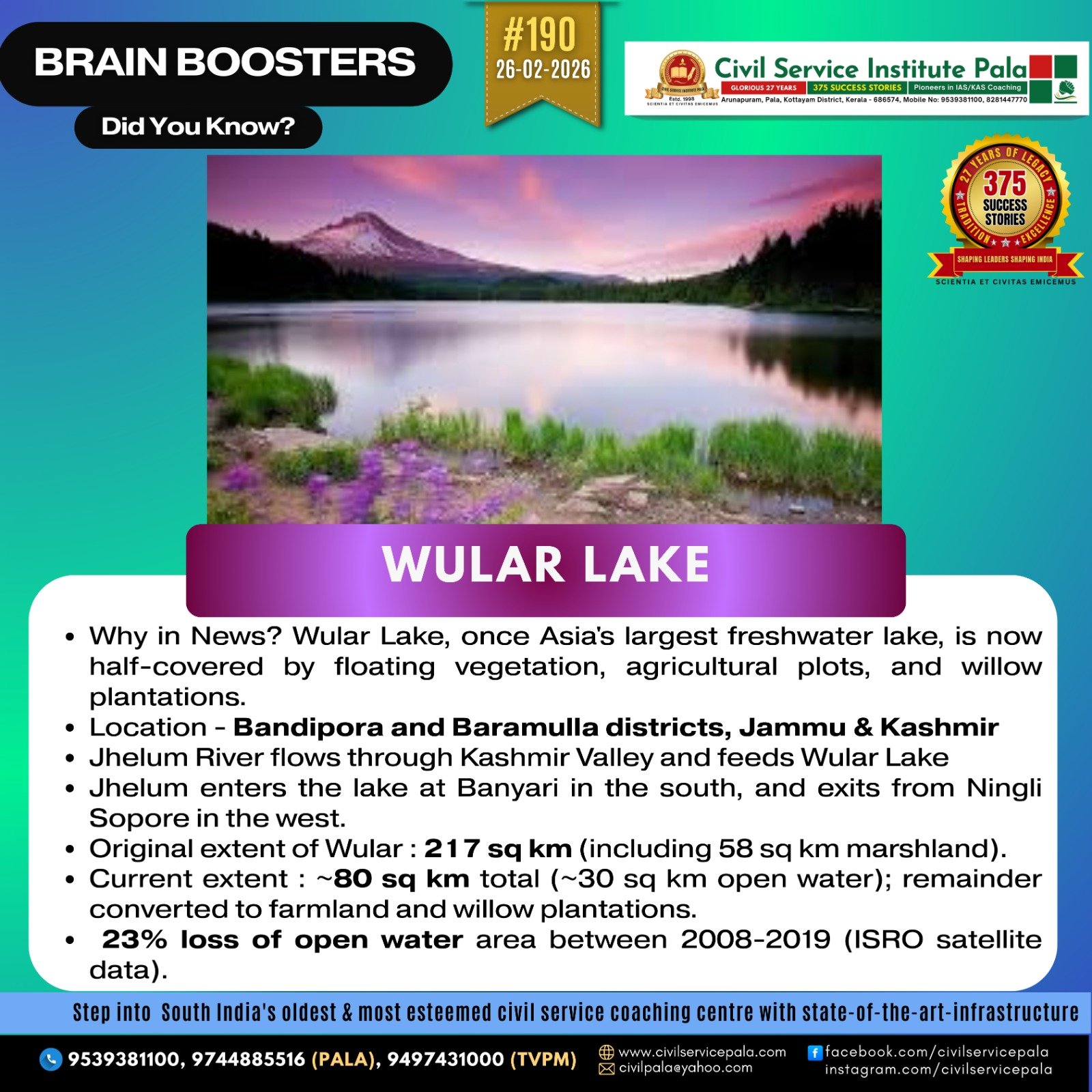
Wular Lake
Why in News? Wular Lake, once Asia's largest freshwater lake, is now half-covered by floating vegetation, agricultural plots, and willow plantations.
• Location - Bandipora and Baramulla districts, Jammu & Kashmir
• Jhelum River flows through Kashmir Valley and feeds Wular Lake
• Jhelum enters the lake at Banyari in the south, and exits from Ningli Sopore in the west.
• Original extent of Wular : 217 sq km (including 58 sq km marshland).
• Current extent : ~80 sq km total (~30 sq km open water); remainder converted to farmland and willow plantations.
• 23% loss of open water area between 2008-2019 (ISRO satellite data).
Ecological Degradation
• Primary Causes: Siltation, encroachment, eutrophication (57% eutrophic by 2018 due to sewage/fertilizer runoff).
• Willow Plantation Impact: 1980s government initiative covered 27 sq km of lakebed; roots consume water, shade blocks aquatic plants.
• Flood Buffer Loss: Reduced storage capacity exacerbated 2014 Srinagar floods.
Fish Catch Decline
• Total Production: 10,544 tons/year → 1,476 tons/year (Wetlands International).
• Per Capita: 20-fold decline despite 3x population growth.
• CPUE: 237 g/hour (from several kg/hour two decades ago; Sher-e-Kashmir University).
Wular Conservation and Management Authority (WUCMA)
Established in September 2012, WUCMA implements the Comprehensive Management Action Plan (CMAP 2007) developed by Wetlands International South Asia. Covering 130 sq km with 84 km perimeter, its mandate includes wetland demarcation, catchment conservation, biodiversity protection, livelihood enhancement, and eco-tourism promotion. The authority maintains Kashmir Valley's hydrography as a critical flood absorption basin supporting ecological and economic functions.
Wular Conservation Project
The multi-pronged project targets lake restoration by
1. reclaiming silted and willow-planted areas;
2. water quality improvement through reduced agricultural runoff and sewage;
3. biodiversity enhancement for native fish, birds, and aquatic life;
4. sustainable livelihoods via alternatives to willow farming;
5. community engagement through awareness programs, capacity building, and participatory decision-making.
