



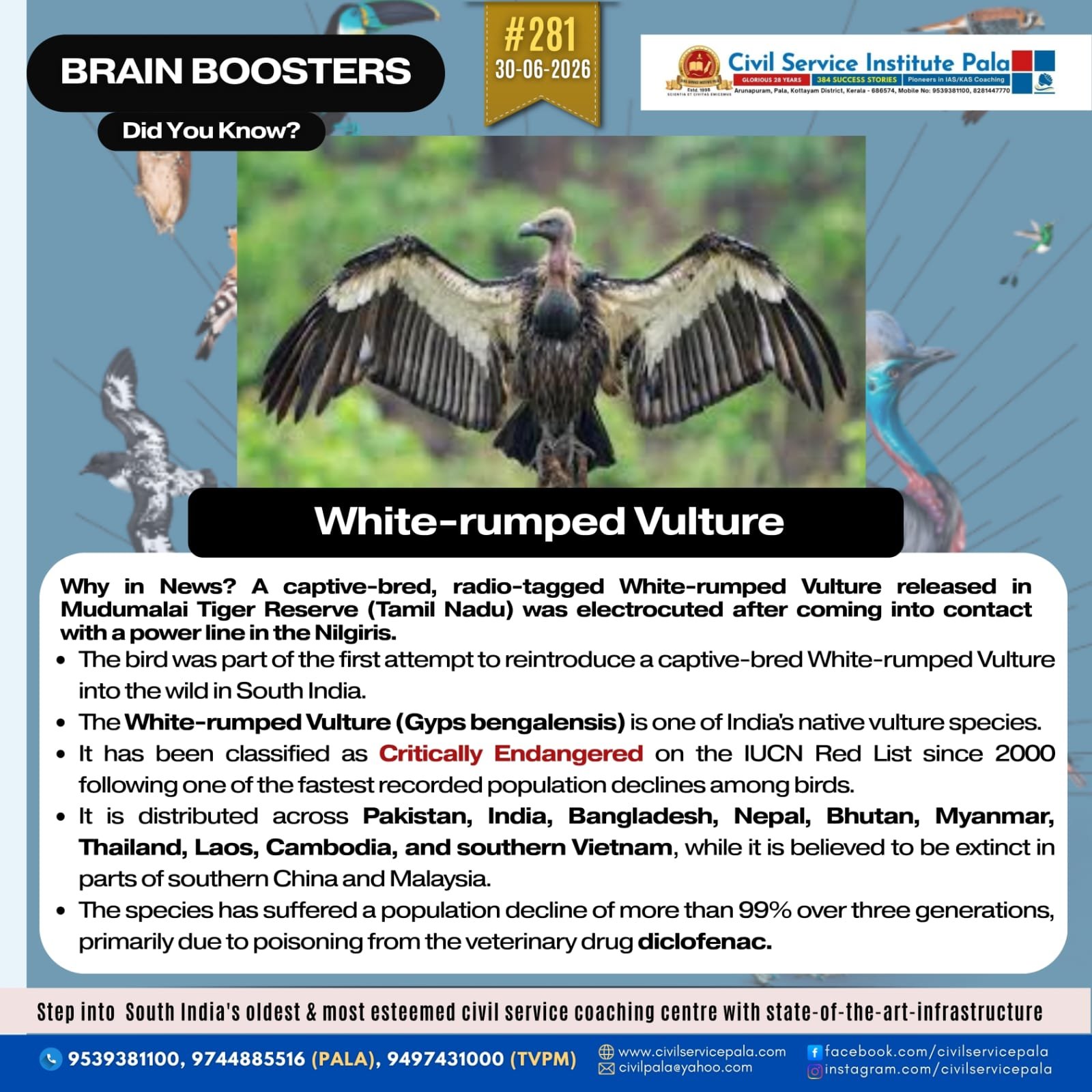
White-rumped Vulture (Gyps bengalensis)
White-rumped Vulture (Gyps bengalensis)
Why in News?
• A captive-bred, radio-tagged White-rumped Vulture released in Mudumalai Tiger Reserve (Tamil Nadu) was electrocuted after coming into contact with a power line in the Nilgiris.
• The bird was part of the first attempt to reintroduce a captive-bred White-rumped Vulture into the wild in South India, making the incident significant for future conservation and reintroduction programmes.
White-rumped Vulture
• The White-rumped Vulture (Gyps bengalensis) is one of India's native vulture species and is listed as Critically Endangered on the IUCN Red List.
• It has been classified as Critically Endangered since 2000 following one of the fastest recorded population declines among birds.
• The species has suffered a population decline of more than 99% over three generations, primarily due to poisoning from the veterinary drug diclofenac.
• It is distributed across Pakistan, India, Bangladesh, Nepal, Bhutan, Myanmar, Thailand, Laos, Cambodia, and southern Vietnam, while it is believed to be extinct in parts of southern China and Malaysia.
Reasons for Population Decline
• The primary cause of decline in the Indian subcontinent has been feeding on carcasses of livestock treated with the veterinary drug diclofenac, which causes fatal kidney failure in vultures.
• In parts of Southeast Asia, improved animal husbandry that reduced carcass availability, and accidental poisoning associated with hunting and fishing practices have also contributed to the species' decline.
Recent Reintroduction Effort
• The bird was initially released in Tadoba-Andhari Tiger Reserve (Maharashtra) in December 2025 before being moved to Mudumalai Tiger Reserve (Tamil Nadu).
• Mudumalai was selected because it supports the last sizeable population of White-rumped Vultures in South India, with the expectation that the released bird would integrate with wild vultures.
• However, the bird failed to acclimatise, repeatedly moved outside the reserve, and was eventually electrocuted while exploring the Nilgiris landscape.
• The incident marks the first unsuccessful reintroduction of a captive-bred White-rumped Vulture into this landscape and is expected to influence future conservation strategies.
Conservation Concerns
• The incident highlights the challenges of reintroducing captive-bred birds into the wild, including behavioural adaptation and habitat acclimatisation.
• Conservationists have stressed the need to study the reasons behind the bird's failure to adapt before undertaking similar releases.
• Experts have also recommended insulating power lines and using bunch-cabling in vulture habitats to reduce accidental electrocution of vultures and other wildlife.
