



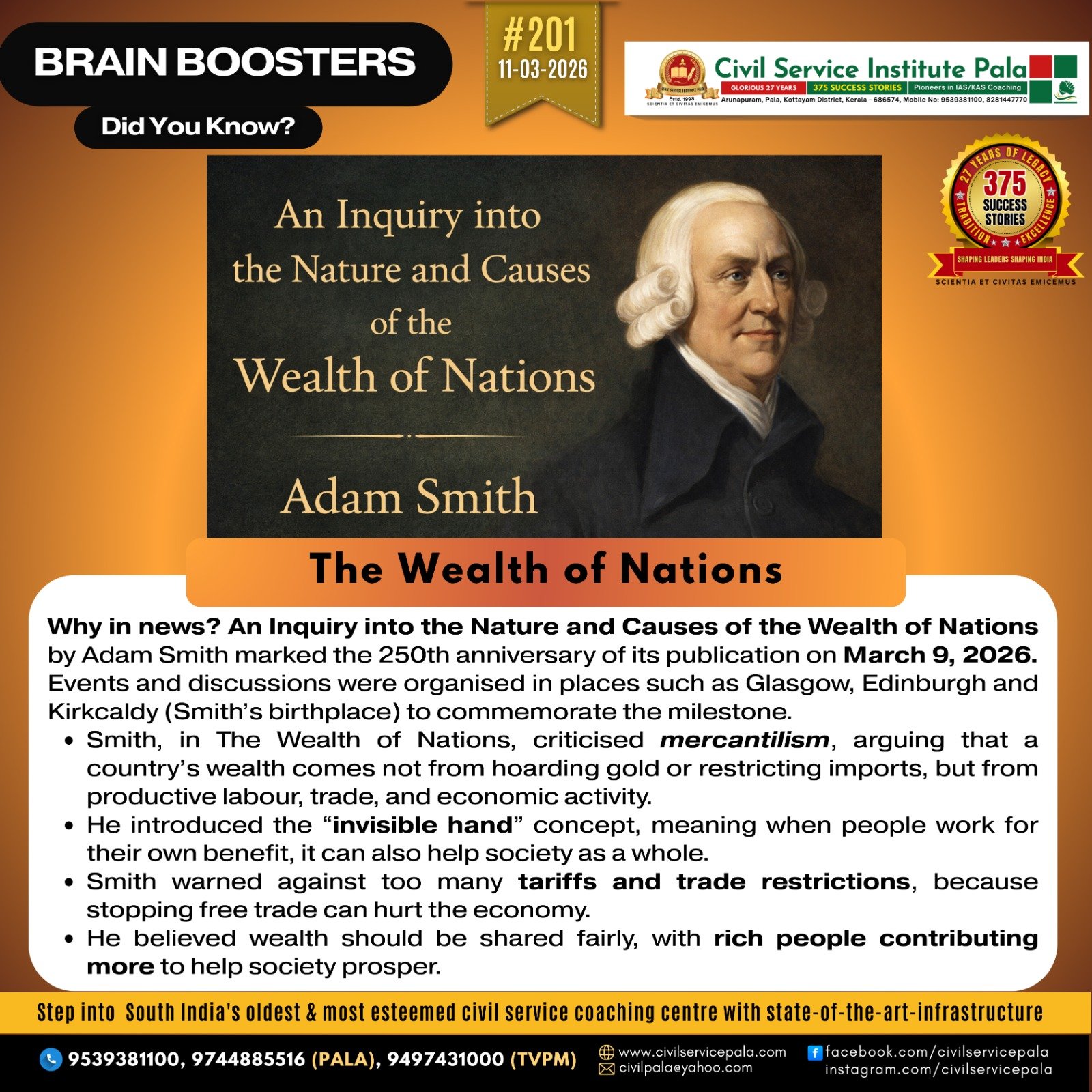
Wealth of Nations
An Inquiry into the Nature and Causes of the Wealth of Nations (simply known as The Wealth of Nations) by Adam Smith marked the 250th anniversary of its publication on March 9, 2026. Events and discussions were organised in places such as Glasgow, Edinburgh and Kirkcaldy (Smith’s birthplace) to commemorate the milestone.
Contemporary Relevance of The Wealth of Nations
Foundation of Modern Economics
• Published in 1776, the book laid the intellectual foundation of classical economics.
• It presented one of the first systematic explanations of political economy—the relationship between society, politics, and economic activity.
• Many modern economic concepts such as markets, trade, productivity, and taxation trace their origins to this work.
Critique of Mercantilism
• Smith strongly opposed the prevailing doctrine of mercantilism, which argued that national wealth came from accumulating gold and restricting imports.
• He instead argued that mutual trade and exchange benefit all nations, challenging the idea of trade as a zero-sum game.
• This argument remains relevant today in debates over trade protectionism and tariffs.
Advocacy of Free Markets and Free Trade
• Smith emphasised that markets function efficiently when individuals pursue their own economic interests.
• He criticised excessive tariffs and trade barriers, arguing that countries should import goods from places where they can be produced more efficiently.
• This principle underlies modern ideas like comparative advantage and global trade integration.
Concept of the “Invisible Hand”
• Smith introduced the famous metaphor of the “invisible hand.”
• It explains how individual self-interest in markets can unintentionally produce benefits for society through efficient allocation of resources.
• The idea continues to influence modern economic theory and policy discussions on market regulation.
Warning Against Monopolies and Special Interests
• Smith warned that monopolies and powerful interest groups can capture the state and distort markets.
• He believed that true market efficiency requires preventing such concentration of economic power.
• This insight is highly relevant today in debates about big tech monopolies and corporate lobbying.
Progressive View on Taxation and Inequality
• Smith argued that the rich should contribute more than proportionally to public expenses.
• He believed a society cannot prosper when most people remain poor and miserable.
• These ideas resonate with modern debates on wealth inequality and progressive taxation.
Importance of Division of Labour
• Smith showed how breaking production into specialised tasks increases productivity and economic growth.
• This principle became central to industrial production systems and modern supply chains.
Early Insights into Behavioural Economics
• Unlike later models that assume perfectly rational individuals, Smith recognised the role of human emotions, biases, and social influences in decision-making.
• His observations about overconfidence bias and psychological motivations resemble ideas in modern behavioural economics.
Concern for Worker Well-being
• Smith warned that extreme repetitive labour could intellectually degrade workers.
• His observations anticipated modern discussions about mental health, automation, and the gig economy.
Continuing Relevance to Modern Economic Debates
Smith’s ideas continue to shape discussions on:
• Globalisation vs protectionism
• Market regulation vs laissez-faire policies
• Income inequality and taxation
• Monopolies and corporate power
• Technological change and labour conditions
Source : THE HINDU & THE INDIAN EXPRESS
