



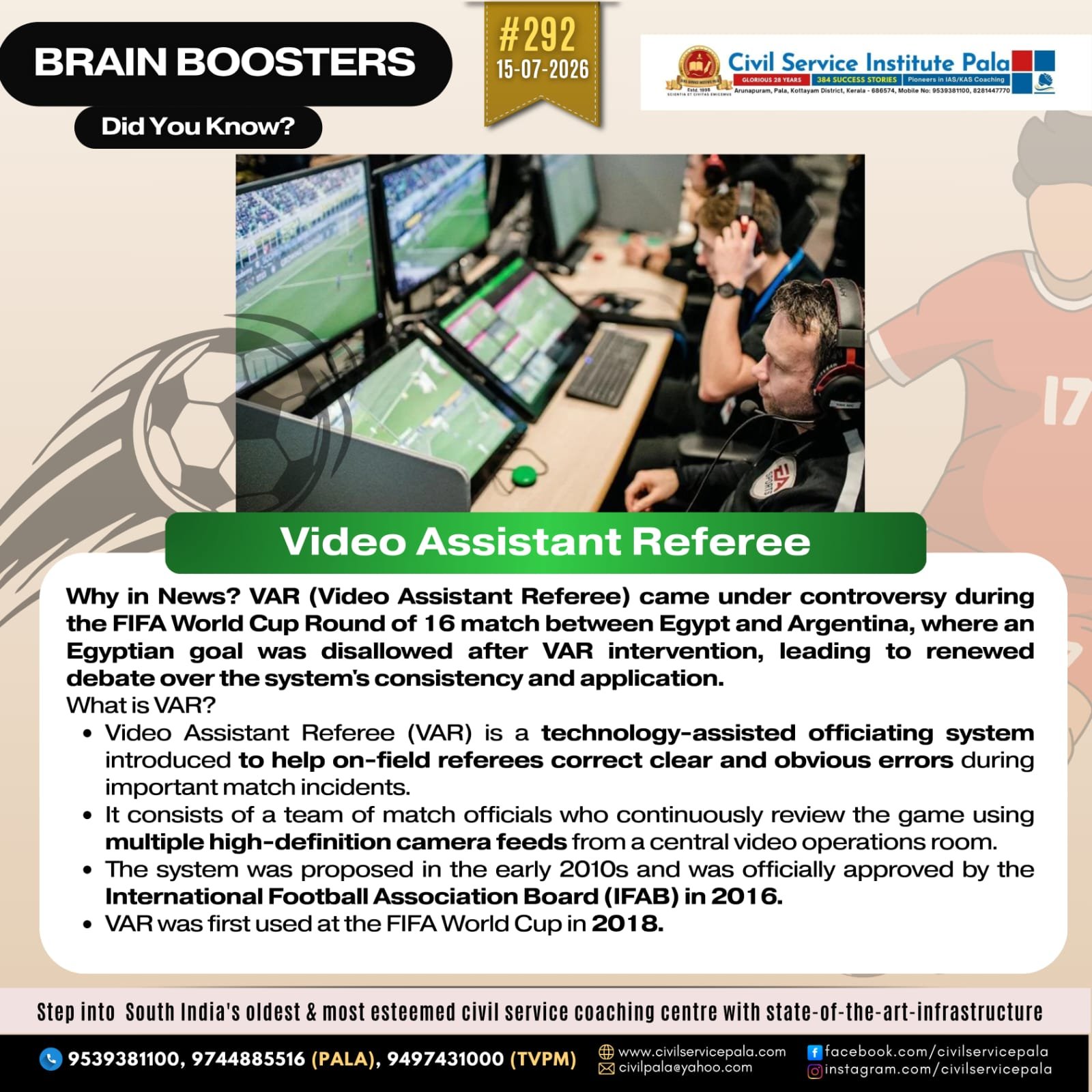
Video Assistant Referee (VAR)
Why in News?
VAR (Video Assistant Referee) came under controversy during the FIFA World Cup Round of 16 match between Egypt and Argentina, where an Egyptian goal was disallowed after VAR intervention, leading to renewed debate over the system's consistency and application.
Video Assistant Referee (VAR)
What is VAR?
• Video Assistant Referee (VAR) is a technology-assisted officiating system introduced to help on-field referees correct clear and obvious errors during important match incidents.
• It consists of a team of match officials who continuously review the game using multiple high-definition camera feeds from a central video operations room.
• The system was proposed in the early 2010s and was officially approved by the International Football Association Board (IFAB) in 2016.
• VAR was first used at the FIFA World Cup in 2018.
How does VAR work?
• Every significant phase of play is continuously monitored by VAR officials using multiple camera angles.
• When a potential clear and obvious error is detected, the VAR team communicates with the on-field referee.
• The referee may:
o accept the recommendation and conduct an On-Field Review (OFR) using the pitch-side monitor, or
o reject the recommendation and retain the original decision.
• The final decision always rests with the on-field referee.
When can VAR intervene?
VAR is permitted to intervene only in specific match-changing situations:
• Goal / No Goal decisions
• Penalty / No Penalty decisions
• Direct Red Card decisions (excluding second yellow cards under normal rules)
• Mistaken identity, when the wrong player is penalised
Additional responsibilities introduced in the 2026 FIFA World Cup include:
• Correcting wrongly awarded corner kicks.
• Assisting in overturning an incorrectly issued second yellow card, which would otherwise result in a player's dismissal.
Recent VAR Controversy
• Egypt's goal against Argentina was disallowed after VAR identified a foul committed earlier in the attacking move.
• FIFA clarified that there is no fixed time or distance limit for reviewing fouls during the build-up to a goal if the incident is considered to have influenced the scoring sequence.
• Following criticism over officiating consistency, FIFA appointed two dedicated in-house VAR officials per match from the quarterfinal stage onwards.
Advantages of VAR
• Reduces major refereeing errors during crucial match incidents.
• Improves fairness through video-based review.
• Provides additional camera angles unavailable to the on-field referee.
• Enhances the accuracy of decisions affecting match outcomes.
Concerns and Criticisms
• Decisions are often criticised for inconsistent interpretation across different referees.
• Frequent reviews may interrupt the flow of the game.
• Fans and players often lack transparency regarding the discussions between VAR officials and the referee.
• VAR sometimes penalises extremely minor infringements that would otherwise go unnoticed, making football excessively technical.
