



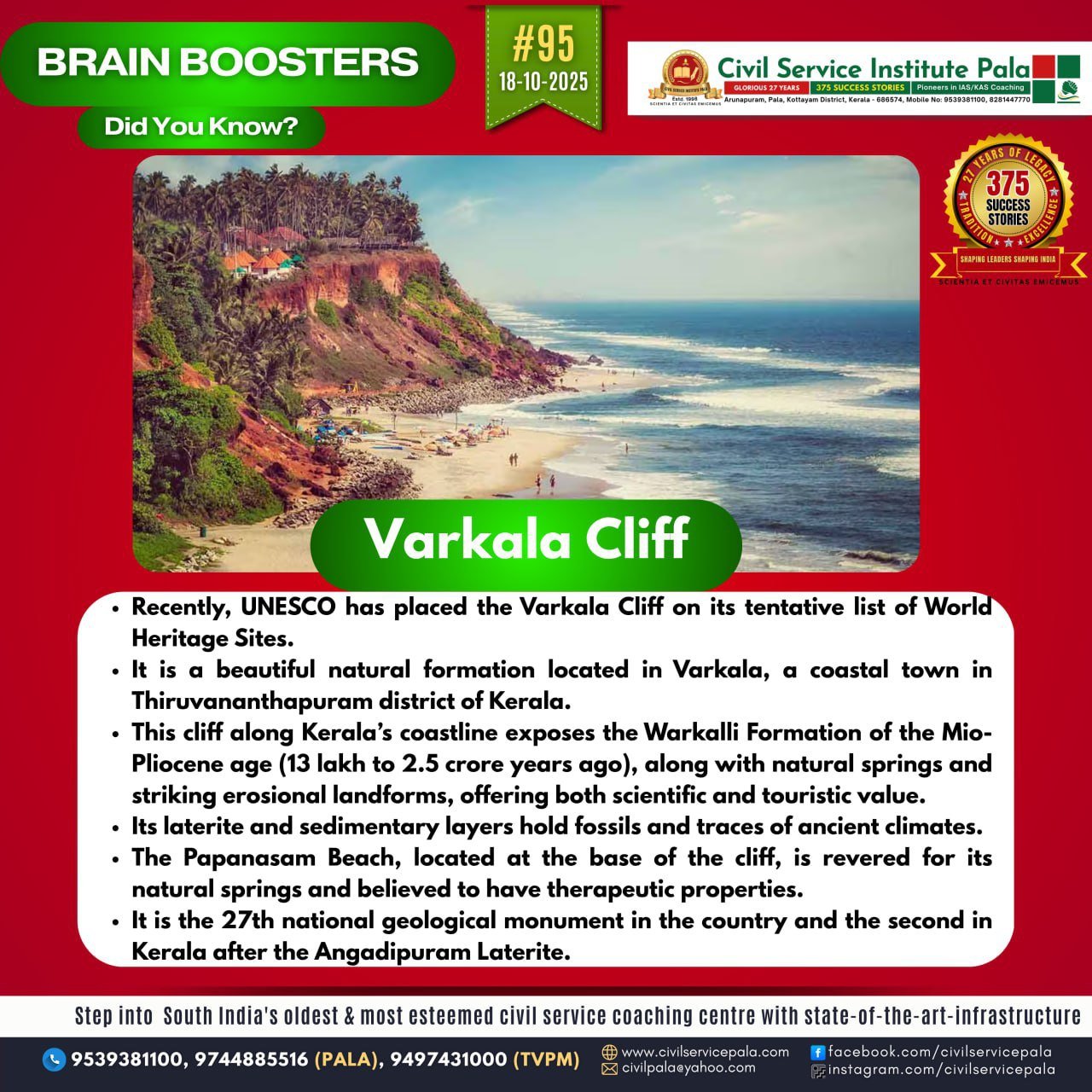
Varkala cliff
Located in Varkala, Kerala, along the Arabian Sea coast. Known for its striking red laterite/sandstone cliffs – a rare geological feature on Kerala’s otherwise flat coastline. Part of the Warkalli Formation (Mio-Pliocene age) composed of sedimentary rocks, clay, lignite lenses, and laterite. Cliff length: about 6–7.5 km, rising up to 40 m in height. Offers scenic views, unique coastal morphology, and spiritual significance.
UNESCO Tentative List Inclusion Added in September 2025 as one of seven new natural heritage sites from India. Included under the category “Natural Heritage of Varkala.” Listed under criteria (vii) and (viii): (vii) – Outstanding natural beauty and aesthetic value. (viii) – Example of major stages of Earth’s history and geological processes. Recognized for its scientific importance and rare minerals like jarosite and palynofossils.
Significance
Only location in Kerala where cliffs meet the sea directly. Serves as a visible cross-section of geological history and sedimentation. Contains unique Earth–Mars analogue features valuable for scientific study.
Cultural and spiritual associations: Janardana Swamy Temple and Sree Narayana Guru’s Sivagiri Mutt nearby. Major tourism and pilgrimage destination in Kerala. Meaning of Tentative List Status A preliminary step before full UNESCO World Heritage nomination. Requires additional documentation, conservation, and management plans. UNESCO will later assess whether it has Outstanding Universal Value (OUV) and sufficient protection and integrity.
Benefits of Recognition Global recognition for Kerala’s natural heritage. Boosts eco-tourism and scientific research opportunities. Encourages better conservation and funding support. Promotes local economic growth through sustainable tourism. Enhances education and awareness of geological heritage.
Challenges and Risks
Erosion and instability: Soft laterite and sediments prone to natural wear.
Unregulated development: Construction and tourism infrastructure near the cliff edge cause stress.
Waste and drainage issues: Poor management can worsen erosion.
Climate change impacts: Sea-level rise and storm surges pose threats.
Governance gaps: Need for stricter zoning, monitoring, and enforcement.
Local Implications Kerala government and local authorities must implement cliff-edge protection and sustainable tourism rules. Businesses near the cliff may face stricter regulations under Coastal Regulation Zone laws. Expected improvements in signage, waste management, and visitor pathways. Local community involvement will be crucial for long-term preservation.
