



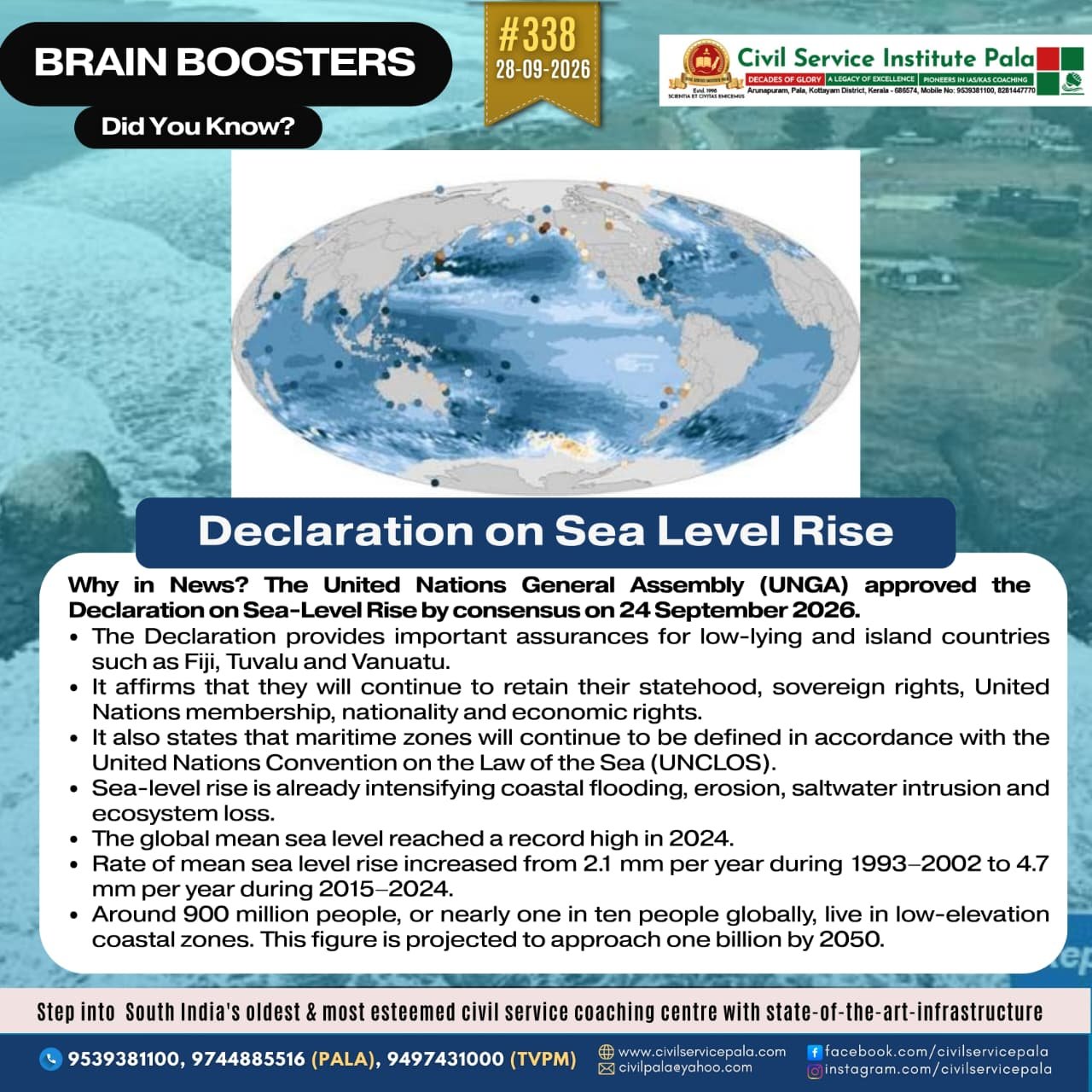
UN Declaration on Sea-Level Rise
UN Declaration on Sea-Level Rise
Why in News?
The United Nations General Assembly (UNGA) approved the Declaration on Sea-Level Rise by consensus on 24 September 2026, strengthening international cooperation on the climate, developmental and legal consequences of rising seas.
International Law
The Declaration provides important assurances for low-lying and island countries such as Fiji, Tuvalu and Vanuatu. It affirms that they will continue to retain their statehood, sovereign rights, United Nations membership, nationality and economic rights, even if rising seas threaten their habitable territory.
It also states that maritime zones will continue to be defined in accordance with the United Nations Convention on the Law of the Sea (UNCLOS), even when rising sea levels cause coastlines to retreat inland.
Rising Vulnerability
Sea-level rise is already intensifying coastal flooding, erosion, saltwater intrusion and ecosystem loss. The global mean sea level reached a record high in 2024, while its rate of rise increased from 2.1 mm per year during 1993–2002 to 4.7 mm per year during 2015–2024.
Around 900 million people, or nearly one in ten people globally, live in low-elevation coastal zones. This figure is projected to approach one billion by 2050.
Small Island States
Small Island Developing States (SIDS) are among the most vulnerable, with around 65 million people facing limited land area, narrow economic bases and high dependence on coastal ecosystems and infrastructure. SIDS collectively account for less than 1% of global greenhouse gas emissions, yet many experience sea-level rise faster than the global average.
The impacts extend beyond physical displacement to housing, health, food and water security, infrastructure, tourism, fisheries, fiscal stability, culture and heritage.
Equity
The burden of sea-level rise is unequally distributed. Countries and communities with limited fiscal space, institutional capacity, finance and technology often face greater exposure and vulnerability.
Women and girls, children, older persons, persons with disabilities, Indigenous Peoples, migrants and people living in poverty can face disproportionate risks, particularly where public services, land tenure and social protection are weak.
Declaration Framework
The four-page Declaration organises international action around four broad areas:
1. Science and data on sea-level rise.
2. Adaptation and financing for vulnerable countries and communities.
3. Livelihoods and socio-economic development, including data-sharing and early-warning systems.
4. Legal consequences of sea-level rise, including issues of statehood and maritime zones.
It also calls for responses that protect livelihoods and cultural heritage and involve affected communities.
From Meeting to Declaration
The process began with the first UNGA High-Level Meeting on Sea-Level Rise on 25 September 2024, aimed at strengthening international cooperation and supporting vulnerable developing countries and coastal communities.
The UNGA subsequently decided that its 81st session would hold a one-day high-level plenary meeting on 24 September 2026, resulting in a concise, action-oriented and intergovernmentally negotiated declaration adopted by consensus.
Why It Matters
The Declaration moves sea-level rise beyond a purely environmental concern by recognising its implications for international law, statehood, maritime rights, development, livelihoods and climate justice. It also commits UN member states to continued engagement, including another high-level meeting before the end of the 84th UNGA session
