



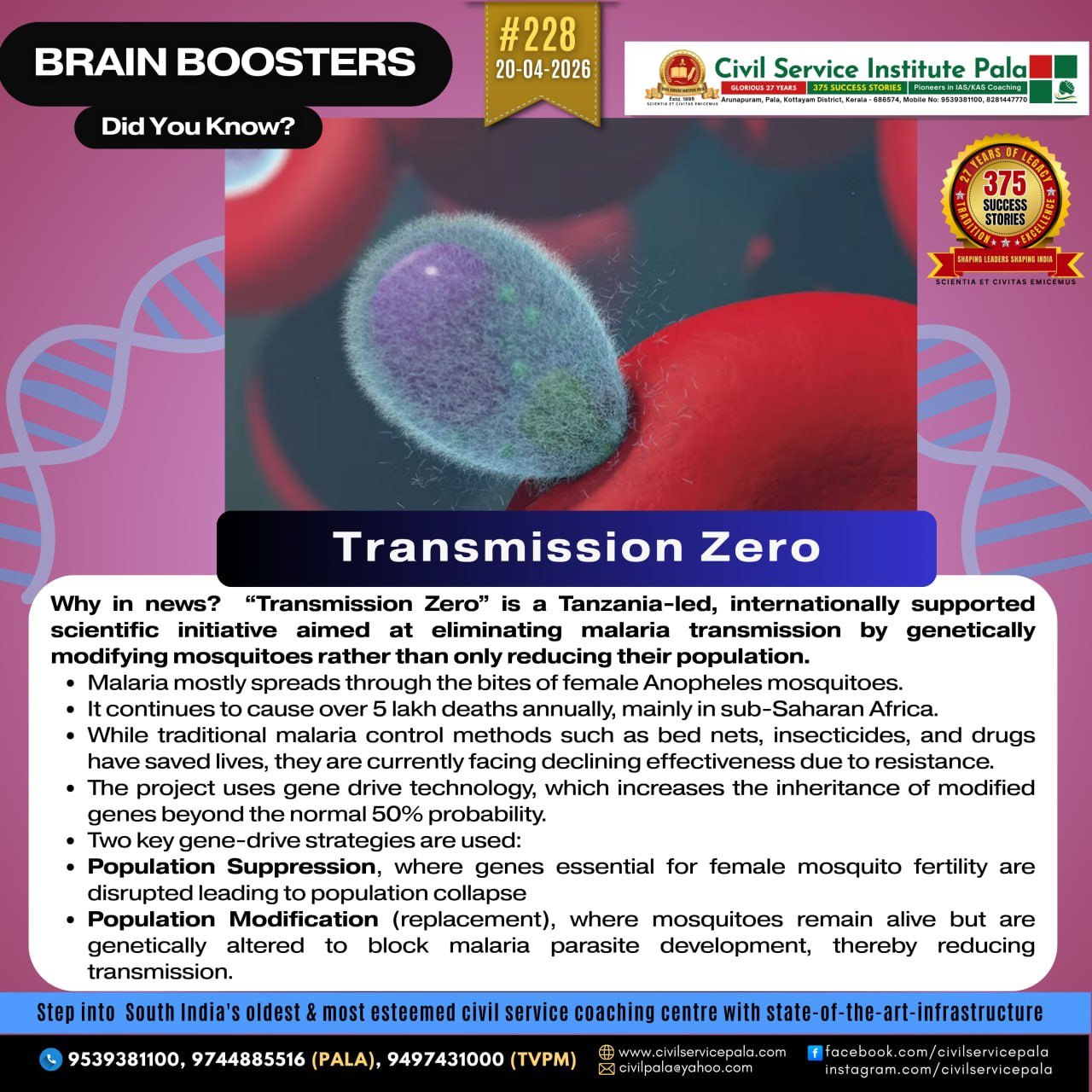
Transmission Zero
• “Transmission Zero” is a Tanzania-led, internationally supported scientific initiative aimed at eliminating malaria transmission by genetically modifying mosquitoes rather than only reducing their population.
Malaria – overview
• Globally, malaria remains a major public health challenge, with about 282 million cases and 610,000 deaths reported in 2024 across 80 countries.
• Experts highlight that the WHO African Region bears a disproportionate burden, accounting for nearly 95% of global malaria cases (265 million) and deaths (579,000).
• Children under five years are the most vulnerable group, contributing to about 75% of malaria-related deaths in the African region.
• Malaria is a life-threatening but preventable and curable disease, caused by Plasmodium parasites and transmitted primarily through the bites of infected female Anopheles mosquitoes.
• The disease does not spread through casual human contact, although rare transmission can occur via blood transfusion or contaminated needles.
• Symptoms of malaria range from mild to severe, with early signs including fever, chills, and headache, while severe cases can lead to confusion, seizures, breathing difficulty, and death if untreated.
• High-risk groups include infants, young children, pregnant women, travellers, and immunocompromised individuals, particularly those with HIV/AIDS.
• Malaria can be effectively prevented through vector control and prophylactic measures, such as avoiding mosquito bites and using preventive medicines.
• Timely treatment is crucial, as infections—especially those caused by Plasmodium falciparum—can progress rapidly to severe illness and death within 24 hours if untreated.
• Five species of Plasmodium infect humans, of which P. falciparum (most deadly and prevalent in Africa) and P. vivax (dominant outside Africa) pose the greatest global threat.
• The other malaria species which can infect humans are P. malariae, P. ovale and P. knowlesi.
Transmission Zero
• “Transmission Zero” is a Tanzania-led, internationally supported scientific initiative aimed at eliminating malaria transmission by genetically modifying mosquitoes rather than only reducing their population.
• While traditional malaria control methods such as bed nets, insecticides, and drugs have saved lives, they are currently facing declining effectiveness due to resistance.
• The project is being developed to ensure local relevance and capacity building focused in African nations.
• Malaria continues to cause over 5 lakh deaths annually, mainly in sub-Saharan Africa.
• Mosquitoes are developing resistance to insecticides, while parasites are evolving drug resistance.
• Experts suggest that biological complexity of parasites and ecological concerns make long-term solutions difficult.
• These setbacks have led scientists to reconsider disease control techniques.
Important Features
• The project uses gene drive technology, which increases the inheritance of modified genes beyond the normal 50% probability.
• Normally, a gene has a 50% chance of inheritance, but gene drives increase this to over 90%, ensuring rapid spread.
Working of a Gene Drive
• Using the gene-editing tool CRISPR–Cas9, scientists design a genetic system that copies itself onto the partner chromosome during reproduction.
• As a result, far more than half of the offspring inherit the modified gene, often over 90%.
• Over multiple generations, this biased inheritance allows a gene to spread rapidly through a population.
• Two major strategies are being developed:
o Population suppression : In this method, genetic drives disrupt the genes essential for female mosquitoes to develop or become fertile. As the drive spreads, more females become sterile, causing mosquito populations to shrink or collapse.
o Population modification (replacement) : mosquitoes remain alive but carry genes that prevent the malaria parasites from developing inside their bodies. This strategy reduces the mosquitoes’ ability to transmit malaria.
• A key study in Tanzania demonstrated that genetically modified mosquitoes can block real-world malaria infections, not just laboratory strains.
Tanzania Study
1. Population Modification study
• The researchers engineered local Anopheles gambiae mosquitoes to produce two antimicrobial peptides in their midgut after feeding on malaria-infected blood.
• In the modified mosquitoes, the parasites were severely impaired and often failed to reach the infectious stage.
• In some experiments, none of the modified mosquitoes carried potentially transmissible parasites.
2. Split Gene Drive
• Here, one mosquito line carried the anti-malaria genes while another provided the Cas9 enzyme.
• When combined, about 94% of offspring inherited the protective trait, allowing the researchers to test the protective genes without immediately deploying a fully self-propagating drive.
Way Forward
• Experts suggest gene drives could become a complementary tool, not a replacement for existing malaria control strategies.
• Deployment requires strict ecological risk assessment, regulatory approval, and community acceptance.
• Research is moving toward self-limiting and reversible gene drives to reduce ecological risks.
