



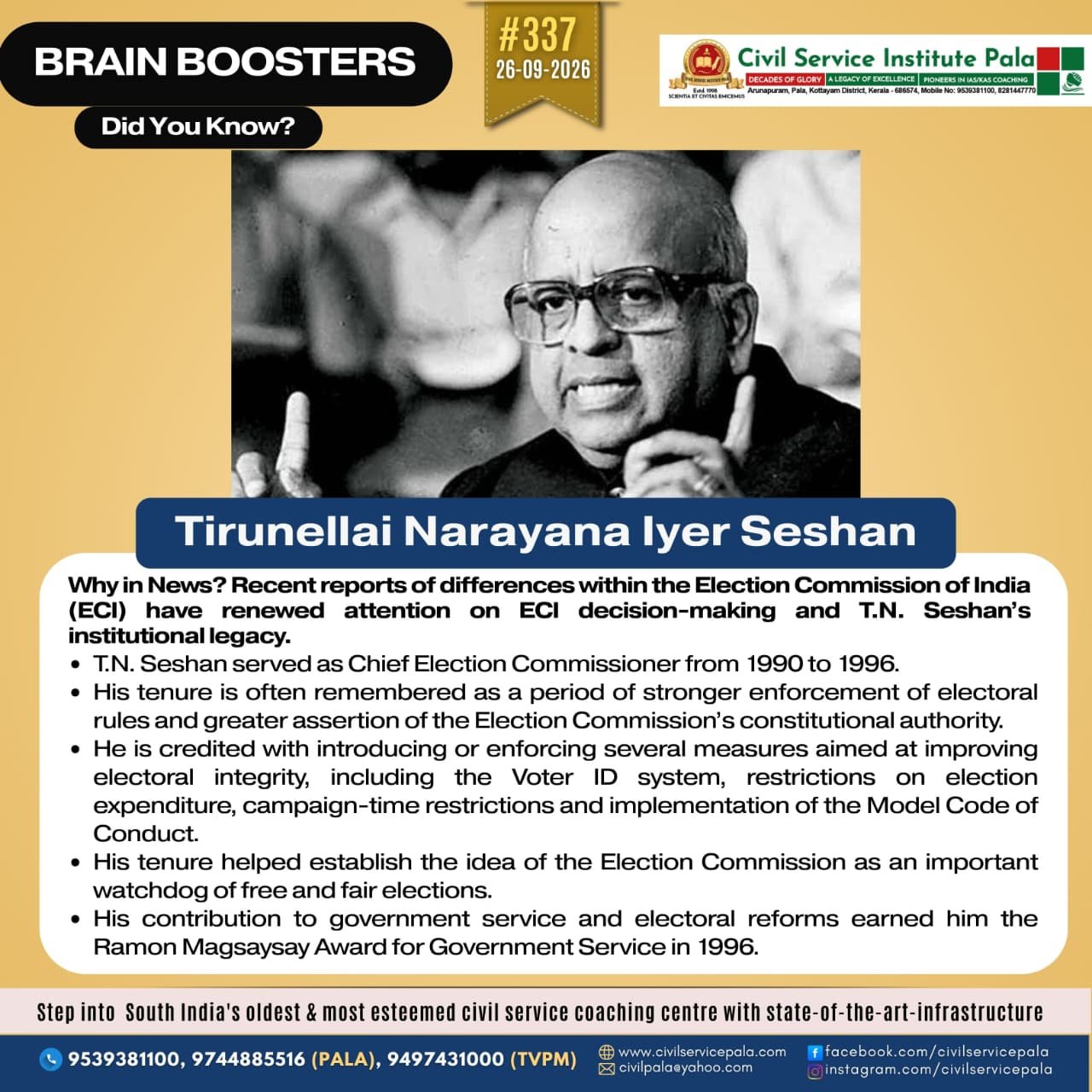
T.N. Seshan and the Assertion of the Election Commission’s Authority
T.N. Seshan and the Assertion of the Election Commission’s Authority
Why in News?
The functioning of the three-member Election Commission of India (ECI) has recently come under scrutiny after reports that two Election Commissioners recorded objections on files at least 14 times in 10 months. The issue has revived attention on how the ECI takes decisions and on the institutional legacy of T.N. Seshan, whose tenure marked a major assertion of the Commission’s authority.
T.N. Seshan and Electoral Reform
A defining tenure: Seshan served as Chief Election Commissioner from 1990 to 1996. His tenure is often remembered as a period of stronger enforcement of electoral rules and greater assertion of the Election Commission’s constitutional authority.
Strengthening electoral safeguards: He is credited with introducing or enforcing several measures aimed at improving electoral integrity, including the Voter ID system, restrictions on election expenditure, campaign-time restrictions and implementation of the Model Code of Conduct.
An assertive constitutional institution: Seshan demonstrated that the Election Commission could exercise its constitutional powers firmly rather than function merely as an administrative arm of government. His actions against electoral malpractice made politicians wary while earning him considerable public support.
Institutional legacy: His tenure helped establish the idea of the Election Commission as an important watchdog of free and fair elections, with the authority to impose checks and balances on electoral processes.
From Civil Servant to CEC
IAS career: An officer of the 1955 batch of the Indian Administrative Service, Seshan served in several positions in Tamil Nadu and the Union Government, including as Collector of Madurai.
Senior administration: He became Cabinet Secretary in 1989 and later served as a member of the Planning Commission. His administrative experience preceded his tenure as CEC.
Recognition: His contribution to government service and electoral reforms earned him the Ramon Magsaysay Award for Government Service in 1996.
Beyond Public Office
Education: Seshan graduated from Madras Christian College (MCC), Chennai, in 1952, where he also taught for two years.
Wider interests: He was described as a multidimensional personality and chaired Sankalp Beautiful World, an organisation involved in providing care for cancer patients.
Public engagement: Even after his years in public office, Seshan continued to engage with public issues. In 2018, he wrote on the Sabarimala issue, questioning the constitutional basis of attempting to impose equality in the manner being debated at the time.
Seshan and the Multi-Member Election Commission
Expansion in 1993: The Election Commission was permanently expanded from a single-member body into a three-member Commission.
Institutional equality: Seshan challenged the appointment of Election Commissioners M.S. Gill and G.V.G. Krishnamurthy before the Supreme Court. In T.N. Seshan v. Union of India (1995), the Court upheld their appointment and established that the three members had equal status and an equal say in decision-making.
Legacy for present functioning: The episode illustrates an important principle: while the CEC chairs the Commission, decision-making in a multi-member ECI is not based on the CEC having a superior vote.
