



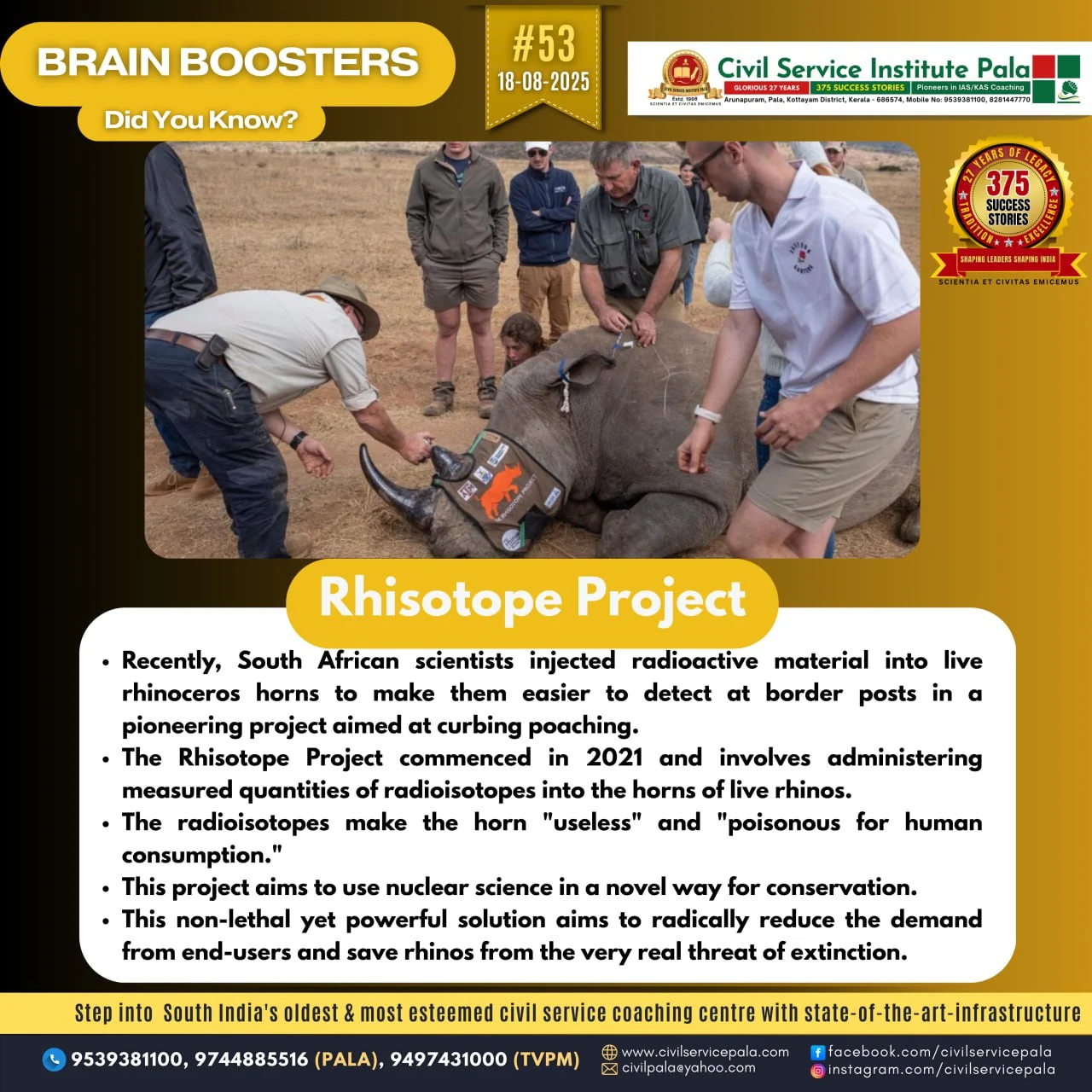
The Rhisotope Project
The Rhisotope Project is a unique international initiative that combines wildlife conservation, nuclear science, and technology to help combat rhino poaching in Africa.
1. Origin & Leadership
Launched in 2021 in South Africa, the country that has the largest population of rhinos.
Led by the University of the Witwatersrand (Wits University), Johannesburg, in collaboration with international partners.
It brings together scientists, conservationists, and nuclear experts.
2. Purpose
To protect rhinos from poaching by making their horns undesirable and traceable.
Rhino poaching is driven by the illegal horn trade (especially in Asia), where horns are wrongly believed to have medicinal or status value.
3. How It Works
Radioisotopes (low-dose radioactive materials) are safely implanted into rhino horns.
These isotopes:
Do not harm the animal (carefully tested to ensure safety).
Make the horns detectable by radiation scanners at airports, ports, and borders.
Act as a deterrent, since buyers won’t want horns that can easily expose them to authorities.
It effectively turns rhino horns into something that smugglers cannot move without being caught.
4. Testing & Phases
First, safety studies were done on rhinos to confirm no health risks.
Then small-scale isotope injections were trialed.
Over time, the project plans to roll it out more widely if proven safe and effective.
5. Significance
A world-first in using nuclear science for wildlife protection.
Helps law enforcement track and stop horn smuggling.
Provides a sustainable, innovative approach against poaching, beyond traditional anti-poaching patrols.
Raises awareness about the misuse of rhino horns in illegal markets.
Source:https://indianexpress.com/article/explained/explained-sci-tech/rhino-poaching-radioactive-isotope-injections-10167467/
