



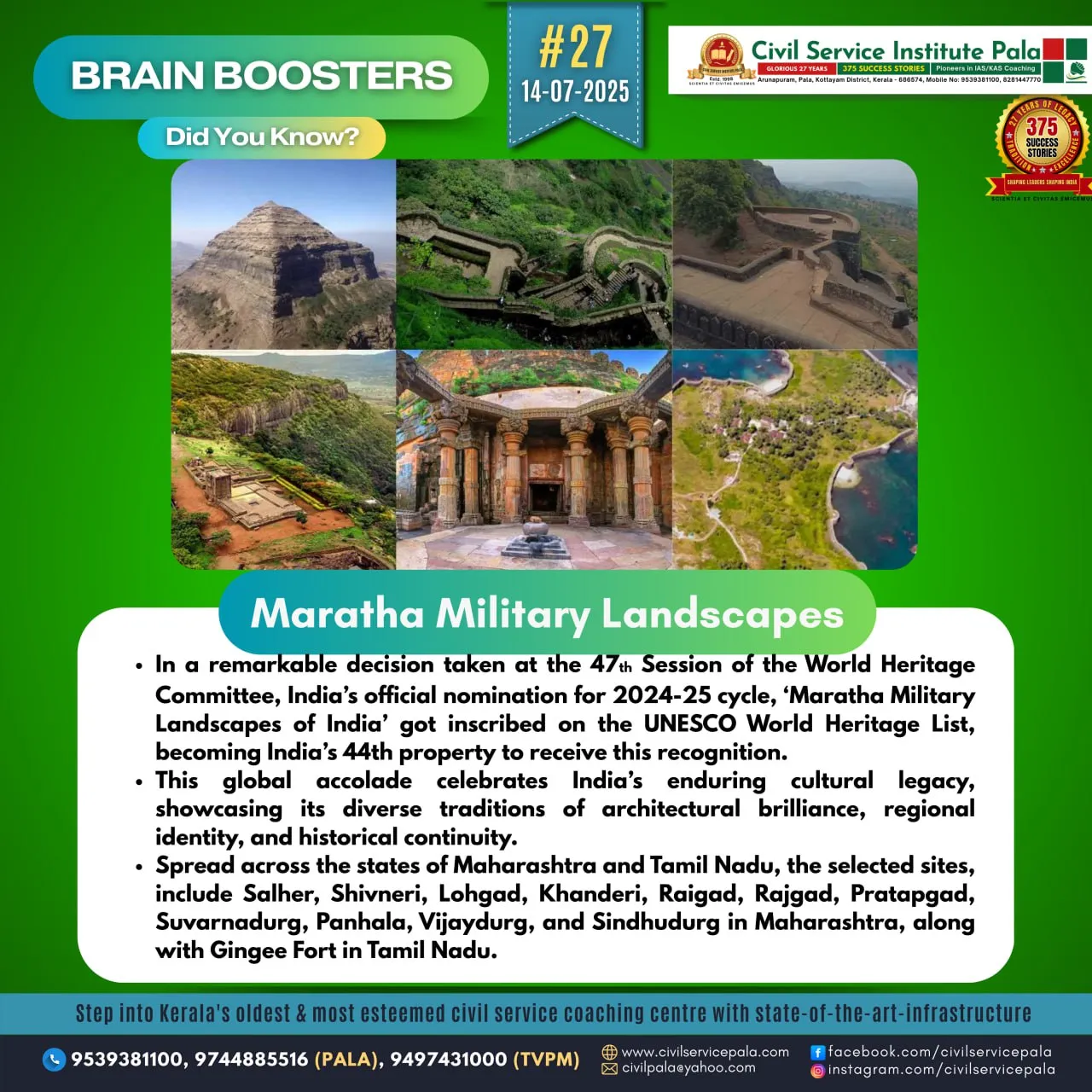
The Maratha Military Landscapes
The Maratha Military Landscapes refer to a unique network of hill forts, fortifications, and associated military settlements built and developed primarily by the Maratha Empire between the 17th and 19th centuries in western India.The Maratha Empire emerged in the 17th century under the leadership of Chhatrapati Shivaji Maharaj, who revolutionized Indian military strategy by utilizing the rugged terrain of the Western Ghats for guerrilla warfare. These forts were not just military outposts but administrative centers, symbols of sovereignty, and places of refuge.
Shivaji adopted a defensive warfare system centered around hill forts, making the Maratha military landscape a significant evolution in Indian fort architecture and strategy. The forts helped withstand the Mughal, Bijapur Sultanate, and later British military campaigns. Key Features of the Maratha Military Landscapes:
Hill Forts Built in Strategic Locations:
These forts were generally located on hilltops, ridges, and plateaus in the Sahyadri (Western Ghats), offering panoramic surveillance and natural defense. Examples include Raigad Fort, Sinhagad Fort, and Torna Fort.
Guerrilla Warfare Architecture (Ganimi Kava):
The Marathas developed a unique warfare style that relied on quick movements, surprise attacks, and deep knowledge of the terrain. Their forts were designed for swift troop movements, secret exits, and concealed paths.
Integration with Natural Landscape:
Unlike the massive Mughal-style forts, Maratha forts were camouflaged into the rocky terrain, using locally available stone, minimal ornamentation, and natural fortification lines, making them less detectable and more sustainable.
Water Management Systems:
Water scarcity was a concern on hill forts. Ingenious systems like rock-cut cisterns, step wells, and rainwater harvesting mechanisms were created to ensure year-round water supply.
Watch Towers and Signal Systems:
Forts were interconnected through a network of watch towers, using smoke signals, flags, or mirrors (heliographs) to communicate across distances.
Defensive Architecture:
Elements like zigzagging entrances, narrow gates, bastions, slit windows, mazes, and trap doors were incorporated to slow or trap enemy troops during sieges.
Notable Forts Included:
Some of the prominent forts that form the core of the Maratha Military Landscapes are:
Raigad (capital of Shivaji’s kingdom)
Rajgad
Pratapgad
Sinhagad
Torna
Lohagad
Vijaydurg
Sindhudurg (coastal fort built on an island)
Suvarnadurg
Salher Fort (one of the highest in Maharashtra)
Cultural and Political Significance:
These forts were not built for royal luxury like many Mughal forts, but as symbols of Maratha resilience and independence.
They were centers of administration, justice, and governance, with temples, granaries, markets, and residential quarters.
Many forts are associated with important events in Indian history, such as Shivaji’s coronation (Raigad) and battles with the Mughals and British. Today, many of these forts are in ruins, but they remain significant heritage sites attracting historians, trekkers, and devotees. Several are maintained by the Archaeological Survey of India and the Maharashtra state government, while others require conservation efforts.
Source:https://www.pib.gov.in/PressReleasePage.aspx?PRID=2144154
