



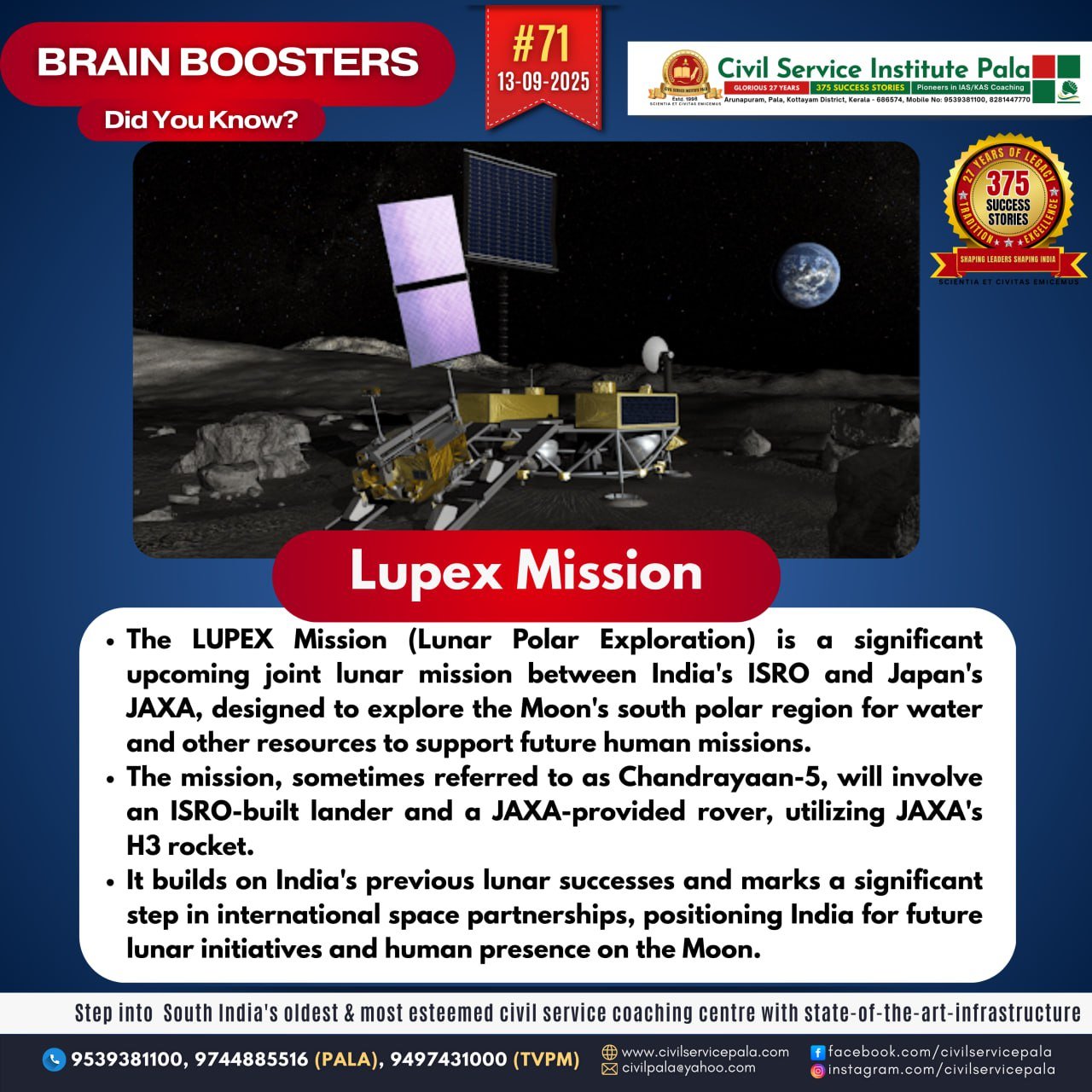
The LUPEX Mission
The LUPEX Mission (Lunar Polar Exploration Mission) is a joint moon mission by India (ISRO) and Japan (JAXA), designed to explore the lunar south pole region. It is a major step in advancing lunar science, resource utilization, and human exploration prospects.
Overview Full form: Lunar Polar Exploration Mission (LUPEX) Agencies involved: ISRO (Indian Space Research Organisation) → develops the lander JAXA (Japan Aerospace Exploration Agency) → develops the rover Planned launch: Around 2026–2028 (subject to readiness) Launch vehicle: Japan’s H3 rocket
Mission Objectives Search for Water Ice Study the distribution, quantity, and nature of water ice at the lunar south pole. Critical for future human missions as water can be used for life support and fuel production. Surface & Subsurface Exploration The rover will drill up to 1 meter deep to analyze lunar soil (regolith) and ice. Helps understand lunar geology and potential resources. Technology Demonstration Prove the capability of precision landing near the lunar poles (challenging due to rough terrain and low sunlight). Test long-duration survival technologies in extreme lunar polar conditions.
Mission Components Lander (by ISRO) Ensures soft landing on the lunar south pole. Carries rover and scientific instruments. Rover (by JAXA) Equipped with drills and spectrometers to study soil and ice. Expected weight: ~350 kg. Will explore for ~6 months. Scientific Payloads Instruments from ISRO, JAXA, and NASA for studying water molecules, minerals, and lunar environment.
Significance First mission to directly study lunar south pole water ice in detail. Supports NASA’s Artemis program and international lunar exploration roadmap. Strengthens India–Japan space collaboration. Boosts India’s role in deep space exploration after Chandrayaan-1, 2, and 3.
