



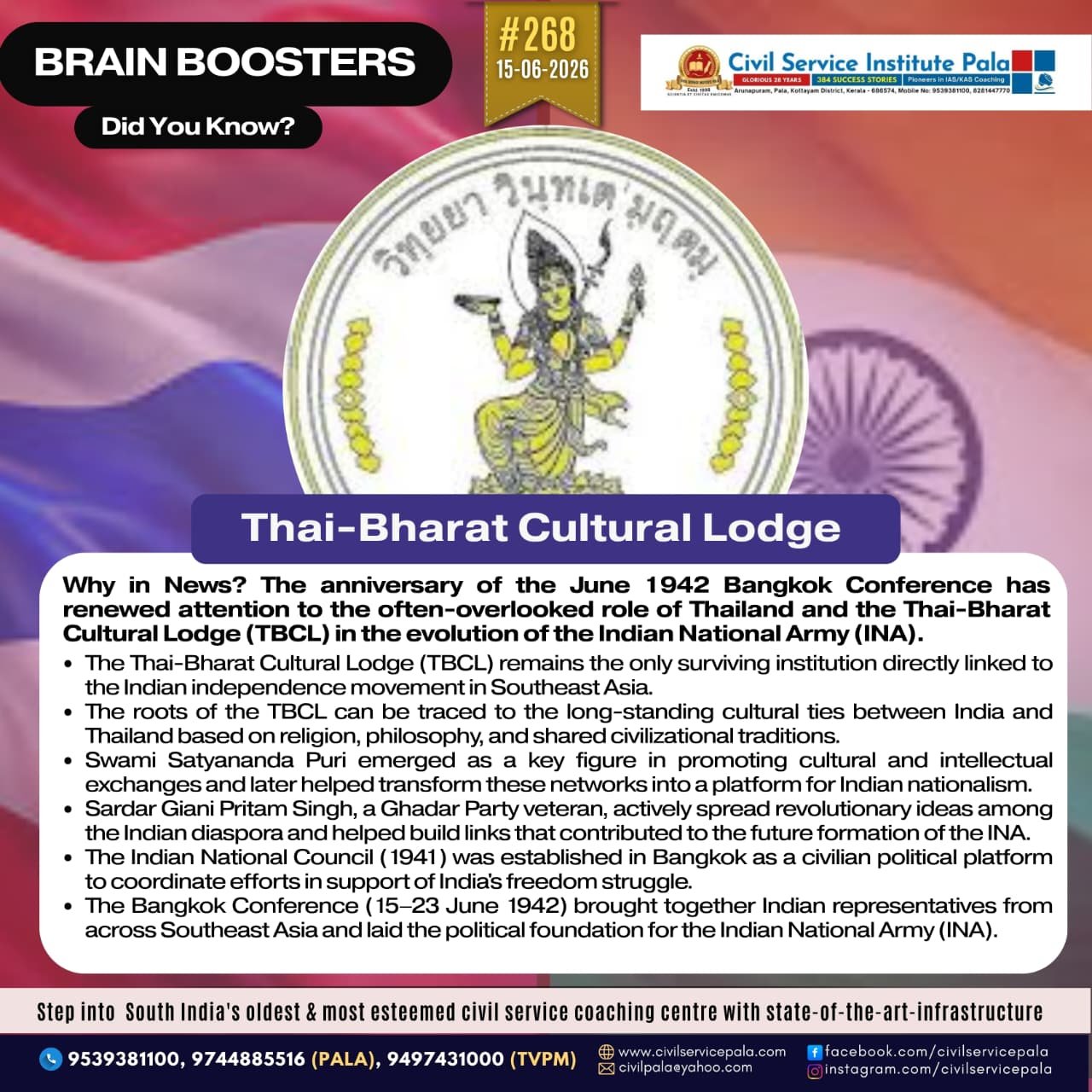
Thai-Bharat Cultural Lodge (TBCL)
Thai-Bharat Cultural Lodge (TBCL) and the Formation of the Indian National Army (INA)
Why in News?
The anniversary of the June 1942 Bangkok Conference has renewed attention to the often-overlooked role of Thailand and the Thai-Bharat Cultural Lodge (TBCL) in the evolution of the Indian National Army (INA).
The TBCL remains the only surviving institution directly linked to this phase of the Indian independence movement in Southeast Asia.
Background: From Cultural Exchange to Nationalist Platform
The roots of the Thai-Bharat Cultural Lodge can be traced to the cultural ties between India and Thailand strengthened during Rabindranath Tagore's visit to Siam (Thailand).
Shared civilizational links based on religion, philosophy, and cultural traditions such as the Ramayana and Ramakien helped deepen Indo-Thai engagement.
Swami Satyananda Puri, a scholar from India, emerged as a key figure in promoting cultural and intellectual exchanges in Thailand.
He established the Dharam Ashram (1939) in Bangkok, which became an important centre for the Indian diaspora and cultural interaction.
The Dharam Ashram was later transformed into the Thai-Bharat Cultural Lodge (TBCL).
Emergence of TBCL as a Nationalist Centre
The hoisting of the Indian Tricolour at the Lodge marked its transformation from a cultural institution into a symbol of the Indian freedom struggle.
The Lodge became a gathering point for Indian nationalists residing in Southeast Asia.
During the Second World War, the TBCL evolved into an important political and organisational base for anti-colonial activities.
It provided an institutional platform through which Indian nationalists could coordinate their efforts outside India.
Key Leaders and Their Contributions
Swami Satyananda Puri
Swami Satyananda Puri served as a leading intellectual force behind the nationalist movement in Thailand.
He helped transform cultural networks into organised political platforms supporting Indian independence.
He became the president of the Indian National Council (INC) established in Bangkok.
Sardar Giani Pritam Singh
Sardar Giani Pritam Singh was a Ghadar Party veteran who actively spread revolutionary ideas among the Indian diaspora.
He established important links between Indian nationalists and Japanese intelligence networks.
His efforts helped lay the groundwork for future military and political cooperation that contributed to the formation of the INA.
Debnath Das
Debnath Das served as the secretary of the Indian National Council.
He played a role in coordinating nationalist activities and organisational efforts in Southeast Asia.
Indian National Council (1941)
The Indian National Council was established in Bangkok as a civilian political platform supporting India's freedom struggle.
It acted as a bridge between civilian nationalist aspirations and military mobilisation efforts.
The organisation helped coordinate the activities of Indian nationalists scattered across Southeast Asia.
Bangkok Conference (June 1942): Turning Point
The Bangkok Conference brought together representatives of Indian communities and freedom fighters from across Southeast Asia.
The conference unified various nationalist groups under a common political and military framework.
It established the Indian Independence League (IIL) as the principal organisation representing overseas Indians.
A 34-point resolution adopted at the conference provided the political blueprint for the Indian National Army.
The resolution envisaged an INA composed of volunteers and former prisoners of war.
The conference sought to ensure that the INA remained under Indian political supervision rather than direct foreign military control.
Delegates also urged recognition of India's independence and of the IIL as the legitimate representative of Indians abroad.
Sacrifice and Setback
The movement suffered a major setback when Swami Satyananda Puri and Sardar Giani Pritam Singh died in an air crash while travelling for discussions related to the movement.
Their deaths created a leadership vacuum but strengthened the determination of remaining activists.
Role of Netaji Subhas Chandra Bose
The arrival of Netaji Subhas Chandra Bose provided the movement with centralised and charismatic leadership.
Bose assumed leadership of both the Indian Independence League and the Indian National Army.
He transformed a largely decentralised movement into a disciplined political and military organisation.
Under his leadership, the INA expanded its mobilisation of volunteers and former prisoners of war.
Bose promoted the idea of "Total Mobilization" to strengthen the freedom struggle.
He elevated cooperation with Japan into a broader diplomatic and strategic partnership aimed at securing recognition for a Provisional Government of Free India.
Importance of TBCL During the INA Phase
Even after the rise of the INA, the TBCL continued to function as an important civilian and institutional support centre.
The Lodge provided cultural, social, and organisational backing to the wider independence movement.
It served as a sanctuary for members of the Indian diaspora committed to the cause of freedom.
The TBCL helped preserve the idea that India's liberation was connected to broader Asian anti-colonial struggles.
Post-War Developments
Following the end of the Second World War, the TBCL was banned and its leaders were imprisoned.
The organisation was later revived through the efforts of dedicated members of the Indian community.
Its revival demonstrated the resilience of the cultural and social networks that had supported the freedom struggle.
These networks helped sustain the legacy of the movement even after the dissolution of the INA.
Present-Day Significance
The Thai-Bharat Cultural Lodge remains the only surviving institution directly associated with this phase of the Indian independence movement.
It functions as a living archive preserving documents, photographs, and records related to the freedom struggle.
The Lodge serves as a symbol of the historical friendship between India and Thailand.
It highlights the contribution of overseas Indians and transnational networks to India's independence movement.
