



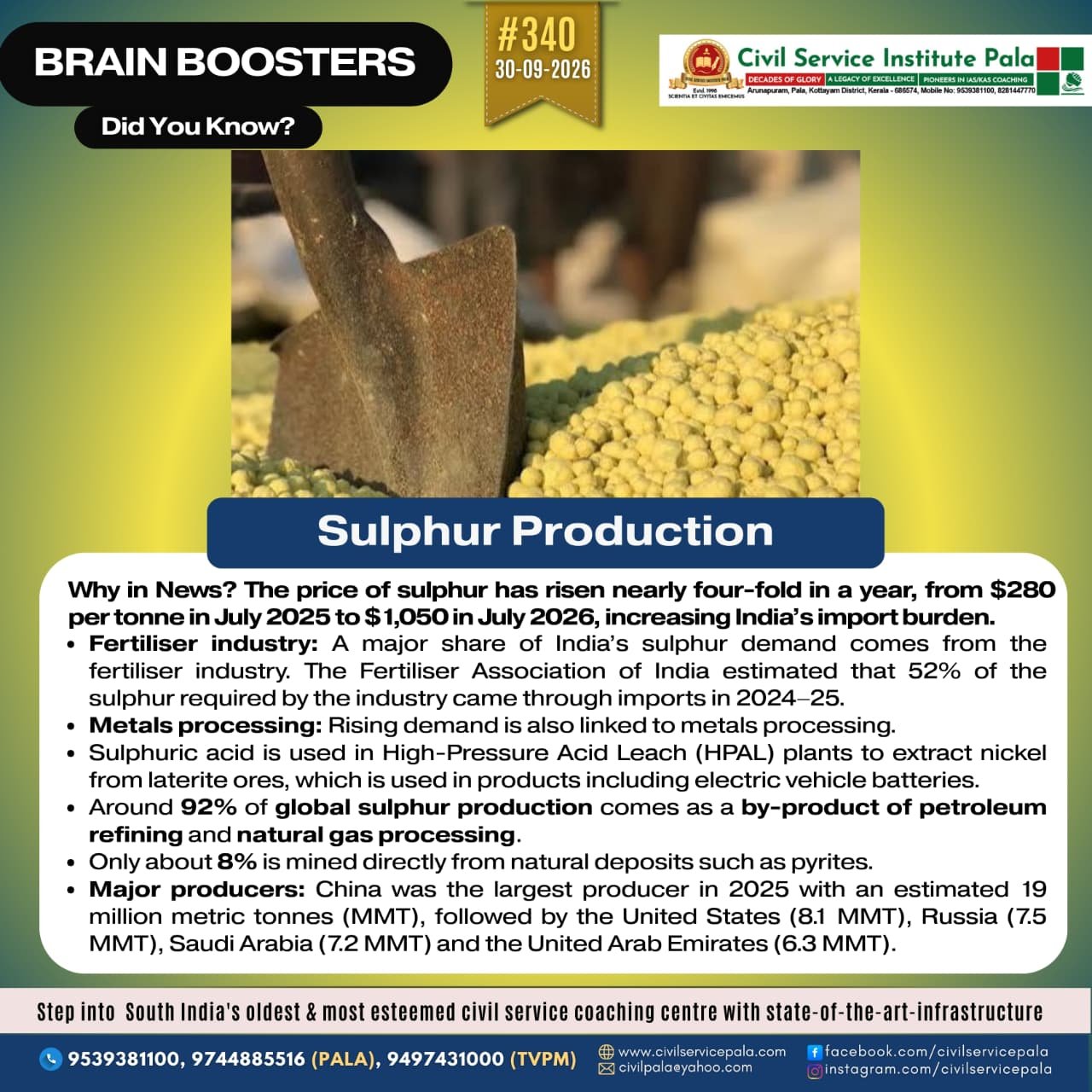
Sulphur Prices: Rising Import Burden for India
Sulphur Prices: Rising Import Burden for India
Why in News?
The international price of sulphur has risen nearly four-fold in one year, from $280 per tonne in July 2025 to $1,050 in July 2026, increasing India’s import burden.
Why is Sulphur Important?
• Fertiliser industry: A major share of India’s sulphur demand comes from the fertiliser industry. The Fertiliser Association of India estimated that 52% of the sulphur required by the industry came through imports in 2024–25.
• Metals processing: Rising demand is also linked to metals processing. Sulphuric acid is used in High-Pressure Acid Leach (HPAL) plants to extract nickel from laterite ores, which is used in products including electric vehicle batteries.
Global Supply
• Around 92% of global sulphur production comes as a by-product of petroleum refining and natural gas processing. Only about 8% is mined directly from natural deposits or sulphur-rich minerals such as pyrites.
• Major producers: China was the largest producer in 2025 with an estimated 19 million metric tonnes (MMT), followed by the United States (8.1 MMT), Russia (7.5 MMT), Saudi Arabia (7.2 MMT) and the United Arab Emirates (6.3 MMT).
India’s Import Dependence
• India is among the top 10 sulphur producers, with production of 3.7 MMT, but still relies on imports to meet domestic demand.
• In 2025, India imported 2.25 MMT of sulphur, of which 2.02 MMT came from West Asia. Russia supplied 0.15 MMT, accounting for 6.5% of India’s imports.
• West Asian producers contribute about 90% of India’s total sulphur imports, making India particularly exposed to supply disruptions in the region.
Why Did Prices Rise?
Supply disruptions: Russia, the third-largest producer, restricted industrial sulphur exports after Ukrainian drone strikes targeted oil and gas-processing plants. The restriction, initially announced until December 2025, was extended until December 31, 2026.
West Asian disruption: The larger disruption came after the U.S. and Israel attacked Iran in 2026, affecting a region that accounts for more than 45% of global seaborne sulphur trade and roughly 90% of India’s sulphur imports.
China’s restrictions: China also restricted sulphuric acid exports in 2026 to meet domestic requirements, adding to pressure on the global market.
Demand–Supply Gap
The price rise is occurring alongside increasing global demand.
• According to the CRU Group, the global sulphur market had entered a structural deficit by 2024.
• Estimated 2025 demand: 72.8 MMT
• Estimated 2025 supply: 70.8 MMT
• Estimated deficit: about 1.9 MMT
Stock releases from Kazakhstan and Saudi Arabia helped bridge the supply gap, but these inventories were also being drawn down.
Battery Link
The growth of battery-related metals processing is an important source of rising sulphur demand.
• Indonesia has emerged as a major player in nickel processing.
• Its sulphuric acid demand increased nearly five-fold from 3.5 MMT in 2021 to 16 MMT in 2025.
• Its sulphuric acid imports also increased from 0.23 MMT to 1.09 MMT during the same period.
This connects sulphur demand not only with fertilisers but also with nickel extraction and battery-related industrial activity.
Impact on India
India’s sulphur import cost increased 2.5 times, from $248 million in 2024 to $638 million in 2025.
The combination of high import dependence, concentration of supplies in West Asia, rising global demand and geopolitical disruptions can increase the cost burden on India, particularly for the fertiliser sector.
