



Subsea Cables: Backbone of Global Digital Connectivity
Subsea Cables: Backbone of Global Digital Connectivity
Why in News?
Recent incidents involving suspected threats to subsea cables in the Arctic, including a Russian submarine reportedly stopped by Britain, Norway and the US, have renewed concerns over the vulnerability of critical undersea digital infrastructure. Finland also conducted a drill in September to prepare for possible cable sabotage following earlier cable-damage incidents.
What are Subsea Cables?
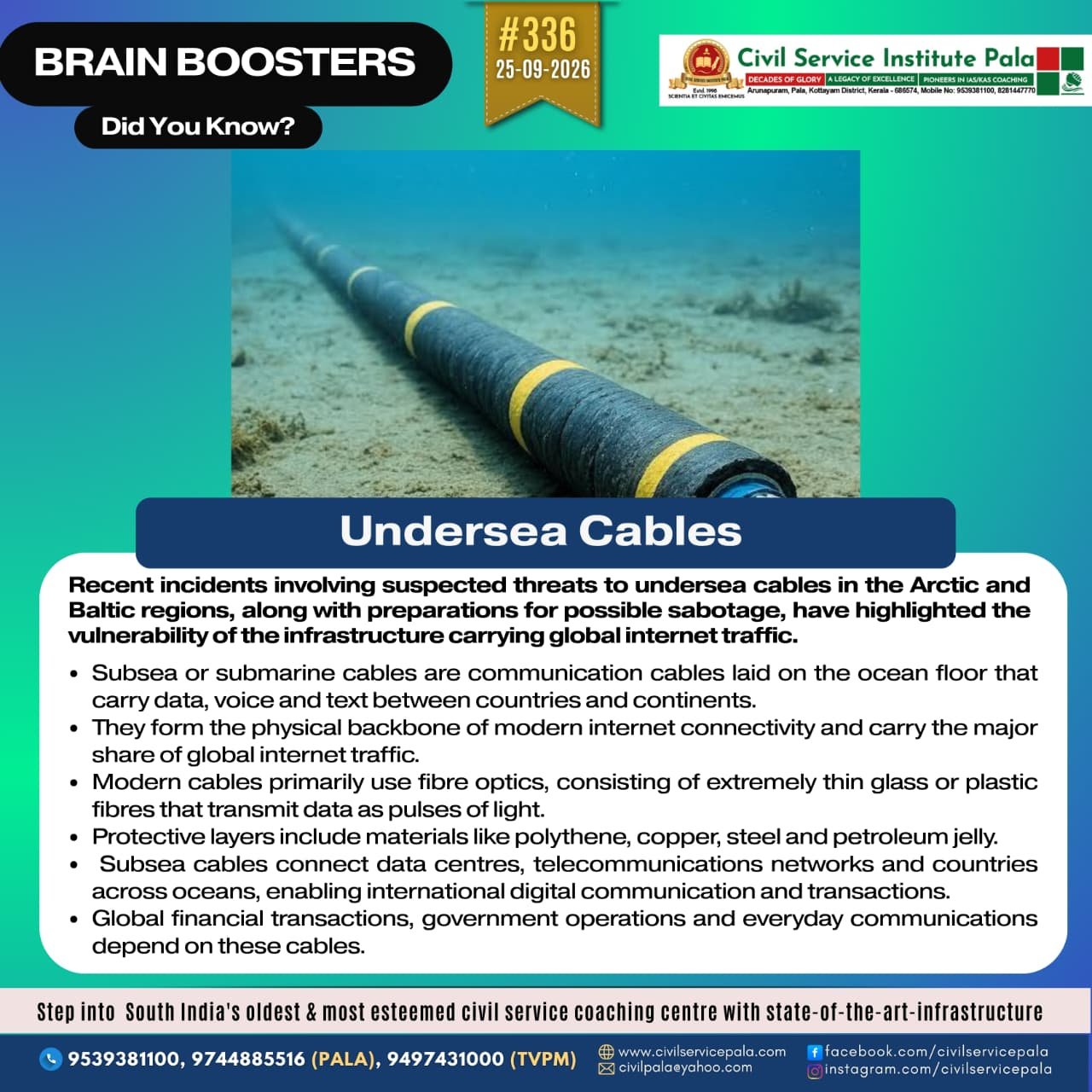
Digital lifelines: Subsea or submarine cables are communication cables laid on the ocean floor that carry data, voice and text between countries and continents. They form the physical backbone of modern internet connectivity and carry over 99% of global internet traffic.
Fibre-optic technology: Modern cables primarily use fibre optics, consisting of extremely thin glass or plastic fibres that transmit data as pulses of light. Protective layers include materials such as polythene, copper, steel and petroleum jelly.
How Does Data Travel Through Subsea Cables?
Digital conversion: Information such as photographs, messages and videos is converted into binary code, represented by 1s and 0s.
Data transmission: A device sends a request through a mobile tower using radio waves. The tower forwards the signal through cables as pulses of light to a data centre. The server sends the requested information back in packets through the cable network, after which it reaches the user's device through the telecommunications network.
Global connectivity: Subsea cables connect data centres, telecommunications networks and countries across oceans, enabling international digital communication and transactions.
Why are Subsea Cables Strategically Important?
Critical digital infrastructure: Global financial transactions, government operations and everyday communications depend on these cables. Their strategic importance is comparable to that of national energy infrastructure.
Connectivity disruption: Damage to a cable can cause major connectivity losses for a region or country. Cable disruptions experienced across several African countries in 2024 demonstrated how such damage can affect access to government services, information and relief.
Economic disruption: Breakage of transaction links can generate economic losses for governments, industries and individuals.
Information security: Digital information, including sensitive communications, is transmitted through these cables. Adversarial attacks on cable infrastructure can create risks of sensitive information being compromised.
Why are Subsea Cables Vulnerable?
Physical damage: Cables can be damaged by earthquakes, strong ocean currents and ship anchors. Fishing activity and large trawlers can also pose risks, particularly in shallower waters.
Sabotage: The strategic importance of cables makes deliberate disruption a potential tool against state operations. Recent concerns include suspected Russian activity around Arctic cables and increased attention to cable-cutting capabilities.
Cybersecurity concerns: Since vast amounts of digital information pass through cable networks, attacks on the infrastructure can have implications beyond physical connectivity.
Repair constraints: Cable repair is technically difficult and expensive. It requires specialised vessels and crews, making limited global repair capacity an additional vulnerability.
Who Owns and Manages Subsea Cables?
Traditional consortium model: Historically, cable systems were primarily financed, owned and managed by telecommunication companies organised into consortiums. These groups can include telecommunications firms, cable manufacturers and content providers.
Consortium decisions: Members collectively determine technical and commercial aspects such as fibre pairs, cable routes, landing sites and local landing partners.
Growing hyperscaler role: Large technology companies providing cloud and infrastructure services have increasingly invested directly in cable systems because of growing bandwidth requirements.
AI-driven demand: AI-related workloads are increasing demand for bandwidth and speed. Unlike some conventional content that can be stored and reused from local servers, AI-related traffic involves new data packets generated by individual queries. This is contributing to a shift from traditional consortium arrangements towards hyperscaler-led projects.
Concentration in Cable Manufacturing
Three major manufacturers: Alcatel Submarine Networks (France), SubCom (US) and NEC (Japan) are identified as the three dominant cable manufacturers.
High market concentration: Together, these companies have built approximately 90% of the total cable length currently deployed, operating through consortium arrangements.
Repair concentration: Cable repair and maintenance services are also concentrated among a limited group of specialised providers operating through regional maintenance agreements with cable consortiums.
Strategic implication: The combination of concentrated manufacturing, repair capacity and growing hyperscaler ownership means that a relatively small group of stakeholders plays a major role in the physical infrastructure supporting global internet connectivity.
