



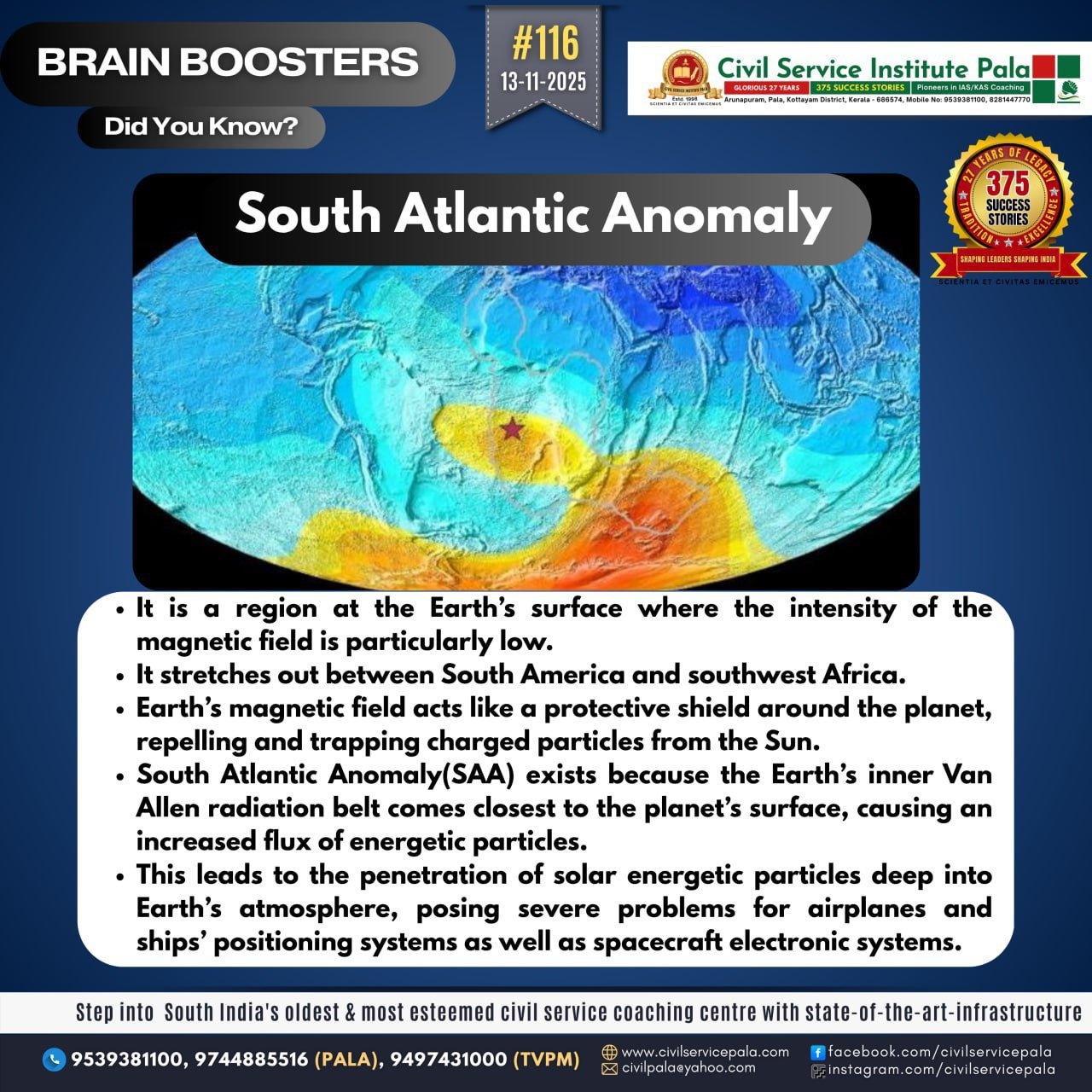
South Atlantic Anomaly (SAA)
The South Atlantic Anomaly (SAA) is a region over the South Atlantic Ocean where the Earth’s magnetic field is unusually weak. This weak spot allows charged particles from the Sun to come closer to the Earth’s surface than in other regions, causing increased radiation levels.
What it is: The South Atlantic Anomaly is an area where the inner Van Allen radiation belt (a zone of energetic charged particles around Earth) comes closest to the Earth's surface. It is centered roughly over Brazil and the South Atlantic Ocean.
Cause: The Earth’s magnetic field is not perfectly aligned with its rotational axis — it is slightly tilted and offset from the planet’s center. Because of this, the magnetic field strength is weaker over the South Atlantic region, allowing more cosmic rays and solar radiation to penetrate the atmosphere.
Effects: Satellites and spacecraft passing through the SAA experience higher radiation exposure. This can cause: Electronic malfunctions or data corruption. Damage to onboard sensors and memory devices. Temporary shutdowns of instruments to protect sensitive systems. Even the International Space Station (ISS) passes through this region and takes precautions.
Scientific Importance: The SAA provides important clues about changes in Earth’s magnetic field, which is slowly weakening and shifting over time. Some scientists believe the SAA could be related to the process of geomagnetic reversal (when the magnetic north and south poles switch places). Location: Roughly between South America and southern Africa, centered near 25° South and 50° West.
