



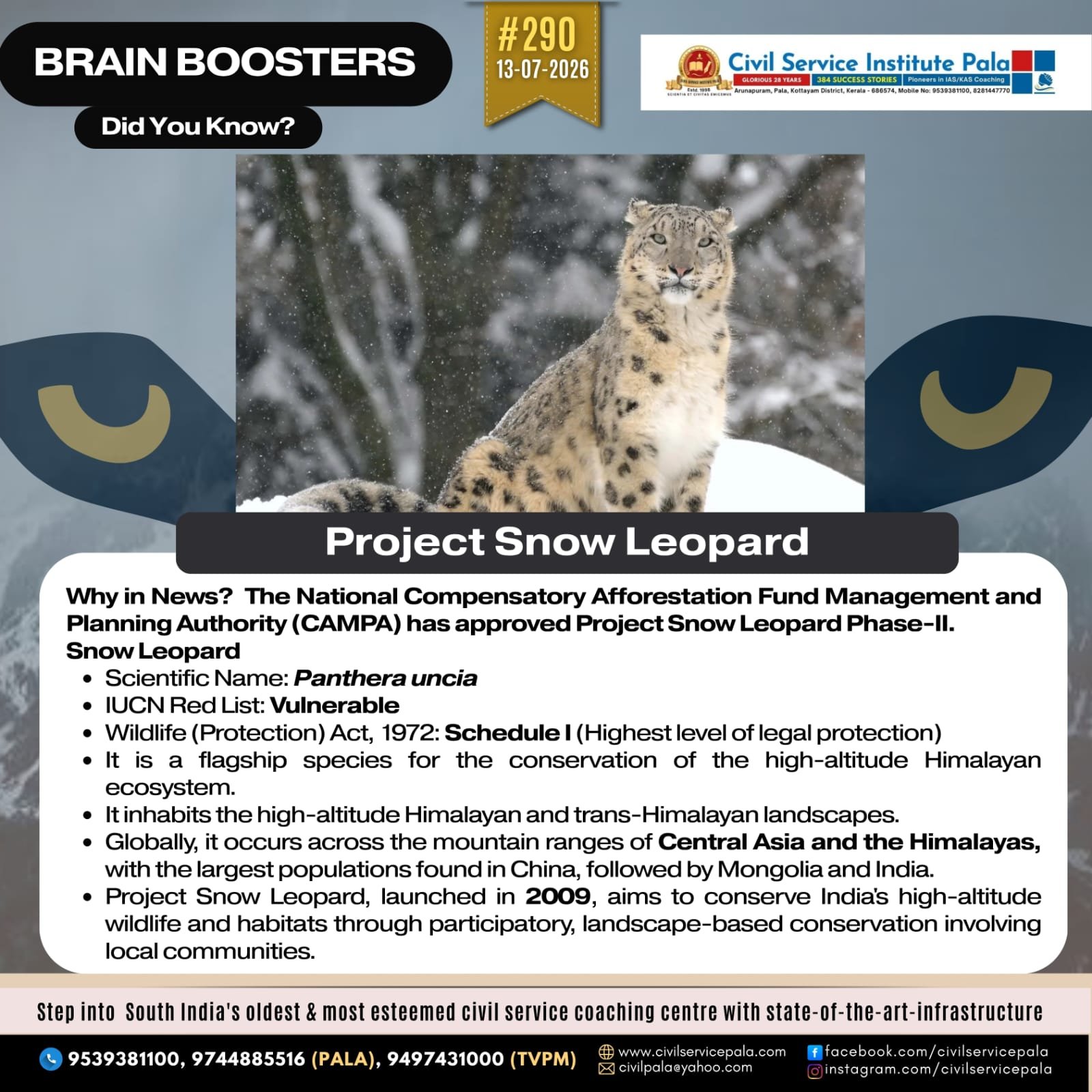
Snow Leopard Conservation in India
Snow Leopard Conservation in India
Why in News?
The National Compensatory Afforestation Fund Management and Planning Authority (CAMPA) has approved Project Snow Leopard Phase-II, which includes the second nationwide Snow Leopard Population Assessment (SPAI 2.0) to strengthen scientific monitoring and conservation of snow leopards across the Indian Himalayas.
Snow Leopard
• Scientific Name: Panthera uncia
• IUCN Red List: Vulnerable
• Wildlife (Protection) Act, 1972: Schedule I (Highest level of legal protection)
• It is regarded as a flagship species for conserving the fragile high-altitude Himalayan ecosystem.
Distribution
• Snow leopards inhabit the high-altitude Himalayan and trans-Himalayan landscapes.
• In India, they are found in:
o Ladakh
o Jammu & Kashmir
o Himachal Pradesh
o Uttarakhand
o Sikkim
o Arunachal Pradesh
• Globally, the species occurs across the mountain ranges of Central Asia and the Himalayas, with the largest populations found in China, followed by Mongolia and India.
• International Snow Leopard Day is observed every year on 23 October to promote awareness and conservation of snow leopards and their fragile mountain ecosystems.
• The Snow Leopard is the State Animal of both Ladakh and Himachal Pradesh.
Project Snow Leopard (PSL)
Objective
• To conserve India's high-altitude wildlife and habitats through participatory and landscape-based conservation involving local communities.
Coverage
• Implemented across biologically important Himalayan landscapes in: Jammu & Kashmir, Himachal Pradesh, Uttarakhand, Sikkim, and Arunachal Pradesh
Snow Leopard Population Assessment in India (SPAI)
First Nationwide Census (2019–2023)
• India completed its first nationwide scientific Snow Leopard Census, known as the Snow Leopard Population Assessment in India (SPAI).
• Findings were released in 2024.
Key Findings
• Estimated population: 718 snow leopards
• State-wise population:
o Ladakh – 477
o Uttarakhand – 124
o Himachal Pradesh – 51
o Arunachal Pradesh – 36
o Sikkim – 21
o Jammu & Kashmir – 9
Survey Highlights
• Covered approximately 1.2 lakh km², representing over 70% of India's potential snow leopard habitat.
• 241 individual snow leopards were photographically identified.
• The assessment was coordinated by the Wildlife Institute of India (WII) with participation from all snow leopard range States and conservation partners.
SPAI 2.0
• SPAI 2.0 was launched during Wildlife Week 2025.
• It aims to:
o Strengthen long-term scientific monitoring.
o Improve population estimation techniques.
o Enhance habitat conservation.
o Increase community participation in conservation efforts.
Major Conservation Initiatives
• Snow leopard is one of the 24 species covered under the Species Recovery Programme of the Centrally Sponsored Scheme Development of Wildlife Habitats.
• The National Snow Leopard Ecosystem Protection Priorities (NSLEP) provides the national framework for snow leopard conservation.
• The SECURE Himalaya Programme focuses on conserving high-altitude ecosystems while improving the livelihoods of local communities.
Protected High-Altitude Landscapes
• Cold Desert Biosphere Reserve (Himachal Pradesh) has been included in the UNESCO World Network of Biosphere Reserves and protects approximately 7,770 km² of snow leopard habitat.
• Other important biosphere reserves supporting snow leopard conservation include:
o Nanda Devi Biosphere Reserve
o Khangchendzonga Biosphere Reserve
