



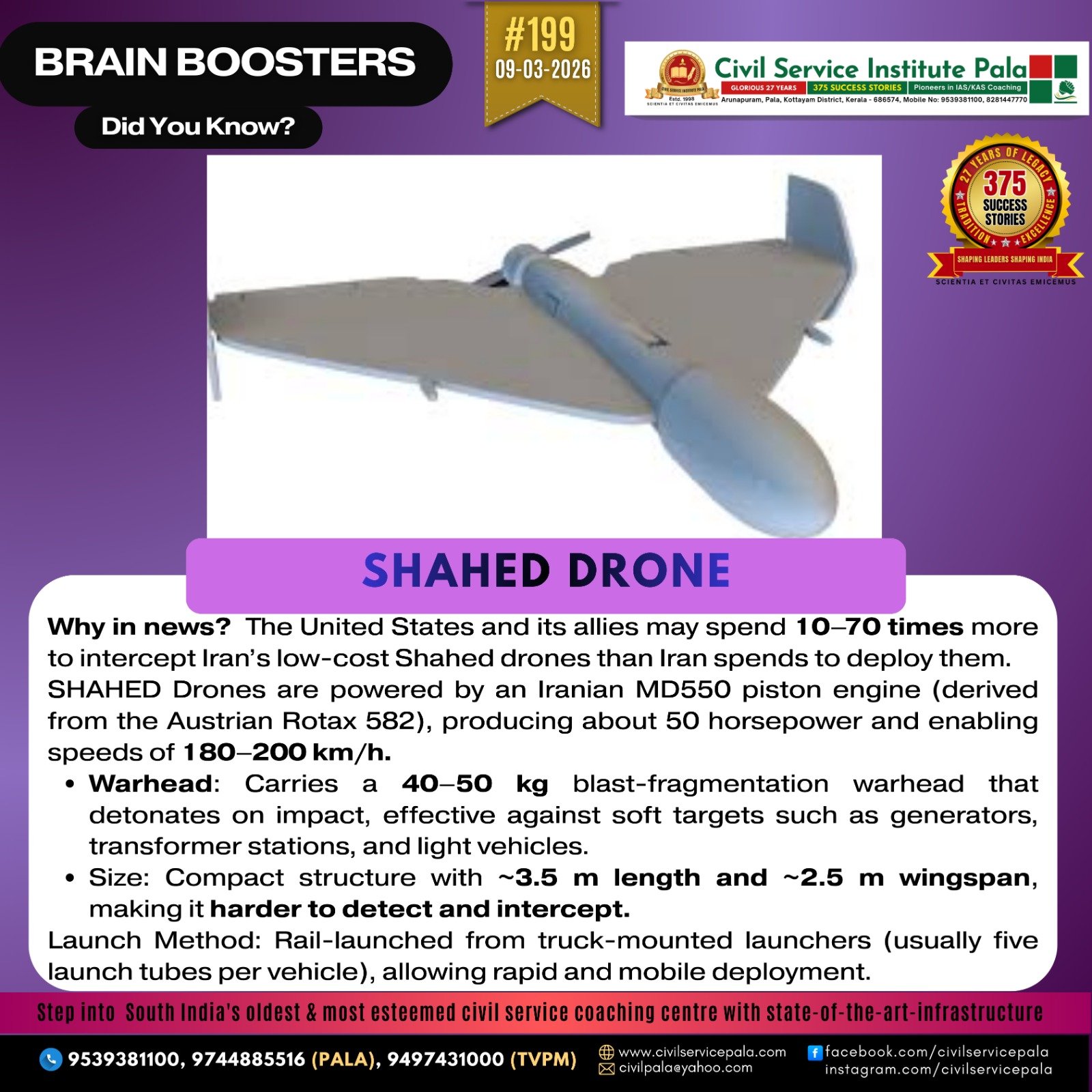
Shahed-136 Drone
Shahed: Iran’s Low-Cost Drone Warfare mechanism
Shahed-136 drone
• Propulsion: Powered by an Iranian MD550 piston engine (derived from the Austrian Rotax 582), producing about 50 horsepower and enabling speeds of 180–200 km/h.
• Warhead: Carries a 40–50 kg blast-fragmentation warhead that detonates on impact, effective against soft targets such as generators, transformer stations, and light vehicles.
• Airframe Design: Features a delta-wing (“geranium leaf”) shape made of fiberglass composites and lightweight aluminium, giving it a small radar cross-section.
• Size: Compact structure with ~3.5 m length and ~2.5 m wingspan, making it harder to detect and intercept.
• Launch Method: Rail-launched from truck-mounted launchers (usually five launch tubes per vehicle), allowing rapid and mobile deployment.
• Flight Profile: Operates at 60–1,000 m altitude, using terrain masking and low radar visibility to evade early detection.
• Operational Strategy: Often deployed in large swarms, overwhelming air-defence systems by forcing the use of expensive interceptor missiles.
Key Variants of Shahed loitering munition
• Shahed-131 drone
o Range: ~900 km
o Speed: ~175 km/h
o Payload: ~15 kg warhead
o Estimated cost: ~USD 10,000
o Role: Smaller and cheaper variant suited for shorter-range swarm attacks.
• Shahed-238 drone
o Range: ~2,000 km
o Speed: ~350 km/h
o Payload: ~35 kg warhead
o Estimated cost: ~USD 50,000
o Role: Faster and longer-range variant designed for deeper strike missions.
Cost of Interception
• The ongoing confrontation between the United States and Iran highlights a new challenge in modern warfare: cheap attack drones versus expensive air-defence systems.
• Iran has increasingly relied on low-cost one-way kamikaze(suicide) drones to conduct strikes across the Middle East.
• Although the U.S. and its allies possess advanced air-defence systems capable of intercepting most threats, these systems cost far more than the drones they destroy.
• The Patriot missile system uses interceptors costing over $3 million per launch.
• This creates a major cost imbalance, where interception may cost 10–70 times more than the attacking drone.
• Limited production numbers further strain defence systems during prolonged conflicts.
Search for Cheaper Counter-Drone Solutions
To reduce interception costs, the U.S. is exploring alternative systems:
• Coyote counter-drone interceptor: drone-based interceptor costing about $126,500 per unit.
• Electronic jamming systems that disrupt navigation signals.
• Laser and microwave weapons designed to disable drones.
• Reverse-engineered system known as LUCAS drone system (Low-cost Unmanned Combat Attack System), costing roughly $35,000.
Current Scenario:
• Iran has reportedly deployed over 2,000 one-way drones in the ongoing conflict.
• The Shahed loitering munition is widely used because it is a compact, truck-launched kamikaze drone (~11 feet long) that carries explosives and detonates on impact, making it easy to conceal and difficult to track.
• Some drones have bypassed advanced air-defence systems, raising concerns about defence reliability.
• A Shahed-like drone targeted the RAF Akrotiri Airbase, likely launched by an Iran-backed proxy, showing the spread of low-cost drone warfare.
• Questions remain about whether the United States and its allies can maintain sufficient interceptor supplies if the conflict continues.
Source : THE INDIAN EXPRESS EXPLAINED
