



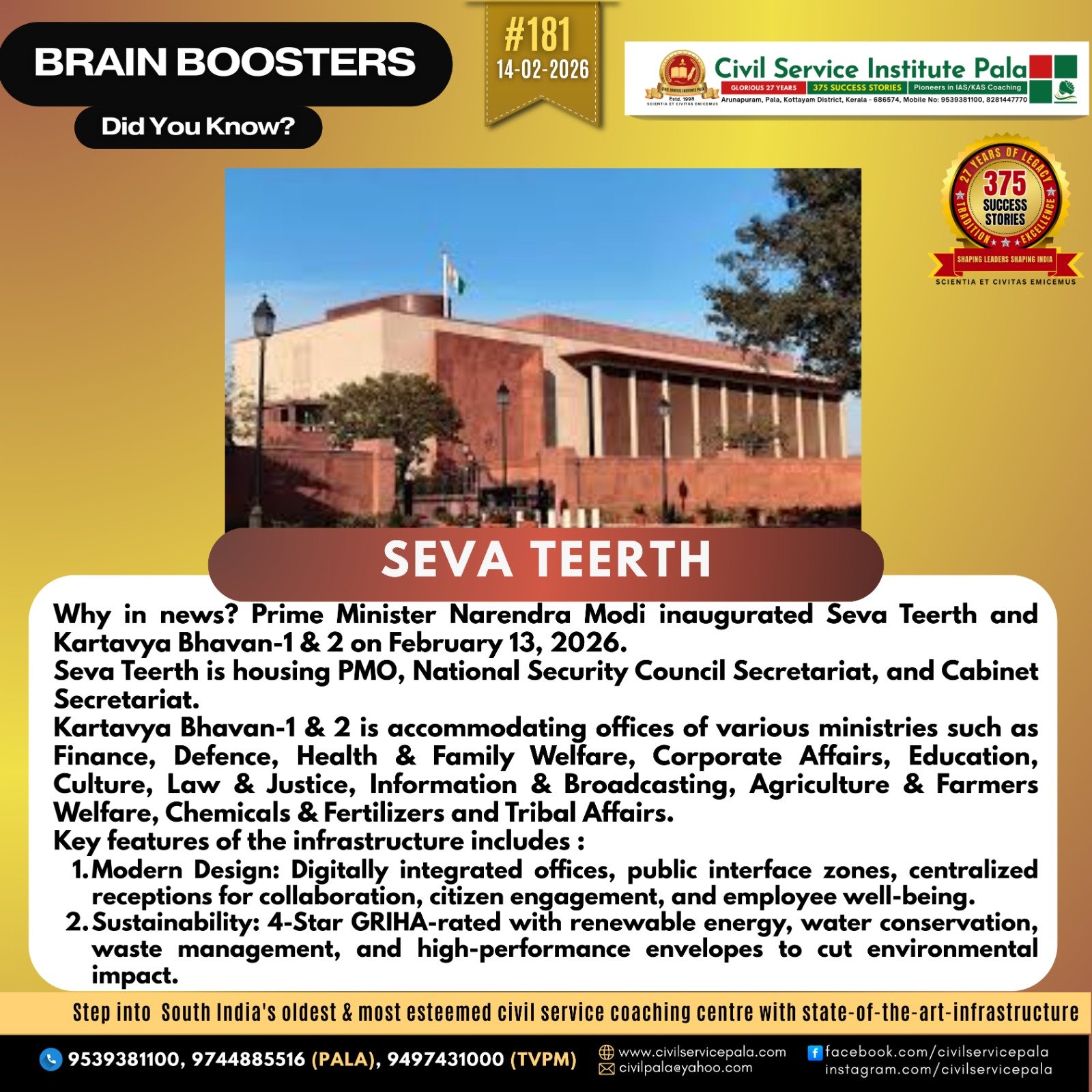
Seva Teerth
Why in news? Prime Minister Narendra Modi inaugurated Seva Teerth and Kartavya Bhavan-1 & 2 on February 13, 2026.
Seva Teerth is proposed to house Prime Minister's Office, National Security Council Secretariat, and Cabinet Secretariat.
Kartavya Bhavan-1 & 2 is proposed to accommodate offices of various ministries such as Finance, Defence, Health & Family Welfare, Corporate Affairs, Education, Culture, Law & Justice, Information & Broadcasting, Agriculture & Farmers Welfare, Chemicals & Fertilizers and Tribal Affairs.
Key Features
• Consolidation: This move ends fragmentation of offices across Central Vista, curbing inefficiencies, coordination issues, high maintenance costs, and poor work environments.
• Modern Design: The new buildings possess digitally integrated offices, public interface zones, centralized receptions for collaboration, citizen engagement, and employee well-being.
• Sustainability: 4-Star GRIHA-rated infrastructure with renewable energy, water conservation, waste management, and high-performance envelopes to cut environmental impact.
• Security: New buildings are equipped with smart access control, surveillance, and emergency systems for safe access.
Significance for Administrative Machinery
This initiative transforms India's governance from dispersed, ageing infrastructure to a citizen-centric, efficient ecosystem. It streamlines decision-making by centralizing PMO/Cabinet functions in Seva Teerth,and boosts inter-ministerial coordination in Kartavya Bhavans.
It operationalizes "Minimum Government, Maximum Governance" by reducing costs, enhancing digital integration, and prioritizing sustainability/security.
Focus area : GS II : Important aspects of governance, transparency and accountability, e-governance – applications, models, successes, limitations, and potential.
GS III :GRIHA standards linkage with conservation and environmental impact assessment.
