



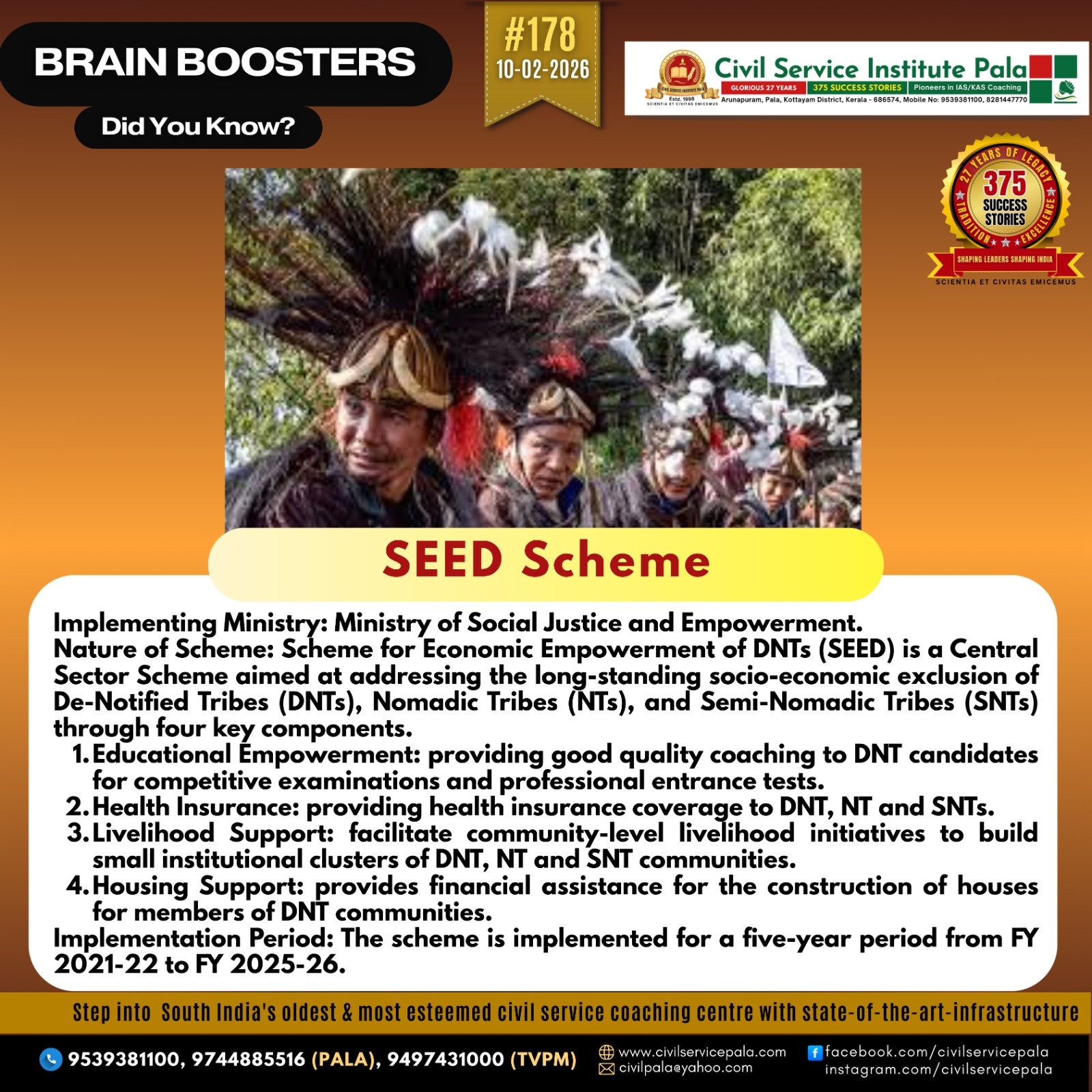
SEED Scheme
SEED Scheme - The Scheme for Economic Empowerment of De-notified, Nomadic and Semi-Nomadic Communities (SEED) was launched on 15 February 2022.
• The scheme was launched by the Union Ministry of Social Justice and Empowerment.
• SEED is a Central Sector Scheme aimed at addressing the long-standing socio-economic exclusion of DNT, NT and SNT communities.
• The scheme is to be implemented for five years from FY 2021-22 to FY 2025-26.
• The total financial outlay of the scheme is approximately ₹200 crore over five years.
Implementing Ministry and Agencies
• The scheme is implemented by the Ministry of Social Justice and Empowerment, Government of India.
• The Department of Social Justice and Empowerment is the nodal department responsible for implementation.
• The scheme is implemented through a dedicated online portal developed by the Department to ensure transparency and targeted delivery.
• Different components of the scheme are implemented in coordination with existing national missions and agencies such as NHA, NRLM and PMAY.
Target Beneficiaries
• The beneficiaries of the scheme are De-notified Tribes (DNTs), Nomadic Tribes (NTs), and Semi-Nomadic Tribes (SNTs).
• These communities historically suffered from criminalisation under colonial laws and continue to face social exclusion, lack of documentation, and poor access to welfare schemes.
• The scheme targets students, families, workers, and homeless households belonging to DNT, NT and SNT communities.
Components of the SEED Scheme
1: Educational Empowerment
• The educational empowerment component provides free professional and competitive examination coaching to students belonging to DNT communities.
• The objective is to enable DNT students to appear in competitive examinations and gain admission to professional courses such as medicine, engineering, MBA and similar fields.
2: Health Insurance Coverage
• This component provides health insurance cover to DNT, NT and SNT families under the framework of Ayushman Bharat – Pradhan Mantri Jan Arogya Yojana (PM-JAY).
• Each eligible family receives a health insurance cover of ₹5 lakh per year for secondary and tertiary healthcare.
• The scheme is implemented through the National Health Authority (NHA) in coordination with State Health Agencies (SHAs).
3: Livelihood Support
• This component focuses on addressing the decline of traditional occupations of DNT, NT and SNT communities.
• Financial assistance is provided to the National Rural Livelihood Mission (NRLM) for institution building at the community level.
• Implementation is carried out in association with State Rural Livelihoods Missions (SRLMs).
• The objective is to enhance productivity, skill development, and employment generation through institutional and technical support.
4: Housing Support
• This component addresses the issue of lack of permanent housing among DNT and NT communities.
• Many DNT families currently live in slums or temporary settlements in both rural and urban areas.
• A separate outlay within Pradhan Mantri Awas Yojana (PMAY-Gramin) is earmarked specifically for DNT households.
• Housing assistance of ₹1.20 lakh per unit in plains and ₹1.30 lakh per unit in hilly areas is provided.
• Only rural DNT families who have not previously availed PMAY benefits are eligible.