



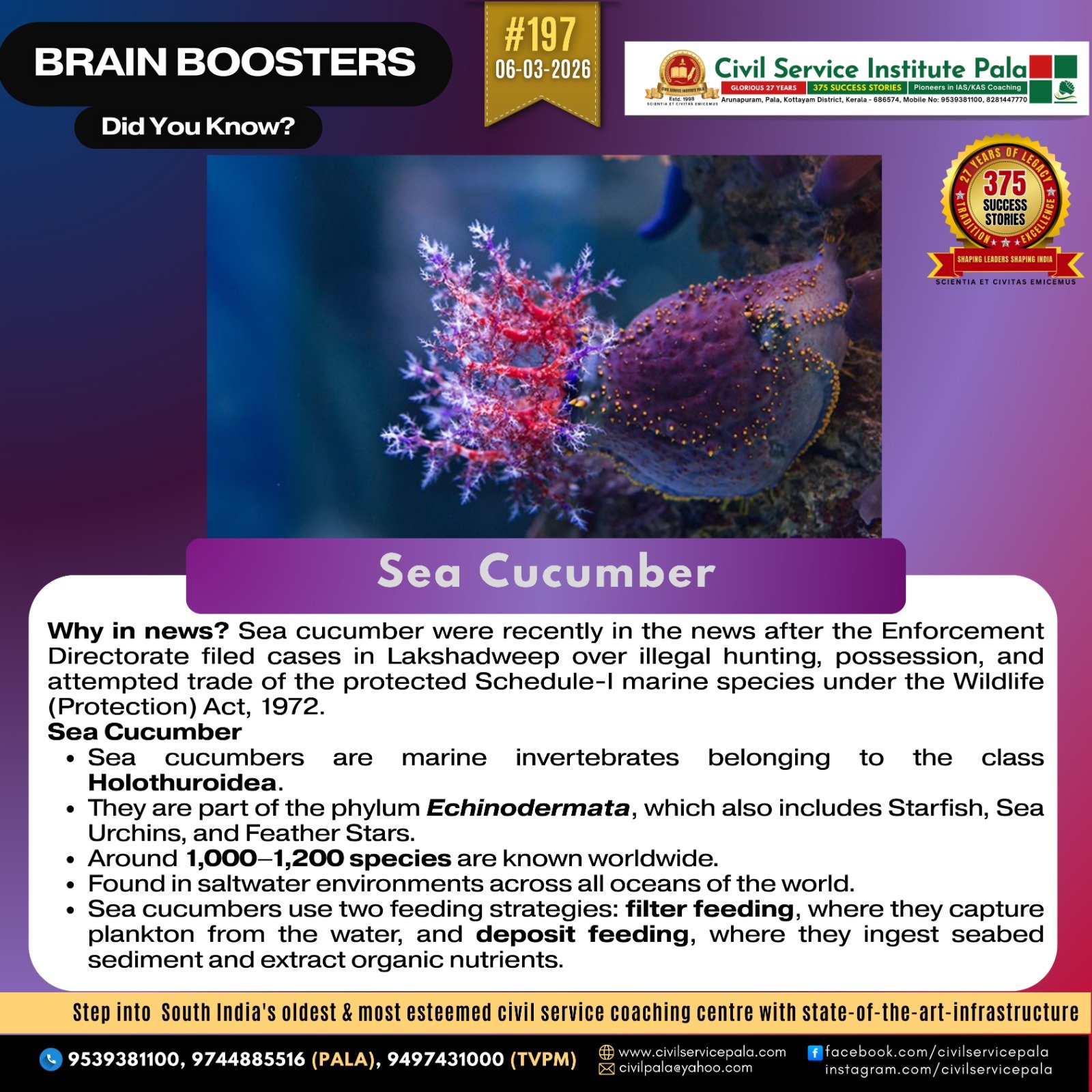
Sea cucumbers
• Sea cucumbers are marine invertebrates belonging to the class Holothuroidea under the phylum Echinodermata, the same group that includes Starfish and Sea Urchins.
• More than 1,700 extant species of sea cucumbers are known worldwide.
• They occur in all oceans, from shallow coastal waters to deep-sea environments, and are mostly benthic organisms living on or within seabed sediments.
• They have a soft, elongated cylindrical body with leathery skin, often resembling a cucumber.
• Their skeleton is reduced to tiny calcium carbonate ossicles, giving them a soft and flexible body.
• Like other echinoderms, they show fivefold radial symmetry, with the mouth at one end and anus at the other.
• Movement occurs through tube feet with suction ends that help in crawling, anchoring, and feeding.
• Sea cucumbers feed using two main strategies: filter feeding, where they capture plankton drifting in water using tentacle-like tube feet, and deposit feeding, where they ingest seabed sediment and extract organic nutrients.
• Their diet includes plankton, algae, organic particles, and decaying matter present in marine sediments.
• They perform bioturbation, ingesting sediment, absorbing nutrients, and excreting the rest, which recycles nutrients and improves seabed health.
• Due to this role, they help clean sediments, maintain water quality, and support marine ecosystem balance, similar to the ecological role of earthworms in soil ecosystems.
• Most species reproduce by external fertilisation, releasing eggs and sperm into seawater, though some species brood eggs internally.
• Major threats to sea cucumbers include overfishing to supply luxury seafood markets, illegal international trade, pollution from urban and agricultural sources, eutrophication of coastal waters, collection of broodstock for aquaculture, and natural disasters such as tsunamis and severe coastal flooding.
• Around 22% of sea cucumber species have been assessed under the International Union for Conservation of Nature Red List, and several commercially exploited species are considered threatened.
• Many species are protected in India under the Wildlife Protection Act 1972, due to concerns about illegal harvesting and smuggling from coastal regions.
