



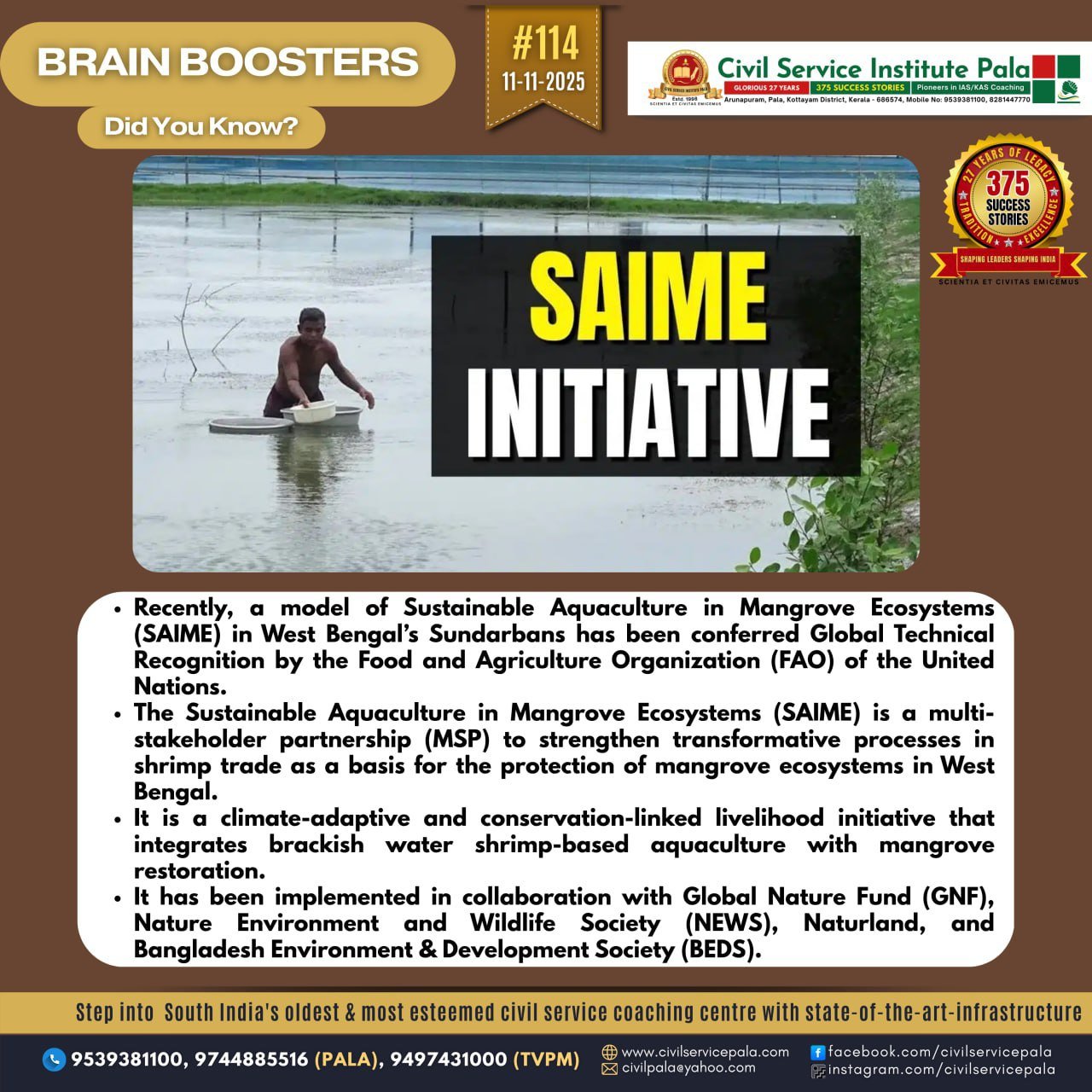
SAIME INITIATIVE
1. What is SAIME?
SAIME stands for Sustainable Aquaculture in Mangrove Ecosystems. It is a community-based and ecosystem-integrated aquaculture model designed to combine shrimp and aquaculture farming with mangrove conservation/restoration in the fragile coastal mangrove zones of the Sundarbans region in West Bengal. The initiative has been developed by the NGO Nature Environment and Wildlife Society (NEWS) (based in West Bengal) in partnership with organisations such as Global Nature Fund (GNF), Bangladesh Environment & Development Society (BEDS), and Naturland . It focuses on the region’s mangrove–aquaculture interface where conventional shrimp farming has often come at the cost of mangrove degradation. SAIME flips that by integrating mangroves into the aquaculture system.
2. Why was SAIME needed?
The Sundarbans region is ecologically sensitive: mangrove forests, tidal influences, a major coastal buffer, and communities dependent on aquaculture and fisheries. Conventional shrimp farming in mangrove regions has often led to: Clearing of mangroves to create ponds, leading to loss of coastal protection, biodiversity decline, erosion and increased vulnerability to storms. High input aquaculture (feed, chemicals) and intensive methods that may degrade the ecosystem and reduce resilience to climate change and sea-level rise. Therefore, a model was needed that could deliver livelihood security (for shrimp farmers) while protecting and restoring mangroves, building climate resilience, and doing so in a cost-effective and sustainable way.
3. How does SAIME work (key features & approach) Here are the core principles and mechanisms of the initiative:
Integrated Mangrove Aquaculture (IMA): The model advocates shrimp/fish aquaculture at low stocking densities and minimal or no additional feed/fertiliser inputs, leveraging natural productivity supported by mangroves. Mangrove cover within aquaculture ponds: One of the striking features is retention/planting of mangroves in the vicinity of or as part of aquaculture ponds. For example, the model maintains around 5 % to 30 % mangrove coverage within/around the pond systems. Use of mangrove litter as natural feed: The leaf litter from mangroves and the ecosystem productivity becomes part of the food chain for the cultivated shrimp/fish, thereby reducing dependence on external commercial feed. Community participation & co-management: Farmers, local communities, NGOs, research institutes, government departments are involved. This bottom-up and participatory model ensures ownership, local adaptation and sustainability. Focus on climate resilience and ecosystem services: Beyond just income, the model emphasises mangroves’ role as natural coastal defences (against storms, sea-level rise), biodiversity conservation, carbon sequestration (blue-carbon) and sustainable livelihoods. Pilot implementation and scaling vision: It started as a pilot in a few hectares and with a limited number of farmers but with a view to scale up. For example: ~29.84 hectares across 42 farmers in the Sundarbans region.
4. Where and when is it implemented?
Geography: The initiative is implemented in the Indian part of the Sundarbans, specifically in the districts of North 24 Parganas and South 24 Parganas in West Bengal. Area coverage: Approximately 29.84 hectares across 42 farmers, according to available data. Timeline: The pilot started around 2019.
5. Key outcomes & benefits observed Increased farmer income / reduced production cost: Farmers reported more than 100% increase in annual net profit due to reduced costs and better survivability etc. Better ecological outcomes: Mangrove sapling survival rates improved (30-50% versus typical 5-10%).
Ecosystem & climate resilience gains: By retaining mangroves and integrating aquaculture, the region enhances its defences against cyclones, salinity intrusion, erosion, and contributes to carbon sequestration – aligning with SDGs.
Sustainable aquaculture practices: Reduced reliance on external feed, chemicals; more natural system; better match with local ecological dynamics.
Recognition: The initiative has gained global recognition – e.g., it received “Global Technical Recognition” from the Food and Agriculture Organization (FAO) of the United Nations in October 2025 for its technical merits.
