



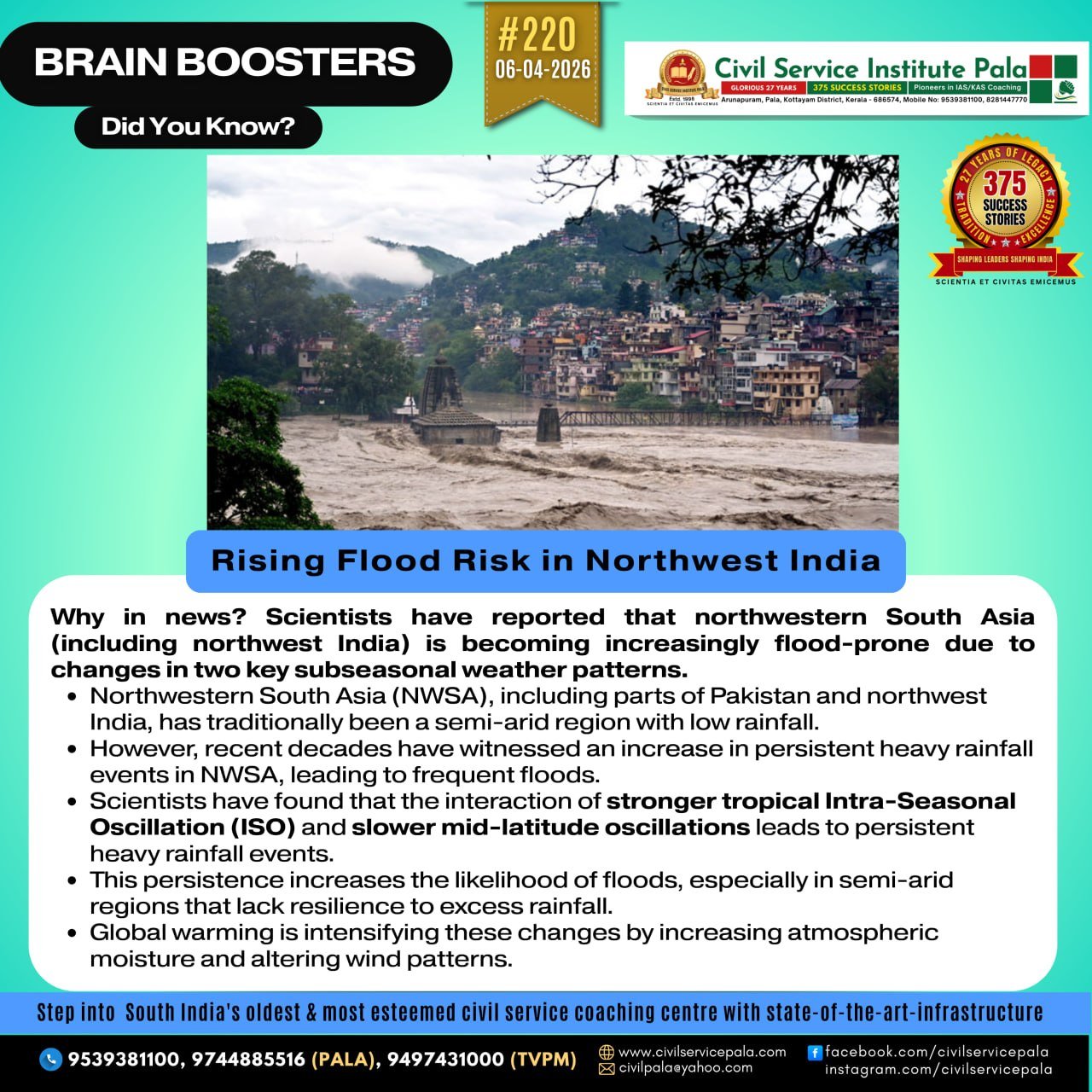
Rising Flood Risk in Northwest India
Scientists have reported that northwestern South Asia (including northwest India) is becoming increasingly flood-prone due to changes in two key subseasonal weather patterns.
Changing Rainfall Pattern in NWSA
• Northwestern South Asia (NWSA), including parts of Pakistan and northwest India, has traditionally been a semi-arid region with low rainfall.
• Monsoon rainfall in South Asia generally shows an east–west contrast, with higher rainfall in eastern regions and lower rainfall in the northwest.
• However, recent decades have witnessed an increase in persistent heavy rainfall events in NWSA, leading to frequent floods.
Intra-Seasonal Oscillation (ISO)
• Intra-Seasonal Oscillations (ISOs) are weather patterns that vary within a season and influence rainfall over periods ranging from 10 to 90 days.
• These oscillations play a crucial role in determining active and break phases of the monsoon.
Two key drivers of increasing floods :
1. Strengthening of Tropical Monsoon ISO
• The tropical monsoon ISO refers to rainfall systems that originate near the equatorial Indian Ocean and move towards the Indian subcontinent.
• Recent changes show that these systems are becoming stronger and penetrating deeper into inland regions like NWSA.
• This results in enhanced and prolonged rainfall in areas that were previously dry.
2. Slowing of Mid-Latitude Oscillation
• Mid-latitude oscillations are atmospheric waves associated with the jet stream (high-altitude winds).
• These waves influence weather systems such as rainfall and storms.
• Recent trends indicate that these oscillations are slowing down, causing rain-bearing systems to remain stationary over NWSA for longer durations.
Combined Impact
• The interaction of stronger tropical ISO and slower mid-latitude oscillations leads to persistent heavy rainfall events.
• This persistence increases the likelihood of floods, especially in semi-arid regions that lack resilience to excess rainfall.
• Together, these two factors account for about 44% of the increase in flood frequency in the region.
Role of Climate Change
• Global warming is intensifying these changes by increasing atmospheric moisture and altering wind patterns.
• Enhanced land-sea temperature contrast supports stronger monsoon systems.
• Weakening of the jet stream contributes to slower movement of weather systems.
Significance
• Semi-arid regions like NWSA are more vulnerable to sudden floods compared to traditionally wet regions.
• Understanding these oscillations improves flood prediction beyond short-term weather forecasts.
• Incorporating ISO patterns into forecasting models can enhance early warning systems and disaster preparedness.
