



Reporters Without Borders (RSF)
• “Reporters Without Borders (RSF) is an independent international organisation that works to promote freedom, pluralism, and independence of journalism.
• It is grounded in the principles of Article 19 of the Universal Declaration of Human Rights.
• It engages in advocacy, research, journalist protection, and global awareness campaigns to safeguard access to free and reliable information.
• One of its key contributions is the annual World Press Freedom Index.
• This index assesses the state of press freedom in 180 countries using indicators such as political context, legal framework, economic conditions, sociocultural environment, and journalist safety.
• The Index serves as an important global benchmark to evaluate media independence and highlight emerging challenges.
• In recent years, RSF has noted a global decline in press freedom, with increasing concerns over violence against journalists, regulatory pressures, and concentration of media ownership.
2026 INDEX FINDINGS
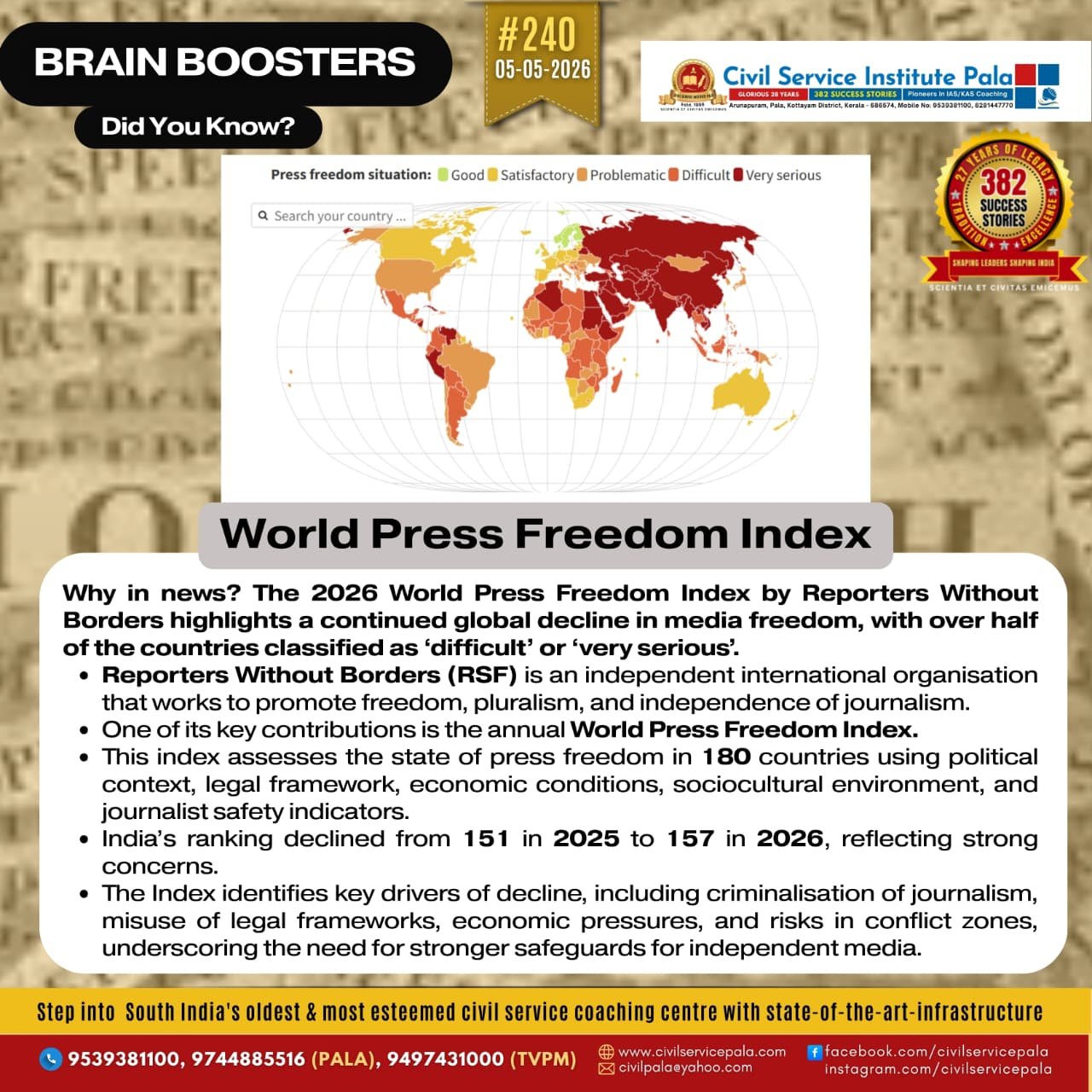
• The 2026 World Press Freedom Index by Reporters Without Borders highlights a continued global decline in media freedom, with over half of the countries classified as ‘difficult’ or ‘very serious’.
• In over half of the world’s countries and territories (52.2%), the state of press freedom is categorised as “difficult” or “very serious.” This category was a small minority (13.7%) in 2002.
• India’s ranking declined from 151 in 2025 to 157 in 2026, reflecting concerns across multiple indicators.
• A small group of countries, particularly in Northern Europe—such as Norway, Netherlands, and Estonia—continue to rank highest in press freedom.
• In contrast, regions such as Eastern Europe and the Middle East remain among the most challenging and dangerous for journalists.
• The Index identifies key drivers of decline, including criminalisation of journalism, misuse of legal frameworks, economic pressures, and risks in conflict zones, underscoring the need for stronger safeguards for independent media.
Criminalisation of Journalism
• The Index’s legal indicator has seen the most severe decline this year.
• This score deteriorated in more than 60% of states — 110 out of 180 — between 2025 and 2026.
• This is notably the case in India (157th), Egypt (169th), Israel (116th) and Georgia (135th).
• The criminalisation of journalism, which is rooted in circumventing press law and misusing emergency legislation and common law, is proving to be a global phenomenon.
INDIAN CONTEXT
• Massive audience base: Media reaches a population of ~1.4 billion with ~210 million TV households
• Television penetration: ~900 privately owned TV channels, with nearly 50% dedicated to news
• Public broadcasting reach: Doordarshan operates in 23 languages, ensuring wide regional coverage
• Print scale: ~140,000 publications across 20+ languages, including ~20,000 daily newspapers
• Circulation strength: Combined print circulation exceeds 390 million copies
• Digital shift: Online and social media platforms have overtaken print as the primary news source, especially among youth
• Radio structure: News broadcasting on radio remains a state monopoly under All India Radio
• Institutional framework: Both AIR and Doordarshan function under Prasar Bharati
World Press Freedom Index - India 2026
• India’s ranking declined from 151 in 2025 to 157 in 2026, reflecting concerns across multiple indicators.
• Press Freedom Index Situation: Very serious
Political context - Reporters Without Borders has raised concerns that growing concentration of media ownership and perceived proximity between political and corporate interests may be undermining media pluralism in India.”
Legal framework – In India, freedom of the press is not explicitly mentioned in the Constitution. However, it is protected under Article 19(1)(a). Reporters Without Borders have raised concerns regarding the use of legal provisions—such as sedition, defamation, and national security laws—by both central and state authorities, which may have implications for media freedom. Recent regulatory measures in the digital and telecommunications domains (the 2023 Telecommunications Act, the 2023 Information Technology Amendment Rules, and the 2023 Digital Personal Data Protection Act) have also been debated for their potential impact on content regulation and journalistic independence.
Economic context - India’s media ecosystem is largely advertising-driven, with government advertising forming a significant revenue source for many outlets. Reporters Without Borders have highlighted concerns that dependence on such funding, along with increasing concentration of media ownership among a few large conglomerates, may influence editorial independence and limit diversity of viewpoints.
Sociocultural context - Concerns have been raised by Reporters Without Borders regarding limited social diversity within the media sector, particularly in leadership roles, which may influence the framing of news and representation of different groups. Issues such as underrepresentation of women and marginalized communities, along with perceived ideological biases in sections of the media, have implications for inclusiveness and plurality of viewpoints.
Safety context – According to the concerns raised by the Reporters Without Borders group, regarding the safety of journalists in India, with instances of harassment, threats, legal action, and occasional violence reported in the course of their work. Journalists covering sensitive issues—such as politics, environment, or conflict-affected regions—may face higher risks, including online abuse and intimidation. These challenges raise broader questions about ensuring a safe and enabling environment for independent journalism.
