



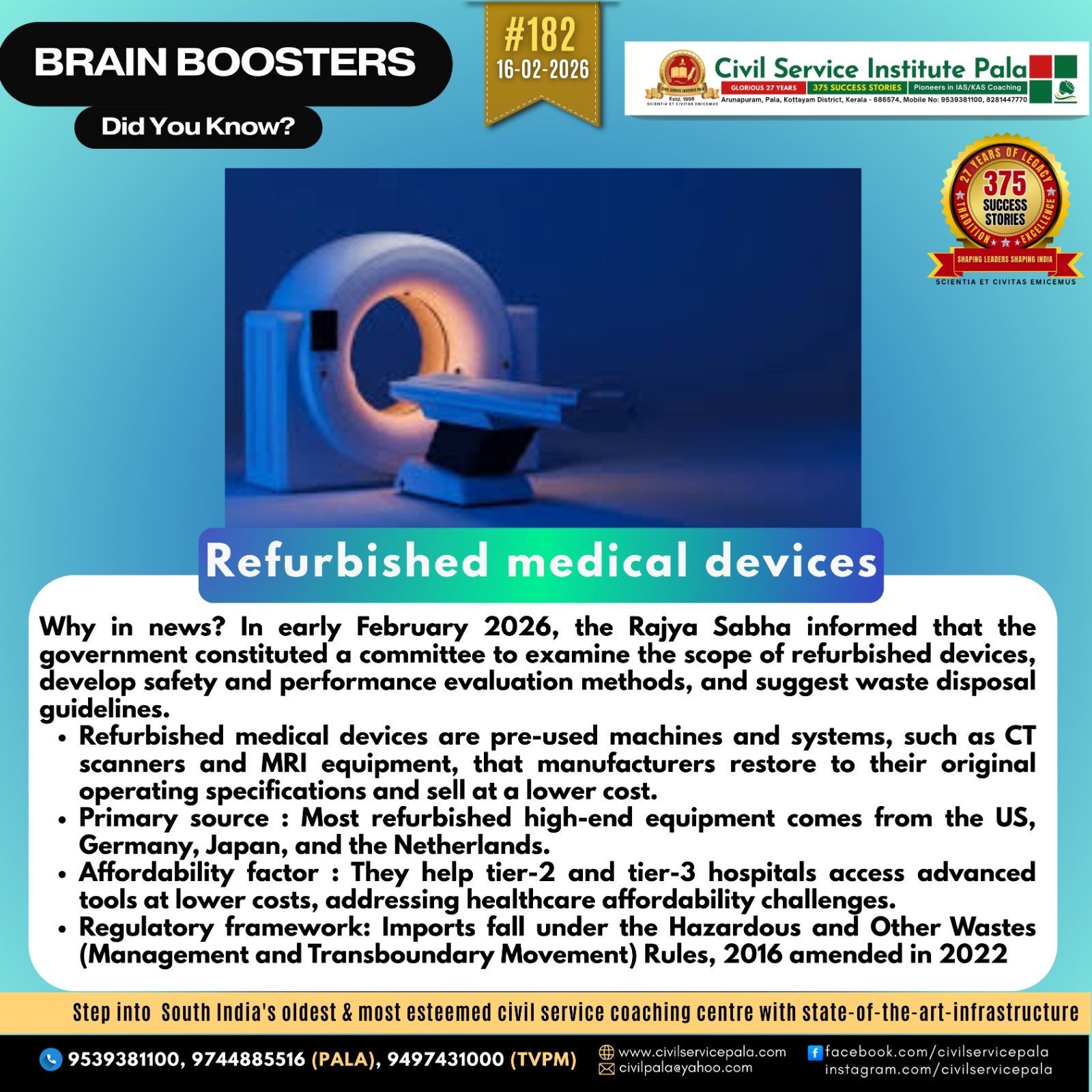
Refurbished Medical Devices
Refurbished Medical Devices: A Learning Module
Definition of refurbished medical devices: Refurbished medical devices are pre-used machines and systems, such as CT scanners and MRI equipment, that manufacturers restore to their original operating specifications through repair, recalibration, and sometimes software updates.
Key characteristics of these devices: These are capital-intensive technologies that cost several million rupees new, making refurbished versions significantly cheaper at 1-3.5 crore for an MRI machine compared to higher prices for brand-new ones.
Primary sources of refurbished devices: Most refurbished high-end equipment comes from countries like the US, Germany, Japan, and the Netherlands, where older machines reach the end of their functional life in developed markets.
Importance for affordability in India: Refurbished devices help tier-2 and tier-3 hospitals, as well as standalone diagnostic centers, access advanced imaging and specialized oncology tools at lower costs, addressing healthcare affordability challenges.
Market size in India: The refurbished medical equipment segment is valued at around Rs 1,500 crore, representing nearly 10% of India's total medical equipment market.
Current Indian import policy: Imports are permitted through a no-objection certificate (NOC) process overseen by a committee under the Ministry of Environment, Forest and Climate Change (MoEFCC), which approves 38 specific high-end items listed by the Ministry of Health and Family Welfare (MoHFW).
Regulatory framework: Imports fall under the Hazardous and Other Wastes (Management and Transboundary Movement) Rules, 2016, with amendments in December 2022 allowing certain high-value used devices subject to technical inputs from the Central Drugs Standard Control Organisation (CDSCO).
Gaps in the Medical Devices Rules, 2017: This rule lacks a dedicated pathway or licensing for refurbished devices, creating ambiguity as it does not define terms like "used," "refurbished," "reconditioned," or "remanufactured."
Recent government action: In early February 2026, the Rajya Sabha informed that the government constituted a committee to examine the scope of refurbished devices, develop safety and performance evaluation methods, and suggest waste disposal guidelines.
Debate on domestic vs. global interests: Indian manufacturers, represented by AiMeD, oppose unrestricted imports, arguing they turn India into a dumping ground for end-of-life equipment and discourage investment in domestic high-tech production.
Perspective from international players: MTaI, representing international manufacturers, supports refurbished devices, stating a blanket ban is impractical and that proper regulation can balance affordability without harming local industry.
Safety and oversight concerns: Critics highlight risks from decade-old core components in refurbished machines, potential lack of full recalibration, and insufficient policy coherence between waste rules and CDSCO standards, raising patient safety issues.
Policy coherence challenge: A 2025 EFC Committee decision allowed imports under waste rules, contradicting CDSCO's stance that refurbished devices cannot be sold without licensing under Medical Devices Rules, 2017.
Core issue of the debate: The discussion has shifted from banning refurbished devices to creating a clear, robust regulatory framework aligned with global standards to ensure safety, performance, and fair competition.
Potential impact on innovation: At similar price points to new domestic products, refurbished imports could stifle investment in India's medical technology sector, as noted by industry leaders.
