



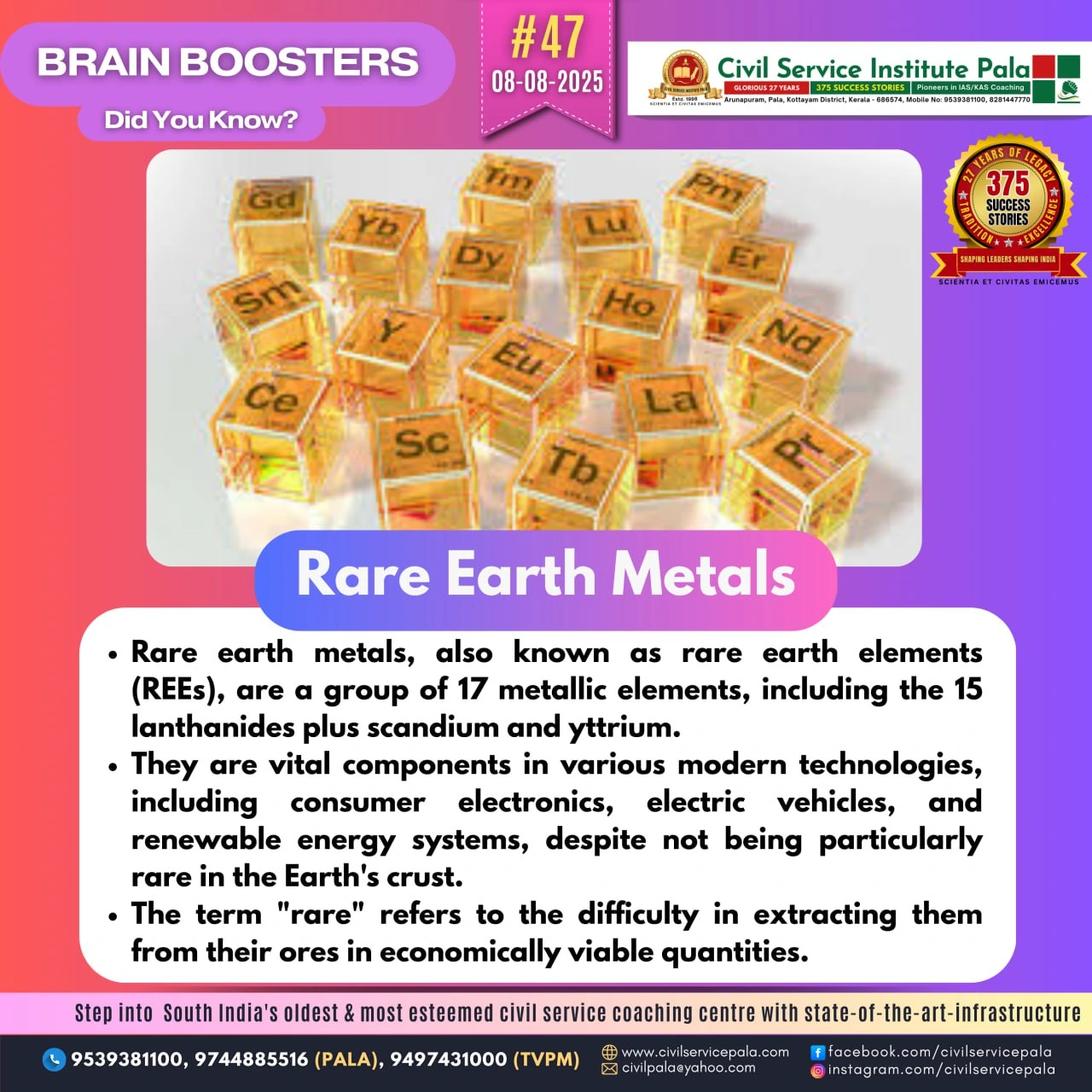
Rare Earth Metals (REMs)
Rare Earth Metals (REMs) are a group of 17 chemically similar metallic elements that are critical for modern technology. Despite the name, most of them are relatively abundant in the Earth’s crust — but they are rarely found in concentrated, economically mineable deposits.
The Elements
Rare earth metals include:
Lanthanides (15 elements):
Atomic numbers 57–71: Lanthanum, Cerium, Praseodymium, Neodymium, Promethium, Samarium, Europium, Gadolinium, Terbium, Dysprosium, Holmium, Erbium, Thulium, Ytterbium, Lutetium.
Two additional elements with similar properties: Scandium and Yttrium.
Key Properties
Silvery-white, lustrous metals.
Good conductors of heat and electricity.
High magnetic strength and catalytic properties.
Easily oxidised and chemically reactive.
Uses
Rare earth metals are crucial for:
Electronics – Smartphones, computers, televisions, and LED lights (e.g., Europium for red phosphors).
Green technology – Wind turbine magnets, electric vehicle motors (Neodymium, Dysprosium).
Military – Guidance systems, radar, lasers.
Energy storage – Batteries for hybrid/electric vehicles (Lanthanum).
Medical applications – MRI contrast agents (Gadolinium).
Major Producers
China dominates the global supply (over 60–70% of production).
Other sources: USA, Australia, Myanmar, India, and Russia.
Challenges
Mining impact: Extraction often produces toxic and radioactive waste.
Supply chain risk: Heavy reliance on a few countries makes global markets vulnerable.
Recycling difficulty: Separating rare earths from used products is technically challenging.
Fun fact
Despite their high-tech importance, rare earth metals are not “rare” in amount — Cerium, for instance, is more common in Earth’s crust than copper. Their “rare” status comes from how tricky and costly it is to extract and refine them.
Source:https://economictimes.indiatimes.com/news/economy/foreign-trade/india-russia-exploring-opportunities-in-rare-earth-critical-minerals-extraction/articleshow/123146294.cms?from=mdr
