


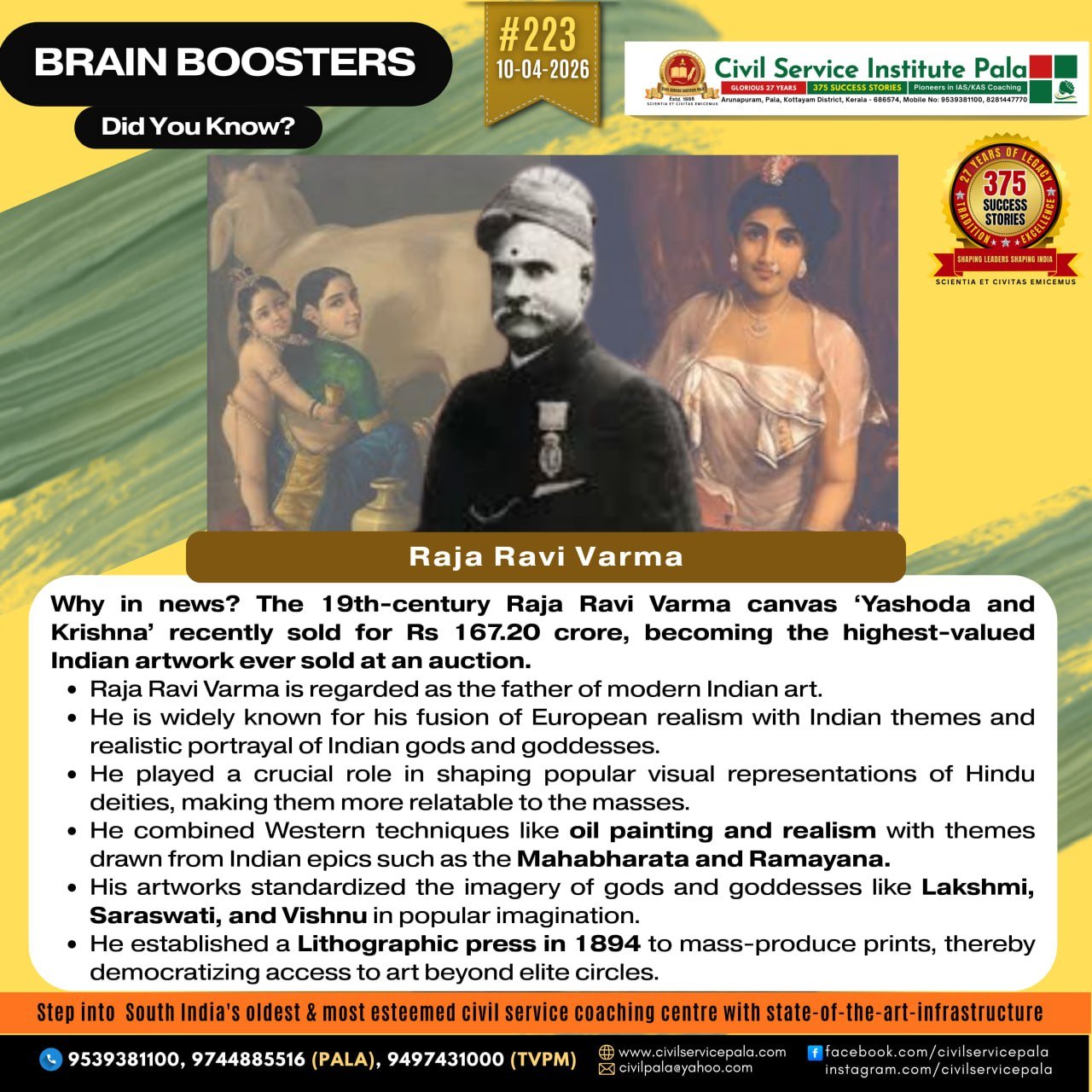
Raja Ravi Varma
• Raja Ravi Varma is regarded as the father of modern Indian art for systematically blending European realism with Indian cultural and mythological themes.
• His painting Yashoda and Krishna recently sold for ₹167.20 crore, becoming the highest-valued Indian artwork ever auctioned.
Early life and training
• He was born in 1848 in Kilimanoor into a family closely associated with the Travancore royal household.
• He produced more than 7,000 paintings, making him one of the most prolific Indian artists of the 19th century.
• He gained prominence as a court painter, receiving commissions from princely states such as Baroda, Mysore, and Udaipur.
• He was commissioned to paint 14 Puranic paintings for the Durbar Hall of the new Lakshmi Vilas Palace at Baroda.
• He painted large-scale mythological works for palace spaces, especially drawing from the Mahabharata and Ramayana.
• His works established standardized visual representations of deities like Lakshmi and Saraswati that continue in popular culture.
• He won international recognition, including awards at exhibitions in Vienna (1873) and the World’s Columbian Exposition in Chicago (1893).
Democratisation of Art
• He established a lithographic printing press in Bombay in 1894 to mass-produce his paintings as oleographs.
• This innovation allowed affordable reproduction of art, breaking the monopoly of elite patronage and making art accessible to the general public.
• His prints circulated widely across households, temples, and public spaces, embedding his style into everyday Indian visual culture.
• Experts highlight that his work marked a transition from traditional court art to modern mass visual culture in India.
• His fusion of Western realism with Indian themes created a new artistic vocabulary during the colonial period.
• His printing model laid the foundation for later visual media traditions, including calendar art and illustrated publications like Amar Chitra Katha.
