



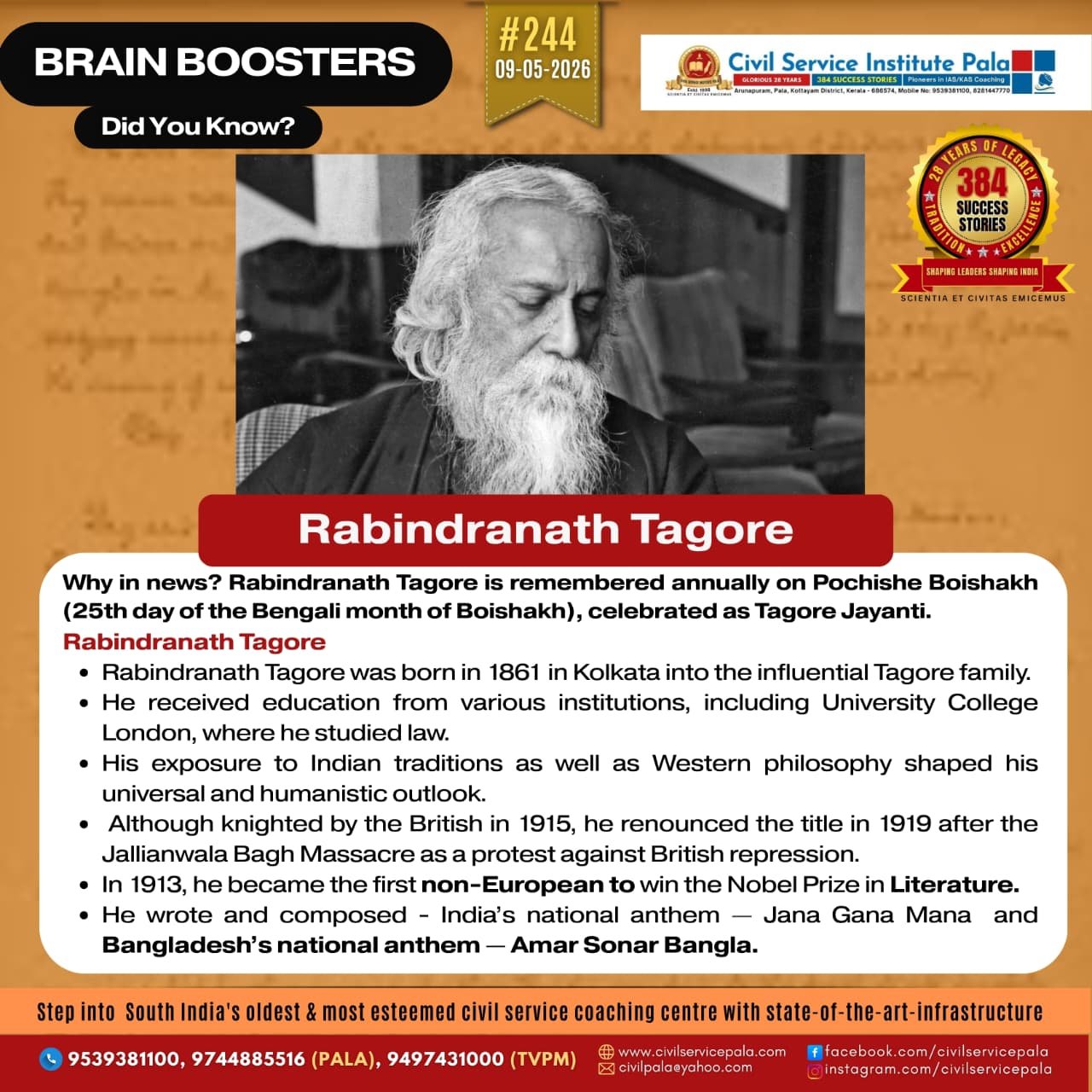
Rabindranath Tagore
Why in News?
• Rabindranath Tagore is remembered annually on Pochishe Boishakh (25th day of the Bengali month of Boishakh), celebrated as Tagore Jayanti.
• His contributions to literature, nationalism, education, music, and cultural renaissance continue to hold major relevance in India and globally.
Early Life and Background
• Rabindranath Tagore was born in 1861 in Kolkata into the influential Tagore family.
• He was the youngest son of Debendranath Tagore, an important leader of the Brahmo Samaj reform movement.
• Tagore showed literary talent at a very young age and began writing poetry at around eight years old.
• He received education from various institutions, including University College London, where he briefly studied law.
• His exposure to Indian traditions as well as Western philosophy shaped his universal and humanistic outlook.
Role in Bengal Renaissance and National Awakning
• Tagore played a major role in the Bengal Renaissance through his writings and educational ideas.
• His works promoted Liberalism, Humanism, Social reform and National consciousness.
• He extensively supported the Swadeshi movement and criticised colonial exploitation.
• Tagore’s nationalism differed from aggressive nationalism because he emphasised universal human values and global cooperation.
• Although knighted by the British in 1915, he renounced the title in 1919 after the Jallianwala Bagh Massacre as a protest against British repression.
Tagore as a Poet
• Tagore is regarded as one of the greatest figures in modern Indian literature.
• He wrote extensively in Bengali and later translated many of his works into English himself.
• His literary style combined Spiritual depth, Nature imagery, Human emotions, and Social criticism.
Nobel Prize
• In 1913, Tagore became the first non-European to win the Nobel Prize in Literature.
• He received the award for Gitanjali (Song Offerings).
Major Literary Works
• Poetry : Gitanjali, Sonar Tari, Balaka, Gitimalya, and Manasi.
• Novels : Gora, Ghare-Baire (The Home and the World), and Yogayog.
• Plays : Dakghar, Raja, Raktakaravi, and Muktadhara.
Short Stories
• Tagore pioneered the modern Indian short story tradition.
• His stories often addressed themes of rural life, women’s condition in society, social inequalities, and human relationships.
Contributions to Music and Art
• Tagore composed more than 2,000 songs collectively known as Rabindra Sangeet.
• He wrote and composed:
o India’s national anthem — Jana Gana Mana
o Bangladesh’s national anthem — Amar Sonar Bangla.
• He was also a painter and took up painting seriously after the age of 70.
• Experts suggest that Tagore integrated literature, music, painting, and philosophy into a unified cultural vision.
Santiniketan
• In 1901, Tagore established a school at Santiniketan.
• He opposed rote-learning and promoted Creativity, Nature-based education, Freedom of thought, and Holistic learning.
Visva-Bharati University
• In 1921, the institution evolved into Visva-Bharati University.
• Tagore envisioned it as a global centre connecting Eastern and Western knowledge traditions.
• The university promoted Cultural exchange, Arts and humanities, and International cooperation.
Social Reform and Humanism
• Rabindranath Tagore strongly criticised social orthodoxy, caste discrimination, gender inequality, and colonial oppression through his writings and public speeches.
• He believed that society should be based on dignity, compassion, equality, and universal brotherhood rather than rigid social hierarchies.
• Tagore’s literary works consistently highlighted the importance of individual freedom, social justice, and harmony among people.
• He also emphasised rural reconstruction and community development, believing that India’s progress depended on the upliftment of village society.
• Experts highlight that Tagore combined deep patriotism with global humanism and therefore rejected narrow, aggressive forms of nationalism.
International Recognition
• Tagore travelled extensively across Europe, America, China, Japan, and Southeast Asia, where he emerged as an important cultural representative of India.
• Through his lectures and writings, he spoke on themes such as civilisation, nationalism, education, spirituality, and human unity.
• His intellectual discussions with Albert Einstein became globally famous for exploring the relationship between science, truth, philosophy, and human consciousness.
• Tagore’s international engagements helped introduce Indian philosophical and cultural traditions to the wider world.
• Tagore played a major role in shaping India’s image as a civilisation rooted in spirituality, creativity, and universal values.
Political and Philosophical Ideas
• Tagore believed that true freedom could not be achieved only through political independence, but also required moral awakening, social reform, and educational empowerment.
• He criticised colonial exploitation while also warning Indians against blindly imitating Western culture and materialism.
• Tagore opposed excessive nationalism and militarism because he feared they could divide humanity and encourage violence.
• His philosophy combined Upanishadic spirituality with universal humanism, artistic freedom, and respect for human dignity.
• Experts highlight that Tagore envisioned a world where cultural exchange, mutual respect, and creative freedom would guide human progress.
