



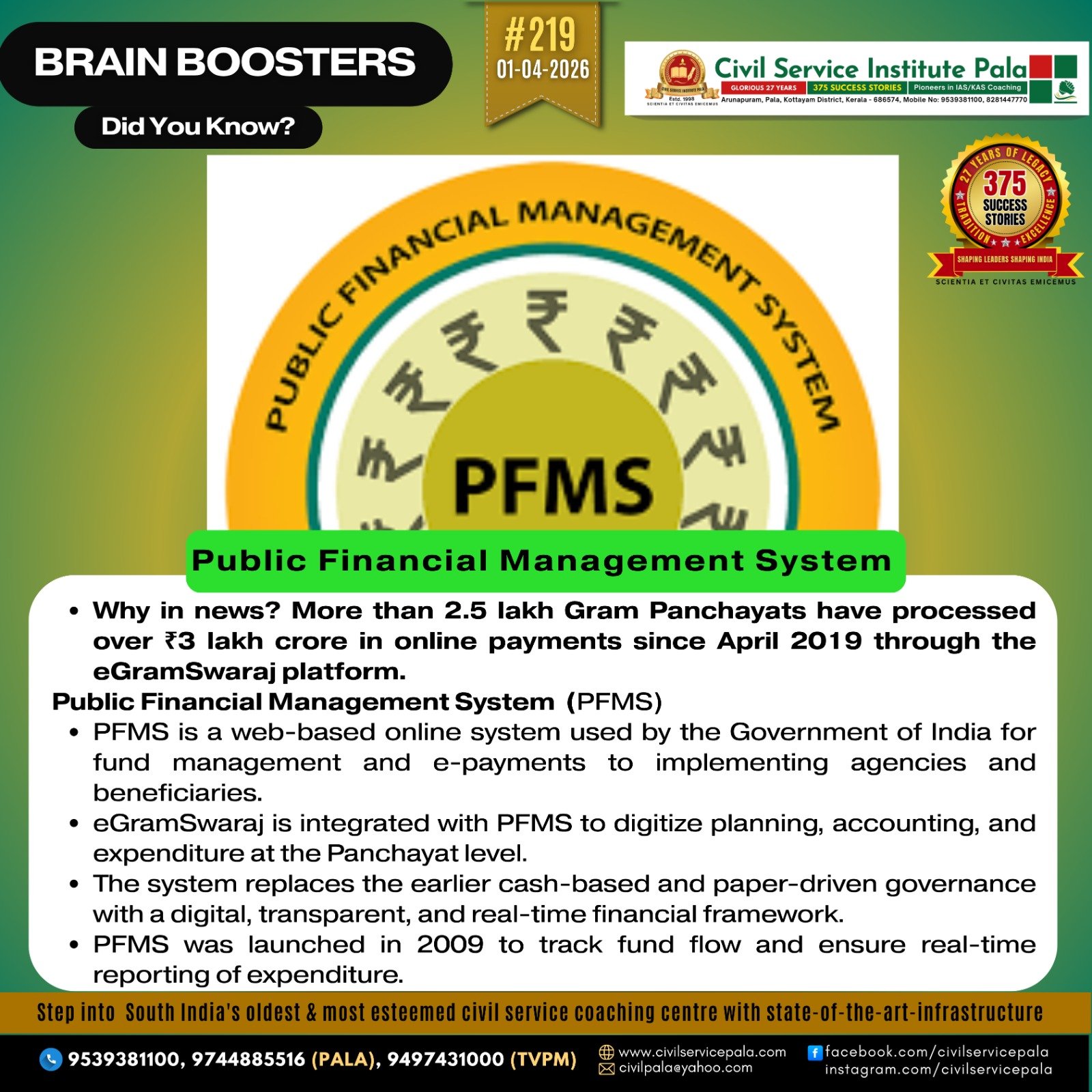
Public Financial Management System
•More than 2.5 lakh Gram Panchayats have processed over ₹3 lakh crore in online payments since April 2019 through the eGramSwaraj platform.
• PFMS is a web-based online system used by the Government of India for fund management, accounting, and e-payments to implementing agencies and beneficiaries.
• PFMS was launched in 2009 to track fund flow and ensure real-time reporting of expenditure.
• eGramSwaraj, developed under the e-Panchayat Mission Mode Project, is integrated with PFMS to digitize planning, accounting, and expenditure at the Panchayat level.
• The system replaces the earlier cash-based and paper-driven governance with a digital, transparent, and real-time financial framework.
• The 15th Finance Commission allocated ₹2,36,805 crore to Panchayats (2021–26), while the 14th Finance Commission allocated ₹2,00,292.20 crore.
Key Features
• PFMS enables direct transfer of funds to vendors and beneficiaries with a complete digital audit trail.
• Experts highlight that real-time tracking and just-in-time fund release reduce delays and leakages in public expenditure.
• The system integrates modules such as Single Nodal Agency (SNA), Treasury Single Account (TSA), Central Nodal Agency (CNA), and SNA-SPARSH for efficient cash management.
• PFMS is linked with major schemes and databases like PM-KISAN, MNREGASoft, and AwasSoft for seamless DBT implementation.
• Bharatkosh (NTRP) is the PFMS portal for online collection of non-tax revenue.
Important Developments
• In FY26 alone, Panchayati Raj Institutions transferred ₹53,342 crore through the eGramSwaraj-PFMS interface.
• Around 2,55,254 Gram Panchayats uploaded development plans on the portal.
• Over 1.6 crore vendors are registered on the platform.
Significance
• Experts state that PFMS enhances transparency by ensuring every transaction is digitally recorded and traceable.
• It strengthens financial discipline by enabling real-time reconciliation and reporting of government accounts.
• Direct Benefit Transfer (DBT) through PFMS ensures funds are credited directly to beneficiaries’ bank accounts, reducing intermediaries.
• Integration with RBI systems ensures faster and secure payments.
• Digitization improves grassroots governance and reduces corruption in rural development funding.
Governance
• PFMS operates under constitutional provisions related to public finance (Article 283) governing receipts and payments.
• It integrates with CBDT and CBIC for near real-time revenue accounting.
• Annual Union Government accounts are compiled using PFMS transaction data.
• Experts highlight that PFMS acts as a unified platform for payment, accounting, and reconciliation across government systems.
Grievance Redressal
• PFMS has introduced a Customer Relationship Management (CRM) system for grievance redressal.
• Each complaint generates a ticket with tracking and automated acknowledgement.
• Users can monitor grievance status and access FAQs through the helpdesk portal.
• Regular “Open House” sessions are conducted for resolving user issues and clarifying doubts.
Challenges
Experts suggest that effective implementation depends on digital literacy at the grassroots level.
• Integration across multiple platforms and databases requires continuous technical upgrades.
• Ensuring data accuracy and avoiding exclusion errors in DBT remain ongoing concerns.
Way Forward
• Experts highlight the need to strengthen digital infrastructure and capacity building at Panchayat levels.
• Expanding real-time analytics can improve policy decisions and expenditure efficiency.
• Continuous system upgrades and user feedback integration can enhance effectiveness.
• Greater interoperability with state-level systems can further streamline governance.
