



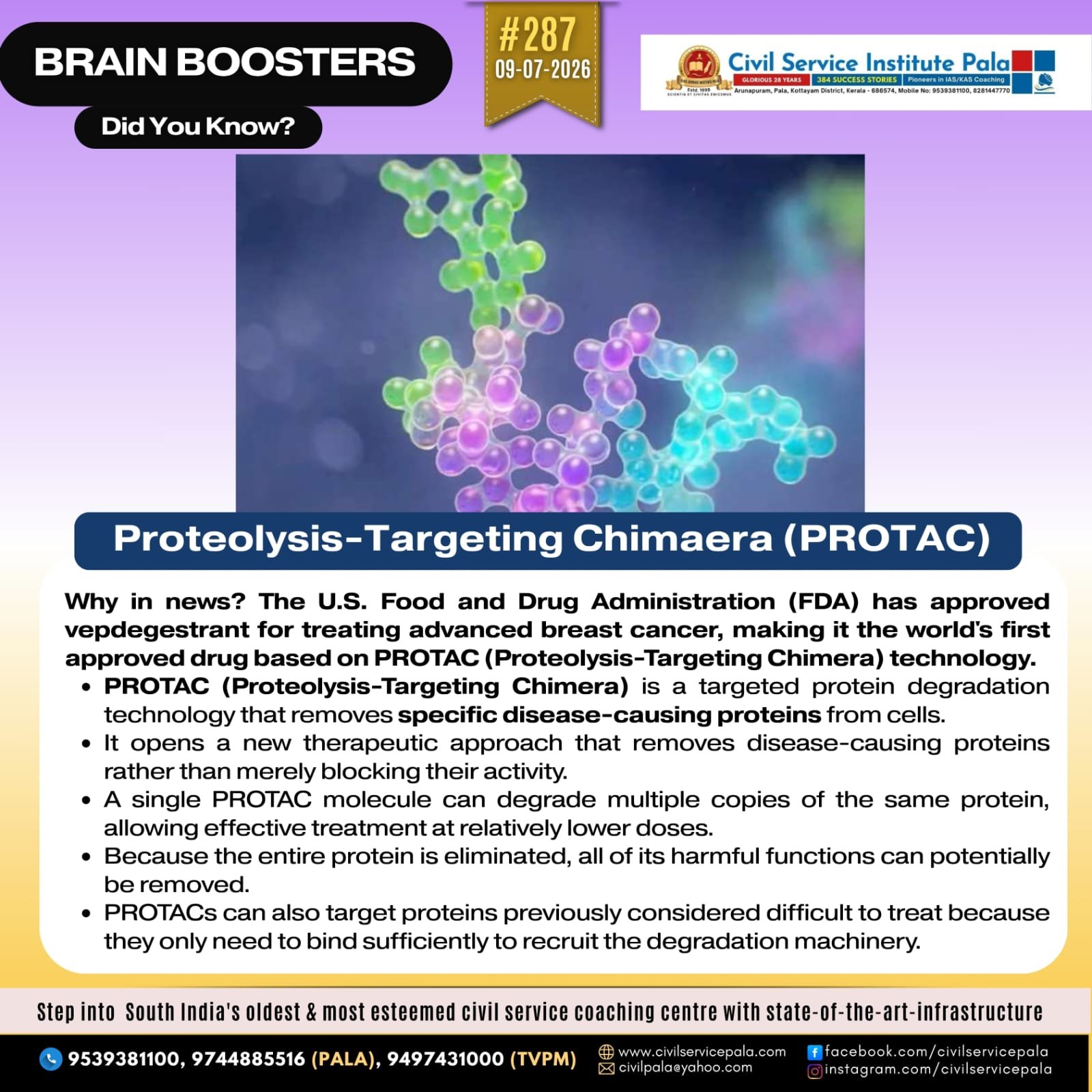
PROTAC Technology & FDA Approval of Vepdegestrant
PROTAC Technology & FDA Approval of Vepdegestrant
Why in News?
The U.S. Food and Drug Administration (FDA) has approved vepdegestrant for treating ESR1-mutated, ER-positive, HER2-negative advanced breast cancer, making it the world's first approved drug based on PROTAC (Proteolysis-Targeting Chimera) technology. The approval marks a major milestone in targeted protein degradation and opens a new therapeutic approach that removes disease-causing proteins rather than merely blocking their activity.
What is PROTAC Technology?
• PROTAC (Proteolysis-Targeting Chimera) is a targeted protein degradation technology that removes specific disease-causing proteins from cells.
• Unlike conventional drugs that temporarily block the function of proteins, PROTAC molecules direct the cell's own protein disposal machinery to permanently destroy the target protein.
• This approach offers a new way to treat diseases involving proteins that were previously considered difficult or impossible to target using conventional medicines.
How Does a PROTAC Work?
• A PROTAC molecule has two functional ends connected by a chemical linker.
• One end binds to the target disease-causing protein.
• The other end binds to an E3 ligase, an enzyme involved in the cell's natural protein degradation system.
• By bringing the target protein and E3 ligase together, the PROTAC marks the protein for destruction through the cell's protein degradation pathway.
• Once degradation is complete, the PROTAC molecule detaches and can repeat the process on another copy of the same protein.
PROTAC vs Conventional Drugs
Conventional Drugs
• Conventional medicines generally work by binding to a protein and blocking one of its biological functions.
• Since the protein remains present inside the cell, the drug must continue to remain in the body to maintain its therapeutic effect.
• Many disease-causing proteins lack suitable binding sites, making them "undruggable" by conventional inhibitors.
PROTAC Technology
• PROTACs completely remove the disease-causing protein instead of merely blocking it.
• A single PROTAC molecule can degrade multiple copies of the same protein, allowing effective treatment at relatively lower doses.
• Because the entire protein is eliminated, all of its harmful functions can potentially be removed.
• PROTACs can also target proteins previously considered difficult to treat because they only need to bind sufficiently to recruit the degradation machinery.
Development of PROTAC Technology
• The concept of targeted protein degradation was first demonstrated in 2001 by researchers at Yale University and Caltech.
• Early PROTAC molecules successfully degraded proteins inside cells but were unsuitable as medicines because they were unstable.
• Significant improvements during the 2010s produced molecules with better stability, selectivity and drug-like characteristics.
• In 2019, bavdegalutamide became the first PROTAC drug to enter human clinical trials for metastatic prostate cancer.
• In 2025, vepdegestrant, jointly developed by Arvinas and Pfizer, became the first PROTAC drug to receive FDA approval.
Vepdegestrant
Target Disease
• ESR1-mutated, ER-positive, HER2-negative advanced breast cancer.
Mechanism
• Vepdegestrant targets and destroys the oestrogen receptor, which drives the growth of many breast cancers.
• In patients carrying ESR1 mutations, the receptor continues functioning despite hormone therapy, causing treatment resistance.
• By degrading the receptor itself, the drug overcomes one important mechanism of resistance.
• The drug is administered orally once daily, unlike fulvestrant which requires intramuscular injections.
Potential Applications of PROTACs
• Treatment of cancers involving difficult-to-target proteins.
• Neurodegenerative diseases associated with abnormal protein accumulation.
• Inflammatory disorders.
• Muscle diseases involving defective proteins.
• More than 40 PROTAC candidates are currently undergoing clinical trials targeting over 200 proteins across different diseases.
Challenges
• PROTAC molecules are larger and structurally more complex than conventional small-molecule drugs, making absorption and distribution more difficult.
• At very high concentrations, PROTAC efficiency may decrease because productive interactions between the target protein and E3 ligase become less frequent.
• Most current PROTACs rely primarily on only two E3 ligases, despite human cells possessing more than 600 different E3 ligases.
• Cancer cells may eventually develop resistance by altering the protein degradation machinery or reducing the availability of E3 ligases.
Why is this Approval Significant?
• It is the first regulatory approval of a PROTAC-based medicine, validating targeted protein degradation as a clinically effective therapeutic strategy.
• It expands treatment options for patients with advanced breast cancer resistant to conventional hormone therapy.
• It opens possibilities for developing medicines against previously "undruggable" proteins across multiple diseases.
• The approval is expected to accelerate research and clinical development of next-generation targeted protein degradation therapies.
