



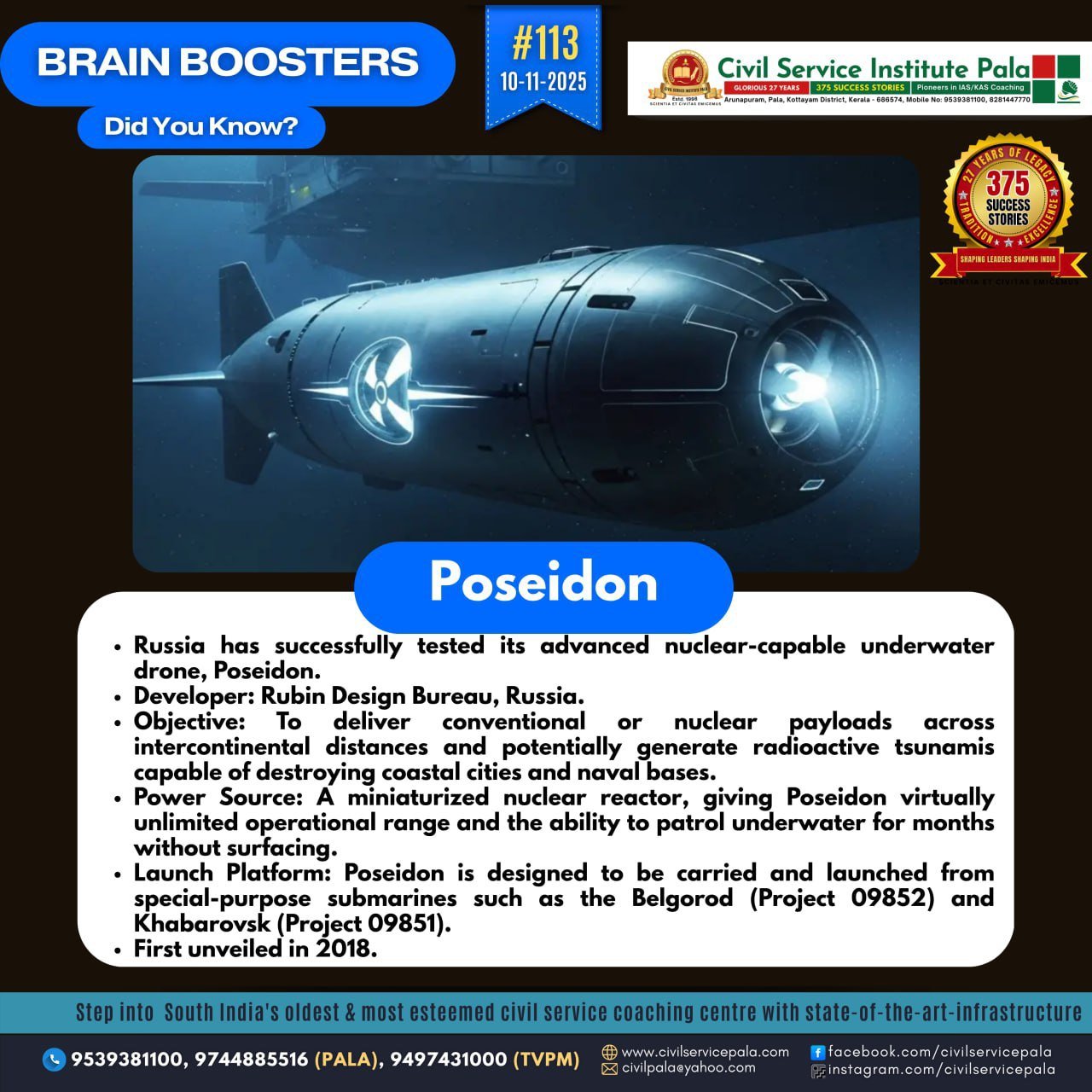
Poseidon
Poseidon is a very large, torpedo-shaped, nuclear-powered autonomous underwater vehicle (AUV) reportedly designed to carry either a conventional or a nuclear warhead. It’s intended for long-range missions (thousands of kilometres) at great depth and with long endurance because of its onboard reactor.
Key technical claims (open-source estimates & Russian statements) Size & form: roughly ~20–24 m long and about 1.6–2 m diameter (estimates vary).
Propulsion: small nuclear reactor / liquid-metal reactor powering electric drive — giving theoretically effectively unlimited range. Range & depth: Russian / analyst estimates place range at ~10,000 km and operating depths up to ~1,000 m. What it’s designed to do Russia describes Poseidon as a strategic weapon to bypass missile defenses and threaten coastal military bases and cities; western analysts add roles like attacking carrier groups or seabed installations.
A distinctive public worry has been that a nuclear underwater detonation near a coast — or a “salted” (radiological) warhead — could cause massive coastal devastation and long-term contamination. Many technical and physical limits mean the extreme “radioactive tsunami” scenarios seen in headlines are contested by experts, but the weapon would nonetheless pose serious strategic and environmental risks.
Deployment & testing (status) Russia has linked the system to special submarines (e.g., the large Belgorod platform) intended to carry Poseidon vehicles.
Russia has periodically released footage and statements about development and production; open-source reporting indicates production batches were claimed in Russian media in 2022–2023. In late October 2025, Russian officials announced a test of the Poseidon system that, they said, involved activation of its nuclear power unit — those claims were reported by multiple international outlets. Independent verification of all technical claims is limited.
Uncertainties and technical skepticism Many important details remain classified or uncertain (exact warhead yield, reactor design and safety, reliable guidance over intercontinental underwater distances, detectability, and real ability to create catastrophic tsunamis).
Open-source analysts agree Poseidon would be a destabilizing addition to strategic arsenals, but they disagree about some of the most dramatic media claims. Strategic & legal implications Poseidon blurs lines between strategic and theatre nuclear systems, complicates deterrence stability, raises environmental/ humanitarian concerns, and creates pressure for new detection, tracking, and arms-control measures.
Many analysts call it a weapon that increases the risks of escalation and long-term contamination if used.
