



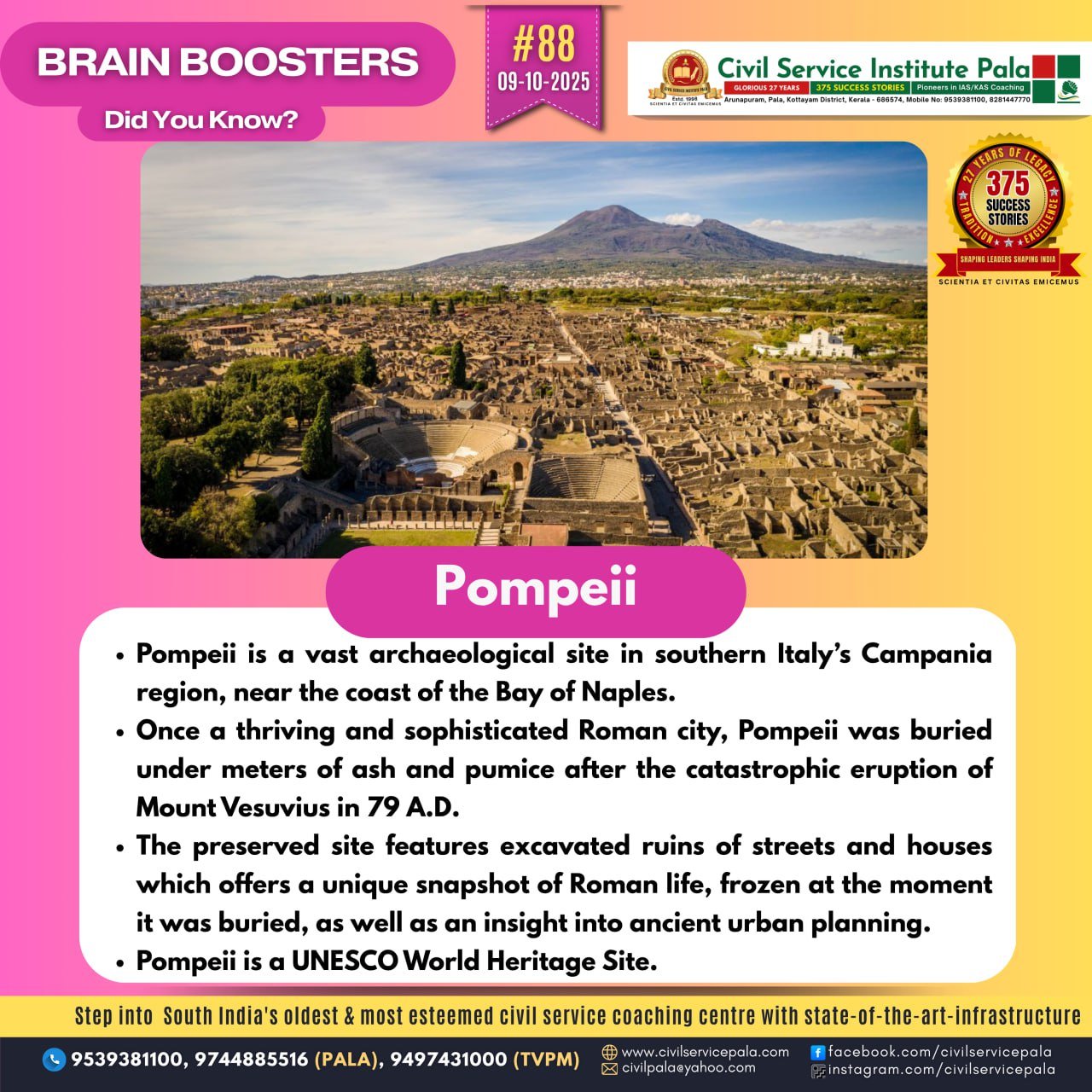
Pompeii
The ruins of Pompeii are one of the most remarkable archaeological sites in the world, offering a detailed glimpse into life during the height of the Roman Empire.
Location Pompeii is located near Naples, in southern Italy, at the base of Mount Vesuvius.
Historical Background Pompeii was a prosperous Roman city founded around the 6th–7th century BCE. It became an important trading and cultural center in the Roman Empire. The city had beautiful villas, public baths, theatres, temples, markets, and paved streets—showing the high level of urban planning and luxury of Roman society.
The Eruption of Mount Vesuvius (79 CE) On August 24, 79 CE, Mount Vesuvius erupted violently. The eruption buried Pompeii (and nearby Herculaneum) under ash, pumice, and volcanic debris up to 6 meters deep. The city was lost for nearly 1,700 years, perfectly preserved under volcanic ash. Many residents were trapped, and their remains were found as plaster casts, capturing their final moments.
Rediscovery and Excavation Pompeii was rediscovered in 1748 by archaeologists. Excavations revealed well-preserved streets, buildings, frescoes, mosaics, and artifacts, giving detailed insight into daily Roman life. The ash had sealed the city so well that even food, tools, and graffiti survived.
Major Attractions in the Ruins The Forum: The central square, surrounded by temples and government buildings. The Amphitheatre: One of the oldest surviving Roman amphitheatres. The House of the Faun: A grand villa famous for the Alexander Mosaic. The Villa of the Mysteries: Renowned for its beautiful frescoes depicting Dionysian rituals. Public Baths and Streets: Show advanced water systems and social life.
Significance
Pompeii provides an extraordinary archaeological record of Roman urban life. It offers insights into architecture, art, social structure, and daily habits. The site is a UNESCO World Heritage Site (since 1997) and one of Italy’s most visited historical attractions.
