



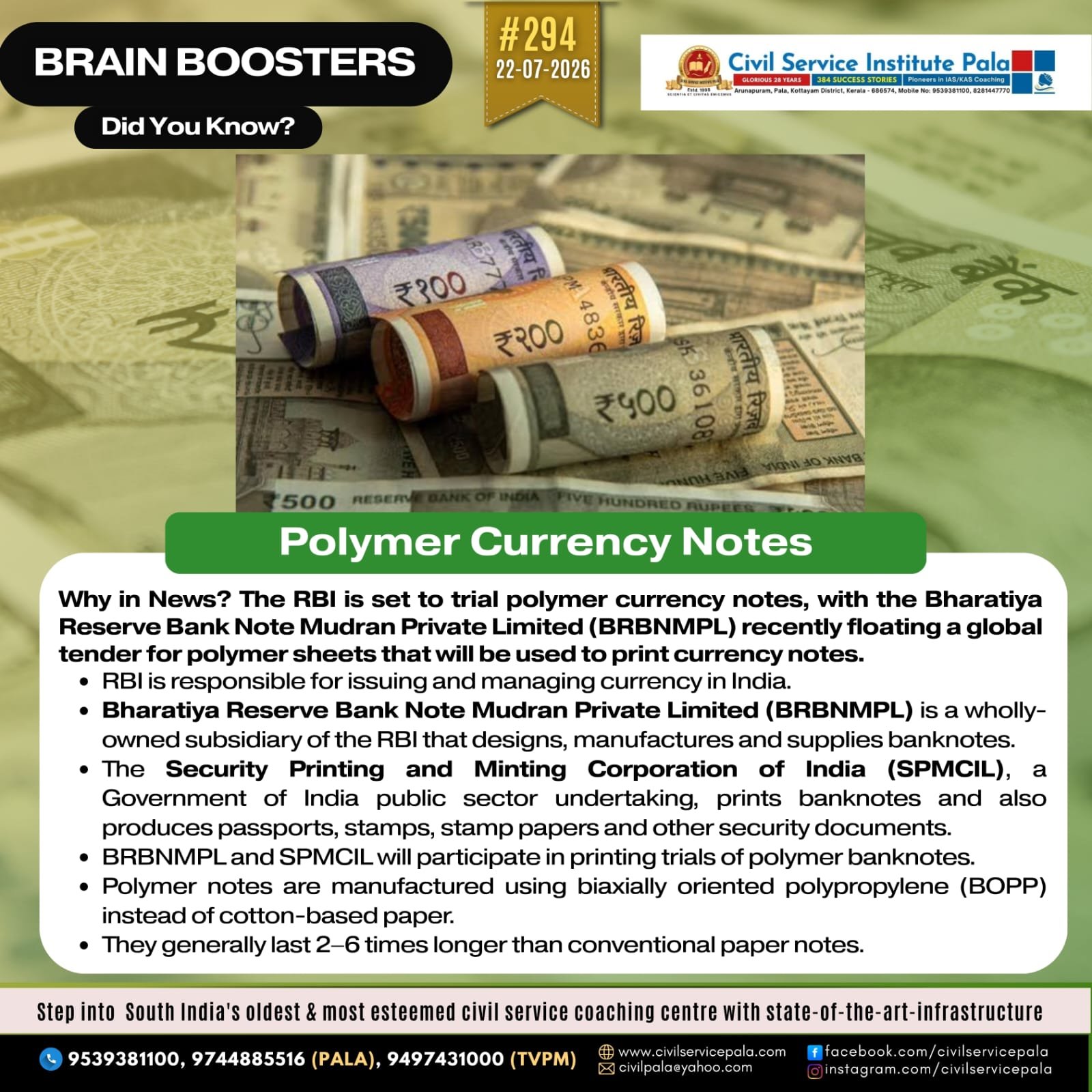
Polymer Currency Notes
Polymer Currency Notes
The Reserve Bank of India (RBI) has initiated the process of trialling polymer currency notes by inviting global bids for polymer substrates through its wholly-owned subsidiary, Bharatiya Reserve Bank Note Mudran Private Limited (BRBNMPL). The trial will cover two denominations of banknotes and, if successful, could pave the way for large-scale adoption of polymer notes in India. The initiative is currently at the field-trial stage following RBI's preliminary evaluation of polymer currency.
Currency Printing Ecosystem in India
Agencies involved
• The Reserve Bank of India (RBI) is responsible for issuing and managing currency in India.
• Bharatiya Reserve Bank Note Mudran Private Limited (BRBNMPL) is a wholly-owned subsidiary of the RBI that designs, manufactures and supplies banknotes.
• The Security Printing and Minting Corporation of India (SPMCIL), a Government of India public sector undertaking, prints banknotes and also produces passports, stamps, stamp papers and other security documents.
• Both BRBNMPL and SPMCIL will participate in printing polymer banknotes during the
What are polymer banknotes?
Polymer banknotes are currency notes printed on biaxially oriented polypropylene (BOPP) instead of cotton paper. They are more durable, cleaner, recyclable and resistant to counterfeiting than conventional paper notes.
Why Polymer Notes?
Advantages of polymer banknotes
• Polymer notes are manufactured using biaxially oriented polypropylene (BOPP) instead of cotton-based paper.
• They generally last 2–6 times longer than conventional paper notes.
• Longer durability reduces replacement costs and lowers environmental impact.
• Polymer notes are more resistant to moisture, dirt and physical wear.
• Advanced security features make them much harder to counterfeit.
• Used polymer notes can be recycled.
Global Experience & Significance for India
Australia became the first country to introduce polymer banknotes in 1988, and over fifty countries now use them. Their widespread adoption has demonstrated improved durability, lower counterfeit rates and reduced lifecycle costs. For India, where over 17,000 crore currency notes are in circulation and counterfeit detection remains a persistent challenge, polymer notes could improve currency security, reduce printing expenditure over time and enhance the efficiency of currency management.
Way Forward
The proposed field trial will determine whether polymer notes are economically viable and operationally suitable under Indian conditions. If successful, the RBI may gradually introduce polymer substrates across multiple denominations. Alongside technological improvements, India will also need secure procurement systems, robust supply-chain safeguards, and continuous enhancement of anti-counterfeiting measures to modernise currency management while maintaining public confidence in the monetary system.
