



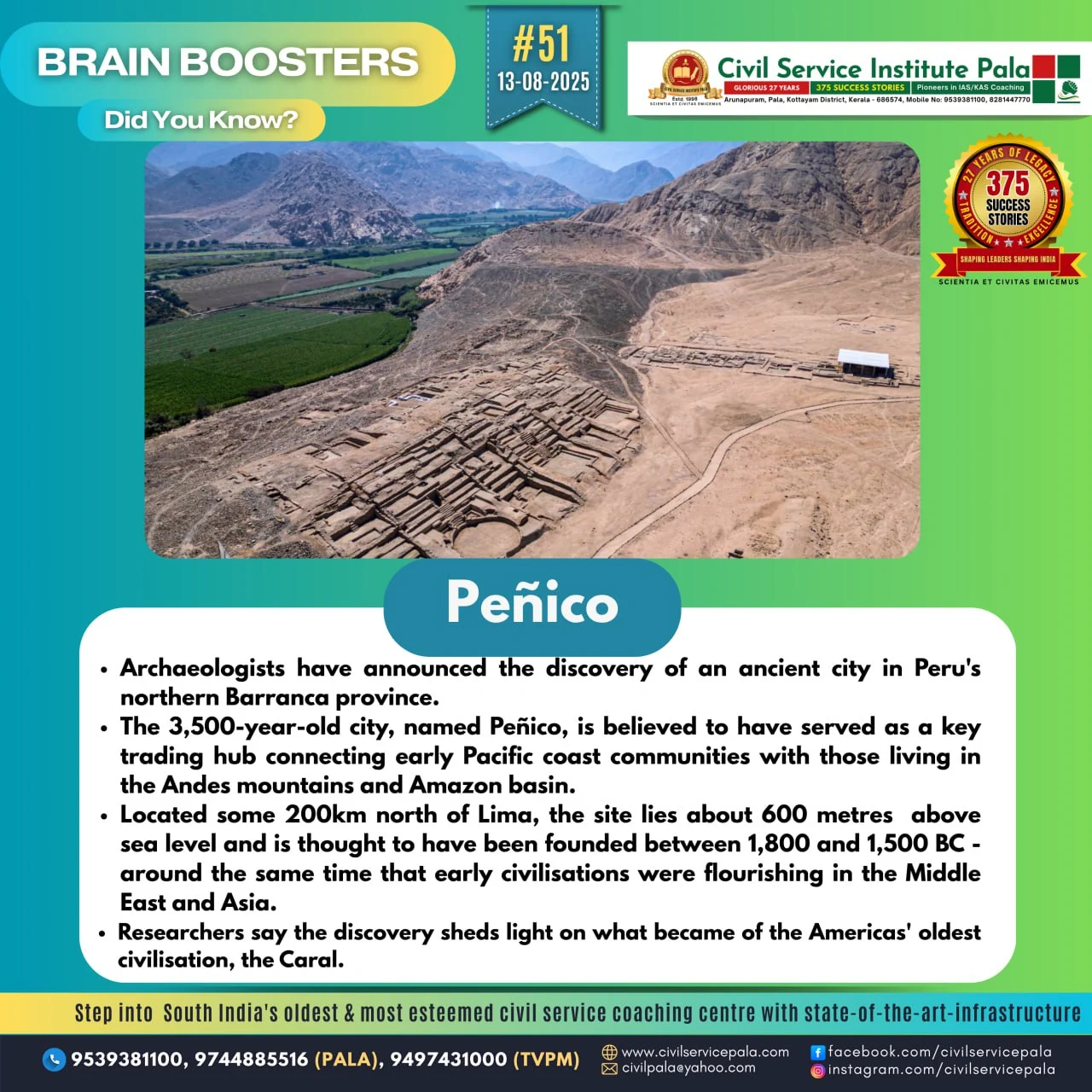
Penico
Location: Penico is situated in the Supe Valley, within the Barranca province of the Lima region, about 180 km (110 mi) north of Lima and roughly 12 mi (19 km) from the Pacific coast. It sits approximately 600 meters (2,000 ft) above sea level on a natural terrace beside a river, a strategic placement protecting it from flooding and landslides.Timeline: Founded between 1800 and 1500 BC, Penico was built roughly contemporarily with early civilizations in the Middle East and Asia, and emerged in the wake of the Caral civilization’s decline.Archaeological work began in 2017, spearheaded by archaeologist Ruth Shady, who also led research at Caral. After eight years of work, 18 distinct structures have been identified, including ceremonial temples, public halls, administrative buildings, and residential complexes.The site is managed as part of the Caral Archaeological Zone, becoming the fourth linked site open to the public, alongside Caral itself, Áspero, and Vichama. A notable feature is the Hall of the Pututos (“B2”), a ceremonial square hall with sculptural reliefs of pututu—conch shell trumpets used to summon gatherings or announce events. Artifacts uncovered include clay anthropomorphic and zoomorphic sculptures, stone tools, ceremonial objects, and beaded necklaces made from seashells and other materials, highlighting extensive inter-regional trade networks.Penico is often referred to as the “City of Social Integration”, as it played a vital role in connecting coastal, Andean, and Amazonian communities.Archaeologists see it as a continuation of Caral’s societal legacy, providing insights into how the civilization adapted to crises like climate-change–induced droughts.
Source:https://www.bbc.com/news/articles/c07dmx38kyeo
