



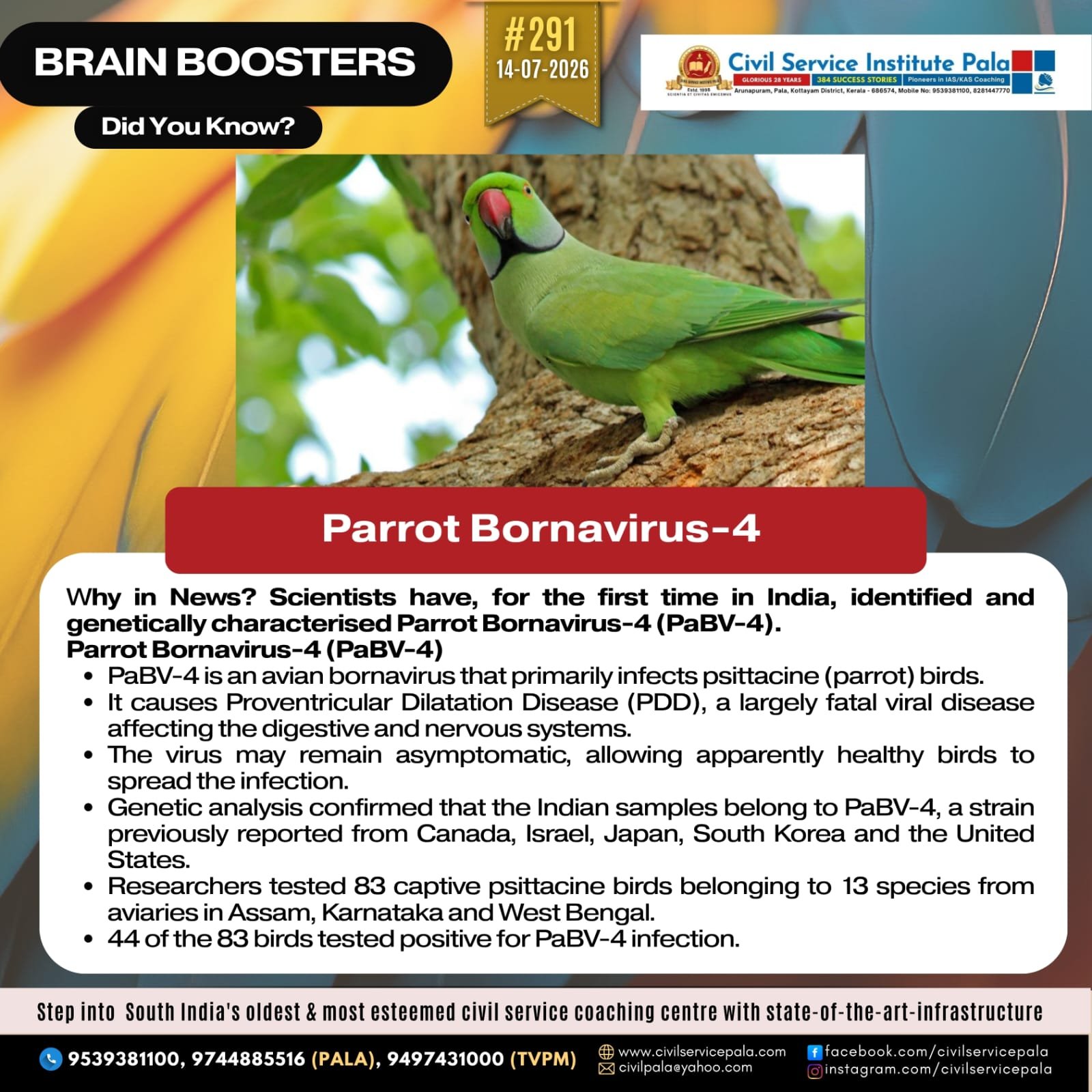
Parrot Bornavirus-4 (PaBV-4)
Parrot Bornavirus-4 (PaBV-4)
Why in News?
Scientists from the Assam Veterinary and Fishery University have, for the first time in India, identified and genetically characterised Parrot Bornavirus-4 (PaBV-4), a virus responsible for Proventricular Dilatation Disease (PDD) in captive parrots and other psittacine birds.
Parrot Bornavirus-4 (PaBV-4)
• PaBV-4 is an avian bornavirus that primarily infects psittacine (parrot) birds.
• It causes Proventricular Dilatation Disease (PDD), a largely fatal viral disease affecting the digestive and nervous systems.
• The virus can remain asymptomatic, allowing apparently healthy birds to spread the infection.
• Genetic analysis confirmed that the virus detected in India belongs to PaBV-4, a strain previously reported in Canada, Israel, Japan, South Korea and the United States.
Key Findings of the Study
• Researchers tested 83 captive psittacine birds belonging to 13 species from aviaries in Assam, Karnataka and West Bengal.
• These species included African grey parrot, ochre-marked parakeet, yellow-collared macaw, eastern rosella, blue-crowned hanging parrot, rainbow lorikeet, and scarlet-chested parrot.
• Out of this, 44 birds tested positive for PaBV-4 infection.
• Infection was detected in:
o Nearly 88% of dead birds suspected of PDD.
o About 19% of apparently healthy cage mates, indicating silent transmission.
• The infected birds belonged to nine species, including several classified as Near Threatened or Endangered.
Conservation Significance
• The findings highlight the risk posed by global trade and captive breeding of exotic parrots in spreading infectious diseases.
• The virus poses a potential threat to the conservation of threatened parrot species as well as the health of captive pet birds.
• The study underscores the need for disease surveillance, quarantine and biosecurity in aviculture and conservation breeding programmes.
Psittacine Birds
• Psittacine birds belong to the Order: Psittaciformes.
• They are characterised by:
o Strong, curved beaks.
o Brightly coloured plumage.
o High intelligence and vocal abilities.
• The order comprises more than 360 species distributed mainly across the tropical and subtropical regions of the world.
Major Members
• Parrots
• Parakeets (including budgerigars)
• Macaws
• Cockatoos
• Cockatiels
• Lovebirds
• Lorikeets
• Rosellas
Distribution
• Psittaciformes are primarily found in the tropics and southern temperate regions.
• They occur across South America, Africa, Asia, Australia, New Guinea, New Zealand, Madagascar, the Pacific Islands and the West Indies.
• In India, they are distributed across much of the country but are largely absent beyond the Himalayan region.
