



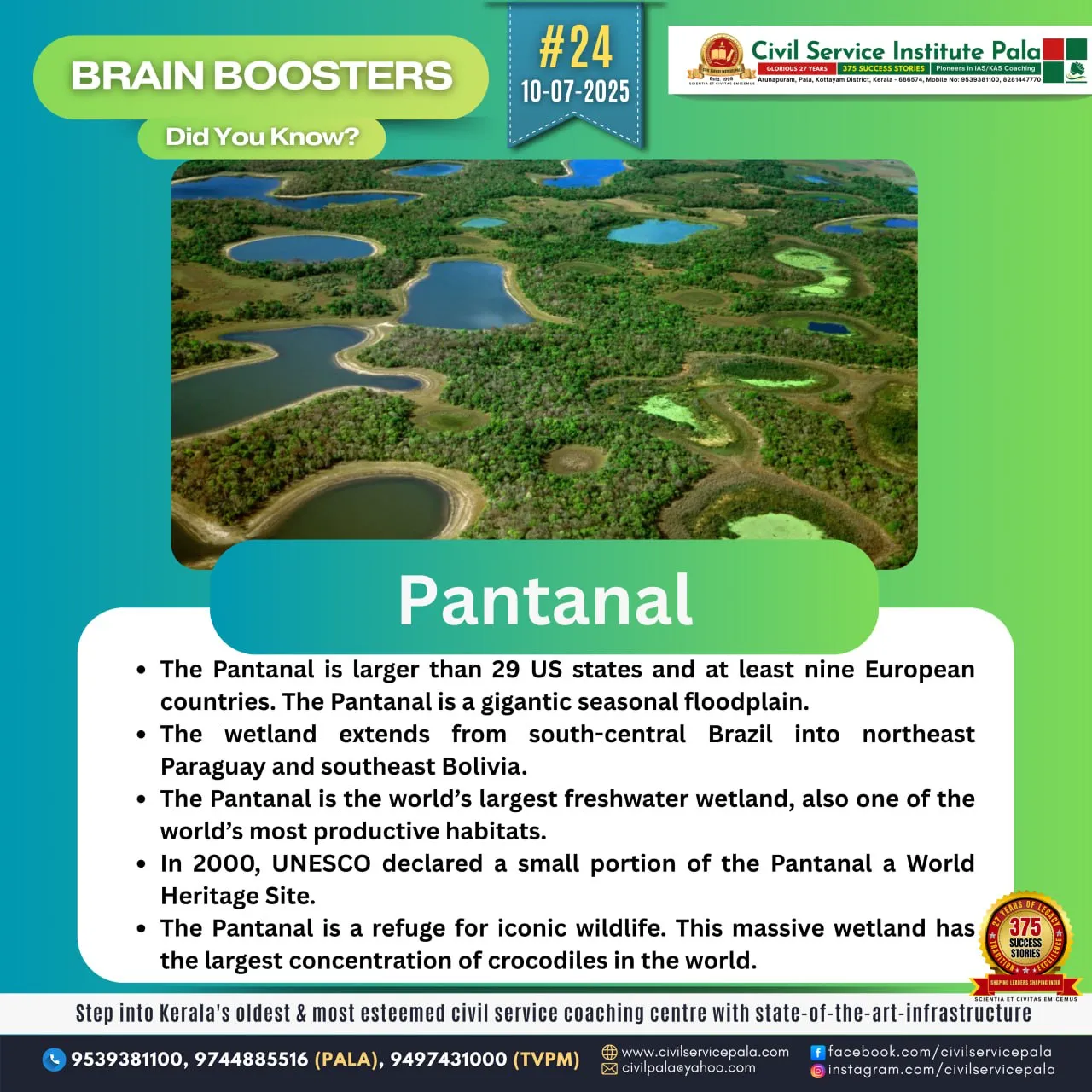
Pantanal
The Pantanal Wetland is one of the world’s largest and most ecologically significant freshwater wetland systems, sprawling across parts of Brazil, Bolivia, and Paraguay. Encompassing approximately 195,000 to 200,000 square kilometers, it is a vast floodplain primarily located in the Brazilian states of Mato Grosso and Mato Grosso do Sul. Unlike other wetlands formed by rainfall or high water tables, the Pantanal is a river-fed wetland, primarily nourished by the Upper Paraguay River and its tributaries, which overflow seasonally.
Seasonal Flooding and Unique Hydrology
One of the defining features of the Pantanal is its annual cycle of flooding and drying, which gives rise to a constantly changing mosaic of habitats — lakes, lagoons, marshes, gallery forests, and grasslands. During the rainy season (November to March), up to 80% of the floodplain may be submerged. This seasonal inundation plays a crucial role in replenishing nutrients, supporting fisheries, and maintaining the region’s extraordinary biodiversity.
Biodiversity Hotspot
The Pantanal is often referred to as “South America’s Eden” because of its rich biodiversity. Despite covering a smaller area than the Amazon Rainforest, the Pantanal is more densely populated with wildlife and offers greater visibility due to its open landscapes. It is home to:
Over 650 species of birds, including the jabiru stork, hyacinth macaw, and roseate spoonbill
Around 300 species of fish, such as piranhas and dourado
More than 100 species of mammals, including the capybara, giant river otter, marsh deer, and the jaguar, for which the Pantanal is one of the best global strongholds
Numerous reptiles, notably the yacaré caiman and anacondas
The ecosystem also supports countless plant species adapted to periodic flooding and plays a vital role in carbon storage and climate regulation.
Importance for People and Economy
Beyond its ecological value, the Pantanal supports local communities, including indigenous populations, ranchers, and fishermen. Traditional cattle ranching, eco-tourism, and sustainable fishing form the backbone of the regional economy. The region is also a vital water source and acts as a natural filtration system, improving water quality downstream.
Threats and Conservation
Despite its ecological richness, the Pantanal faces growing threats from human activities. These include:
Deforestation and agricultural expansion (especially soy farming and cattle grazing)
Hydroelectric projects and river damming, which alter natural flooding cycles
Illegal mining and pollution, particularly mercury contamination
Uncontrolled wildfires, worsened by drought and climate change
Large portions of the Pantanal are privately owned, which complicates conservation efforts. However, several national parks and private reserves aim to preserve its biodiversity, and the wetland is recognized as a UNESCO Biosphere Reserve and a Ramsar Wetland of International Importance.
Source:https://www.nature.org/en-us/get-involved/how-to-help/places-we-protect/pantanal/
