



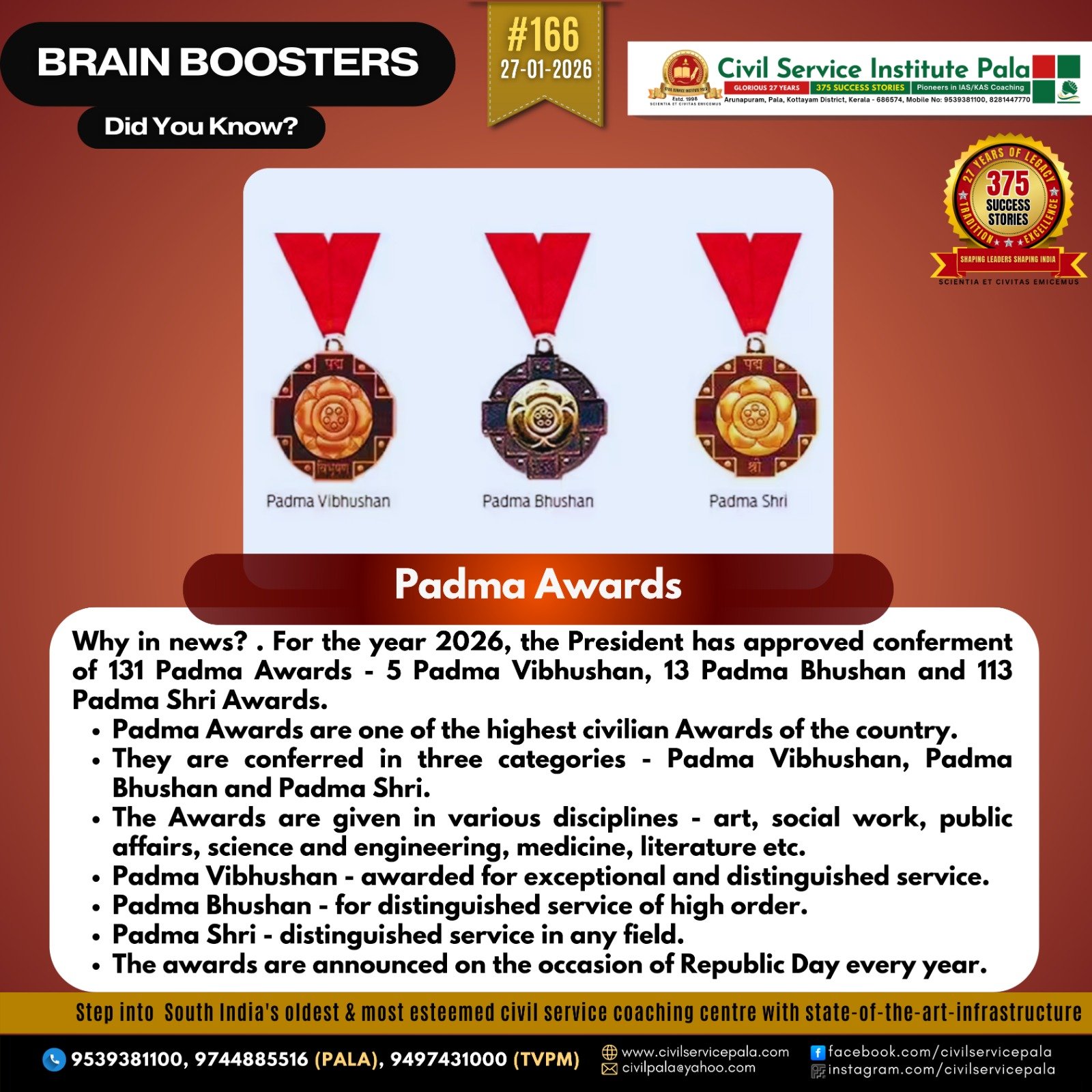
Padma Awards
Padma Awards –
Why in news? . For the year 2026, the President has approved conferment of 131 Padma Awards - 5 Padma Vibhushan, 13 Padma Bhushan and 113 Padma Shri Awards. 19 of the awardees are women and the list also includes 6 persons from the category of Foreigners / NRI / PIO / OCI and 16 Posthumous awardees.
• one of the highest civilian Awards of the country.
• Instituted in 1954
• They are conferred in three categories, namely, Padma Vibhushan, Padma Bhushan and Padma Shri. The Awards are given in various disciplines / fields of activities - art, social work, public affairs, science and engineering, trade and industry, medicine, literature and education, sports, civil service, etc.
• All persons without distinction of race, occupation, position or sex are eligible for these Awards.
• Government servants including those working with PSUs, except Doctors and Scientists, are not eligible for Padma Awards.
• Padma Vibhushan - awarded for exceptional and distinguished service.
• Padma Bhushan - for distinguished service of high order.
• Padma Shri - distinguished service in any field.
• The awards are announced on the occasion of Republic Day every year.
• These Awards are conferred by the President of India at ceremonial functions which are held at Rashtrapati Bhawan usually around March / April every year.
• The Government is committed to transform Padma Awards into “People’s Padma”. All citizens are, therefore, requested to make nominations/recommendations, including self-nomination.
• Concerted efforts are made to identify talented persons whose excellence and achievements really deserve to be recognized from amongst women, weaker sections of the society, SCs & STs, divyang persons and who are doing selfless service to the society.
• In 1996, constitutional the Supreme Court upheld the constitutional validity of the National Awards– Bharat Ratna, Padma Vibhushan, Padma Bhushan and Padma Sri.
• It ruled that these awards do not amount to ‘titles’ within the meaning of Article 18 that prohibits only hereditary titles of nobility.
• Therefore, they are not violative of Article 18 as the theory of equality does not mandate that merit should not be recognised.
• However, it also ruled that they should not be used as suffixes or prefixes to the names of awardees. Otherwise, they should forfeit the awards.
