



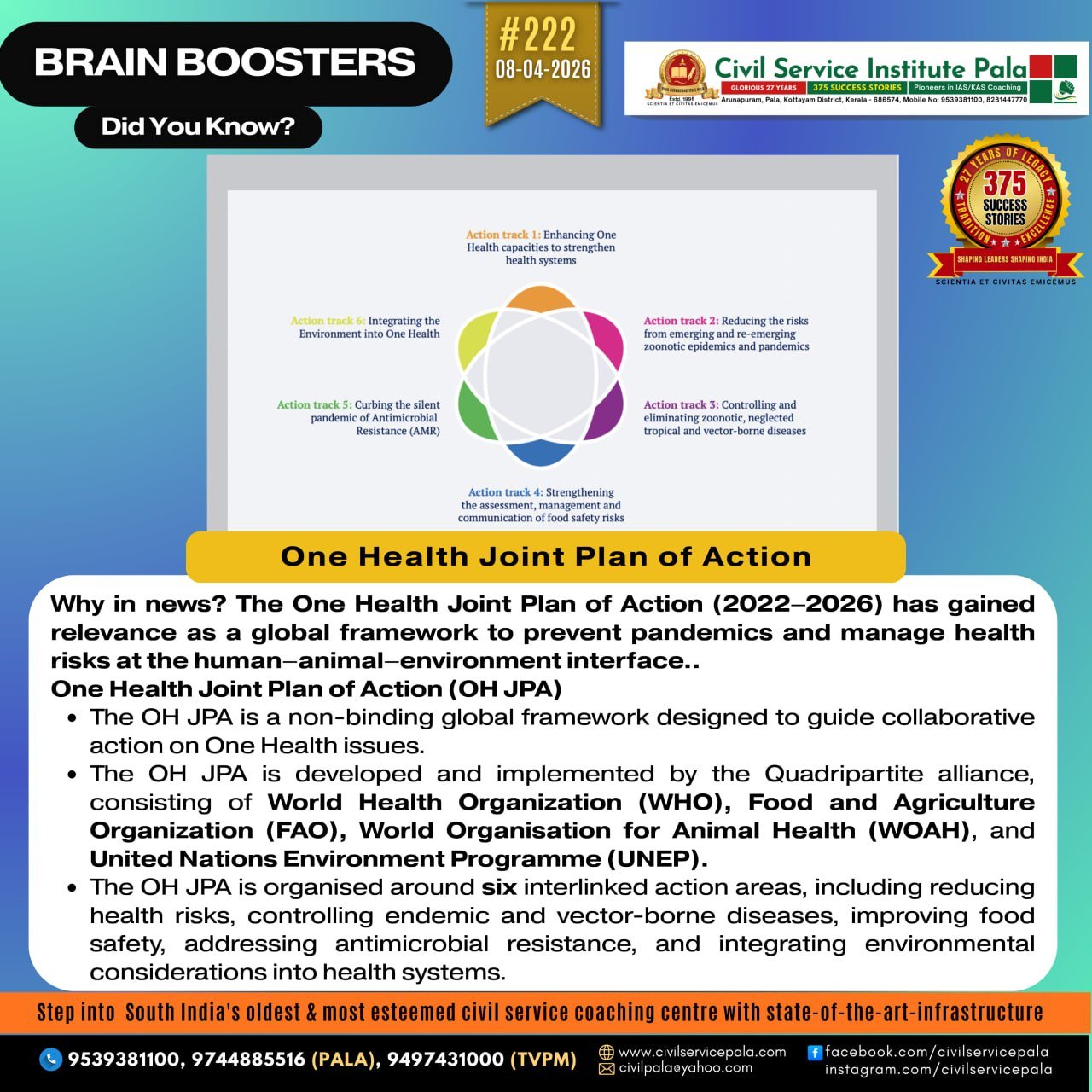
One Health Joint Plan of Action
The One Health Joint Plan of Action (2022–2026) has gained relevance as a global framework to prevent pandemics and manage health risks at the human–animal–environment interface.
• Increasing zoonotic diseases, antimicrobial resistance, and climate-linked health risks have made integrated approaches like One Health crucial.
What is One Health?
• One Health is an integrated and unifying approach that recognises the interdependence of human, animal, plant, and environmental health.
• It aims to improve overall health outcomes by promoting coordination across multiple sectors such as public health, veterinary science, agriculture, and environmental management.
• This approach enables better prevention, detection, and response to health threats, especially zoonotic diseases.
What is the One Health Joint Plan of Action (OH JPA)?
• The OH JPA is a non-binding global framework designed to guide collaborative action on One Health issues.
• It was developed to strengthen coordination among international organisations and support countries in building One Health capacities.
• The plan focuses on creating sustainable and holistic solutions for managing health risks across ecosystems.
Quadripartite Framework
The OH JPA is developed and implemented by the Quadripartite alliance, consisting of:
o World Health Organization (WHO)
o Food and Agriculture Organization (FAO)
o World Organisation for Animal Health (WOAH)
o United Nations Environment Programme (UNEP)
• The term “Quadripartite” refers to the equal partnership of these four organisations working together on One Health issues.
• This system evolved from the earlier “Tripartite” framework, with UNEP formally added in 2022.
Key Action Tracks
• The OH JPA is structured around six interdependent action areas:
o It seeks to strengthen One Health capacities and health systems globally.
o It focuses on reducing risks from emerging and re-emerging zoonotic diseases and pandemics.
o It aims to control endemic, neglected tropical, and vector-borne diseases.
o It promotes improved food safety risk assessment and management.
o It targets antimicrobial resistance as a major global health threat.
o It integrates environmental considerations into health governance frameworks.
Relevance
• Over 60% of emerging infectious diseases are zoonotic, making cross-sector coordination essential.
• The plan enhances global health security by linking climate change, biodiversity loss, and disease emergence.
• It supports countries in improving early warning systems, surveillance, and coordinated response mechanisms.
