



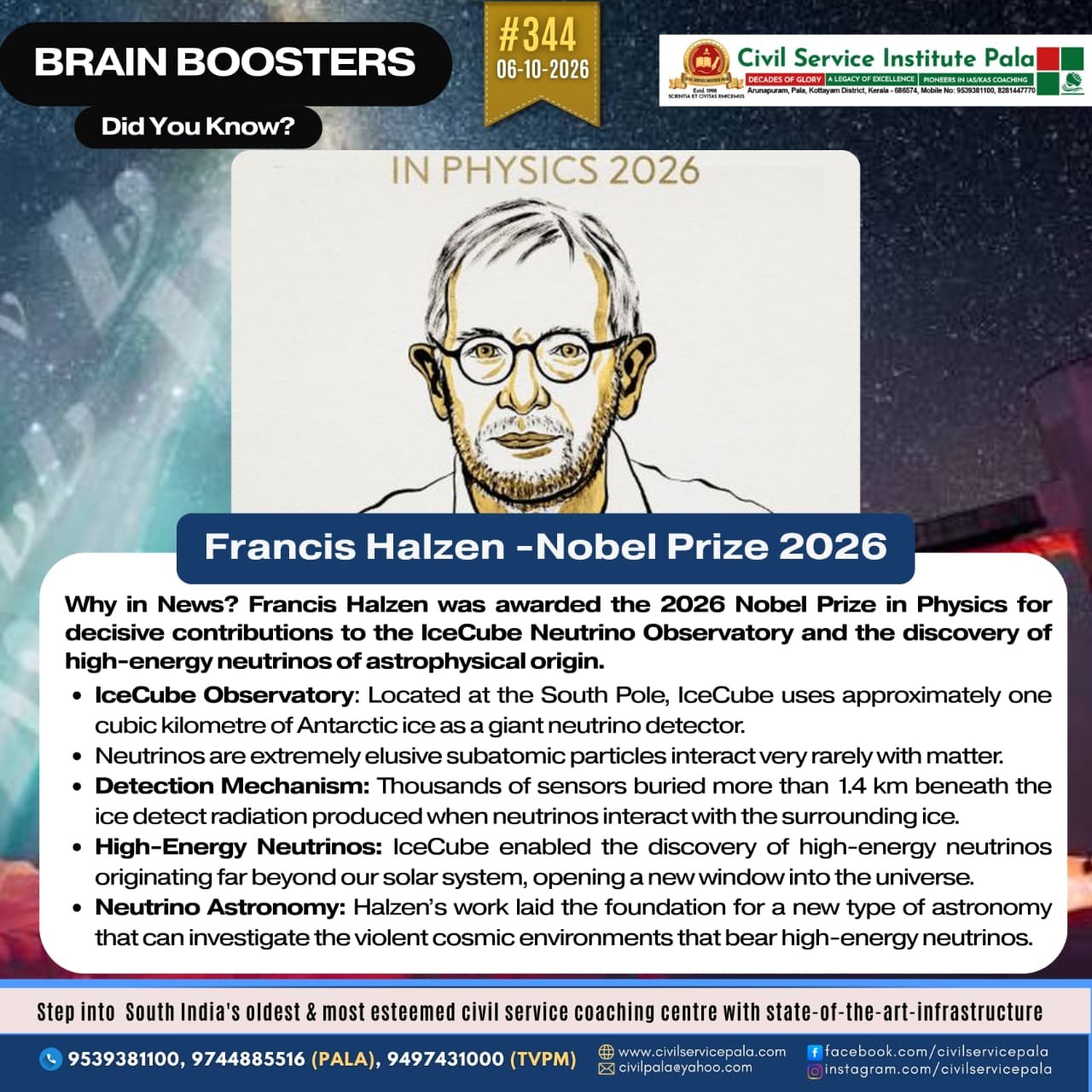
Nobel Prize in Physics 2026: Francis Halzen and the IceCube Neutrino Observatory
Why in News?
Francis Halzen has been awarded the 2026 Nobel Prize in Physics for his decisive contributions to the IceCube Neutrino Observatory and the discovery of high-energy neutrinos of astrophysical origin.
Who is Francis Halzen?
• Francis Halzen was born in 1944 in Tienen, Belgium, and is a Professor at the University of Wisconsin–Madison, USA.
• He laid the foundation for a new form of astronomy by proposing the use of glacial ice at the South Pole to detect elusive particles called neutrinos.
• His idea led to the IceCube Neutrino Observatory, which tracks neutrinos originating from the distant cosmos.
What are Neutrinos?
Elusive Subatomic Particles: Neutrinos are subatomic particles that interact with matter extremely rarely.
“Ghost Particles”: Because of their very weak interaction with matter, neutrinos are often called “ghost particles.”
Cosmic Origin: High-energy neutrinos can originate in distant and violent astrophysical environments, allowing scientists to study processes occurring far beyond our solar system.
Detection Challenge: Because neutrino interactions are extremely rare, detecting them requires a very large volume of material. A human-sized detector could, by some estimates, wait for a century for a single neutrino to interact with a sensor.
What is the IceCube Neutrino Observatory?
Location: IceCube is located at the Earth’s South Pole and uses the Antarctic glacial ice as its detection medium.
Scale: It occupies approximately one cubic kilometre of ice, making it the world’s largest neutrino telescope.
Deep-Ice Sensors: Thousands of sensors are buried more than 1.4 km beneath the ice, along with multiple detectors above the surface.
Global Collaboration: IceCube is built and maintained by the IceCube Collaboration, involving universities across the world and led by the University of Wisconsin–Madison.
Completion: The observatory was completed in 2011.
How Does IceCube Detect Neutrinos?
Rare Interaction: A neutrino can pass through matter without interacting, but occasionally it interacts with the ice surrounding the sensors.
Secondary Particles: Such an interaction can produce charged particles and radiation.
Sensor Detection: The sensors detect the resulting radiation and use its properties to infer the presence of a neutrino and study its characteristics.
Different Neutrino Types: Neutrinos occur in different types. IceCube can identify some types in real time, while identifying others requires scientists to analyse data collected over several years.
Discovery of High-Energy Neutrinos
First Discoveries: Researchers using IceCube soon discovered high-energy neutrinos after the observatory was completed.
Beyond the Solar System: A few years later, researchers were able to publish the discovery of neutrinos that originated far outside our solar system.
New Astronomical Window: This opened the search for the sources of cosmic neutrinos and established the basis for a new type of astronomy.
Astrophysical Information: Continuous collection of neutrino interactions can provide information about the violent environments in which high-energy neutrinos are produced and may reveal previously unknown cosmic phenomena.
Why is a Huge Detector Necessary?
Extreme Rarity: Cosmic neutrinos with extremely high energies are very rare.
Large Detection Volume: A huge volume of ice increases the probability that a neutrino will interact with matter and produce a detectable signal.
One-Cubic-Kilometre Telescope: IceCube therefore uses an enormous volume of Antarctic ice as its detection medium rather than relying on a conventional small detector.
Recent Neutrino Detection
Tau Neutrinos: Scientists recently reported instances in IceCube data collected between 2011 and 2020 that matched the signature of tau neutrinos.
High Confidence: The reported identification had more than 99.999999% confidence.
Significance: The finding demonstrates how long-term IceCube data can be analysed to identify different types of neutrino interactions.
Why is the Discovery Important?
New Type of Astronomy: Halzen's work has helped establish neutrino astronomy as a new way of studying the universe.
Beyond Conventional Observation: Neutrinos provide information about distant cosmic environments through particles that can travel through matter with very little interaction.
Violent Cosmic Environments: High-energy neutrino observations can help researchers investigate the extreme environments in which these particles are produced.
Potential New Discoveries: Continued observations could reveal previously unknown cosmic phenomena.
