



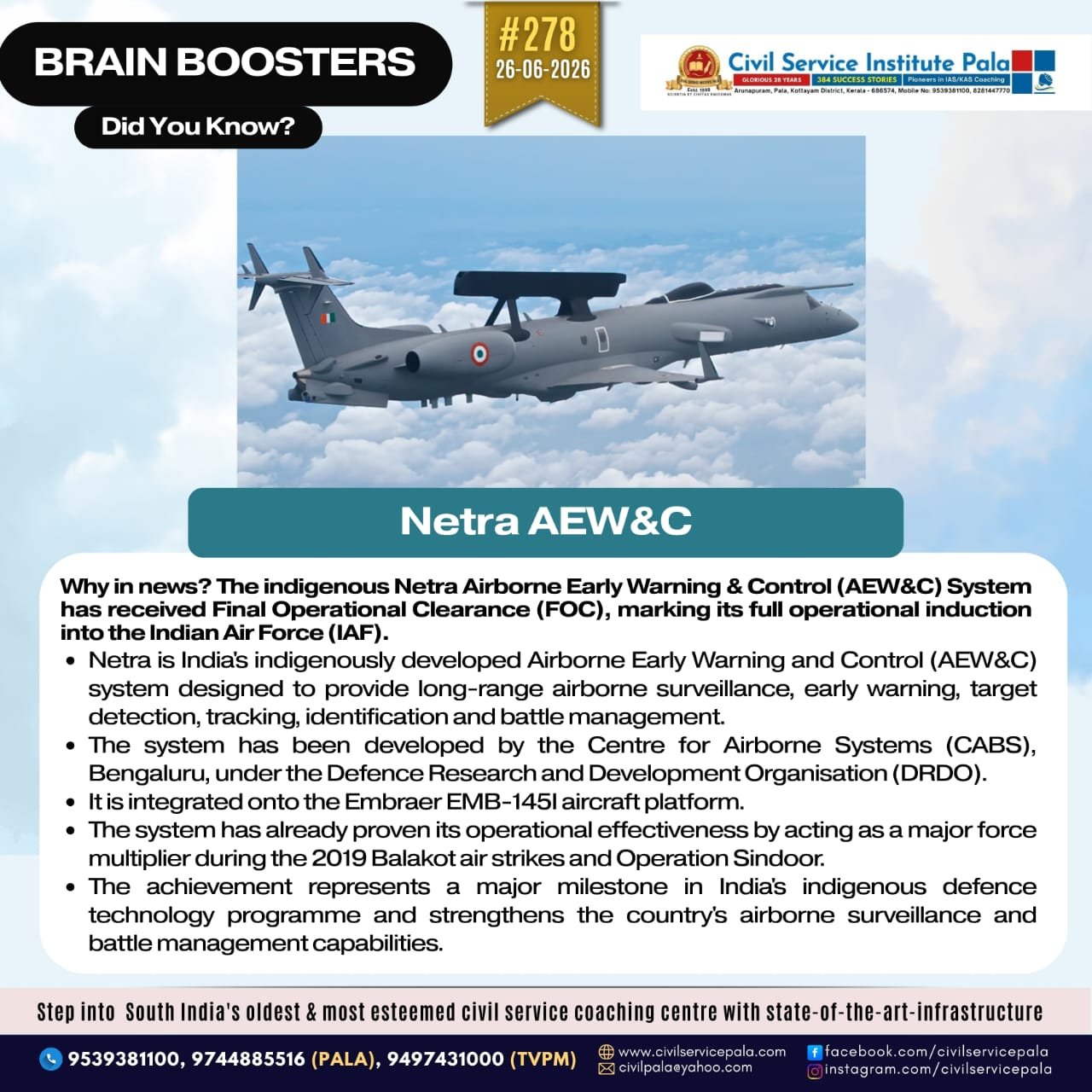
Netra Airborne Early Warning & Control (AEW&C) System
Why in News?
• The indigenous Netra Airborne Early Warning & Control (AEW&C) System has received Final Operational Clearance (FOC), marking its full operational induction into the Indian Air Force (IAF).
• The system has already proven its operational effectiveness by acting as a major force multiplier during the 2019 Balakot air strikes and Operation Sindoor.
• The achievement represents a major milestone in India's indigenous defence technology programme and strengthens the country's airborne surveillance and battle management capabilities.
What is the Netra AEW&C System?
• Netra is India's indigenously developed Airborne Early Warning and Control (AEW&C) system designed to provide long-range airborne surveillance, early warning, target detection, tracking, identification and battle management.
• The system has been developed by the Centre for Airborne Systems (CABS), Bengaluru, under the Defence Research and Development Organisation (DRDO).
• It is integrated onto the Embraer EMB-145I aircraft platform.
• The programme has been developed through close collaboration among the IAF, DRDO and Indian defence industries, making it an important example of indigenous defence capability.
Major Capabilities and Features
• Netra is equipped with an Active Electronically Scanned Array (AESA) radar, enabling continuous long-range surveillance of airborne and maritime targets.
• It incorporates an Identification Friend or Foe (IFF) system for distinguishing friendly aircraft from hostile ones during operations.
• The platform carries an advanced mission computer, secure communication systems, Electronic Support Measures (ESM) and communication support measures for integrated mission management.
• It can detect, track, identify and continuously monitor airborne as well as maritime targets, significantly enhancing the Indian Air Force's network-centric warfare capabilities.
• The system substantially improves situational awareness, airborne surveillance, command-and-control and battle management during military operations.
Strategic Significance
• Netra serves as a major force multiplier by extending the Indian Air Force's surveillance and operational reach far beyond ground-based radar coverage.
• It strengthens India's ability to conduct network-centric operations, enabling faster decision-making and better coordination among multiple combat platforms.
• The successful development of Netra places India among only five countries in the world possessing indigenous AEW&C capability.
• The programme represents a significant achievement in Aatmanirbhar Bharat, demonstrating India's growing self-reliance in advanced aerospace and defence technologies.
• The system reflects successful synergy between operational users, scientific institutions and the domestic defence industry.
Development Timeline
• The concept of an indigenous Airborne Warning and Control System was first initiated during the early 1980s.
• The original programme suffered a major setback after the 1999 crash of a modified HS-748 Avro aircraft near Arakkonam, Tamil Nadu, resulting in the loss of eight personnel, including four IAF officers and four DRDO scientists.
• Following the accident, the programme was temporarily discontinued before being sanctioned afresh in 2004.
• The Initial Operational Clearance (IOC) was granted in 2015, and the system was inducted into the Indian Air Force in 2017.
• The Final Operational Clearance (FOC) has now marked the successful completion of the programme's operational development.
Future Expansion
• The Cabinet Committee on Security (CCS) has approved the development of six additional Netra AEW&C Mk-1A systems.
• The expanded fleet is expected to significantly enhance India's airborne surveillance coverage and operational readiness.
