



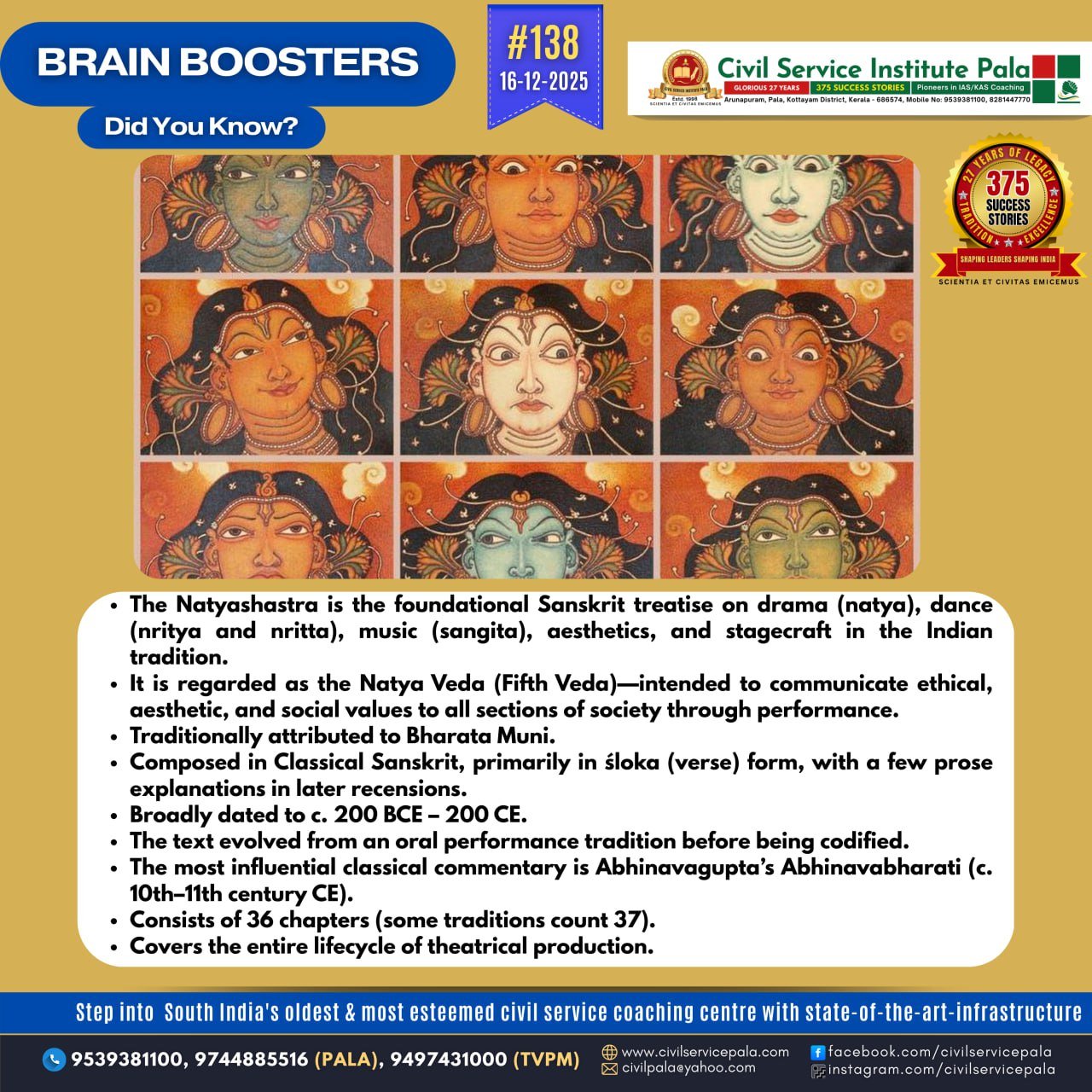
Nāṭyaśāstra
Nāṭyaśāstra is an ancient Indian treatise on performing arts, traditionally attributed to sage Bharata Muni. It is one of the most comprehensive works on drama, dance, and music in the world and forms the foundation of Indian classical performing traditions.
Origin and Period
Believed to have been composed between 200 BCE and 200 CE.
Written in Sanskrit, consisting of about 36–37 chapters and nearly 6,000 verses.
Considered the “Fifth Veda” (Pañcama Veda) because it was meant to be accessible to all sections of society.
Subject Matter
The Nāṭyaśāstra provides detailed guidelines on:
Drama (Nāṭya) – structure of plays, plot types, characters, dialogues.
Dance (Nṛtya & Nṛtta) – body movements, postures, gestures (aṅgahāra, karaṇa).
Music (Saṅgīta) – vocal and instrumental music, rhythms (tāla), melodies (rāga in early form).
Stagecraft – theatre architecture (raṅgamaṇḍapa), costumes, makeup, props, and lighting.
Acting (Abhinaya) – four types:
Āṅgika (body movements),
Vācika (speech),
Āhārya (costume & makeup),
Sāttvika (emotions).
Concept of Rasa
The most influential contribution of the Nāṭyaśāstra is the Rasa theory, explaining aesthetic experience.
Originally eight Rasas:
Śṛṅgāra (love)
Hāsya (humour)
Karuṇa (compassion)
Raudra (anger)
Vīra (heroism)
Bhayānaka (fear)
Bībhatsa (disgust)
Adbhuta (wonder)
Later, Śānta (peace) was added as the ninth Rasa.
Significance
Foundation of major Indian classical dance forms such as Bharatanatyam, Kathakali, Odissi, Kathak, and Manipuri.
Influenced Sanskrit drama (e.g., works of Kālidāsa).
A unique synthesis of art, philosophy, psychology, and aesthetics.
Cultural Importance
Nāṭyaśāstra views art as a medium for moral instruction, spiritual upliftment, and social harmony.
It emphasizes that performance should both entertain and educate the audience.
