



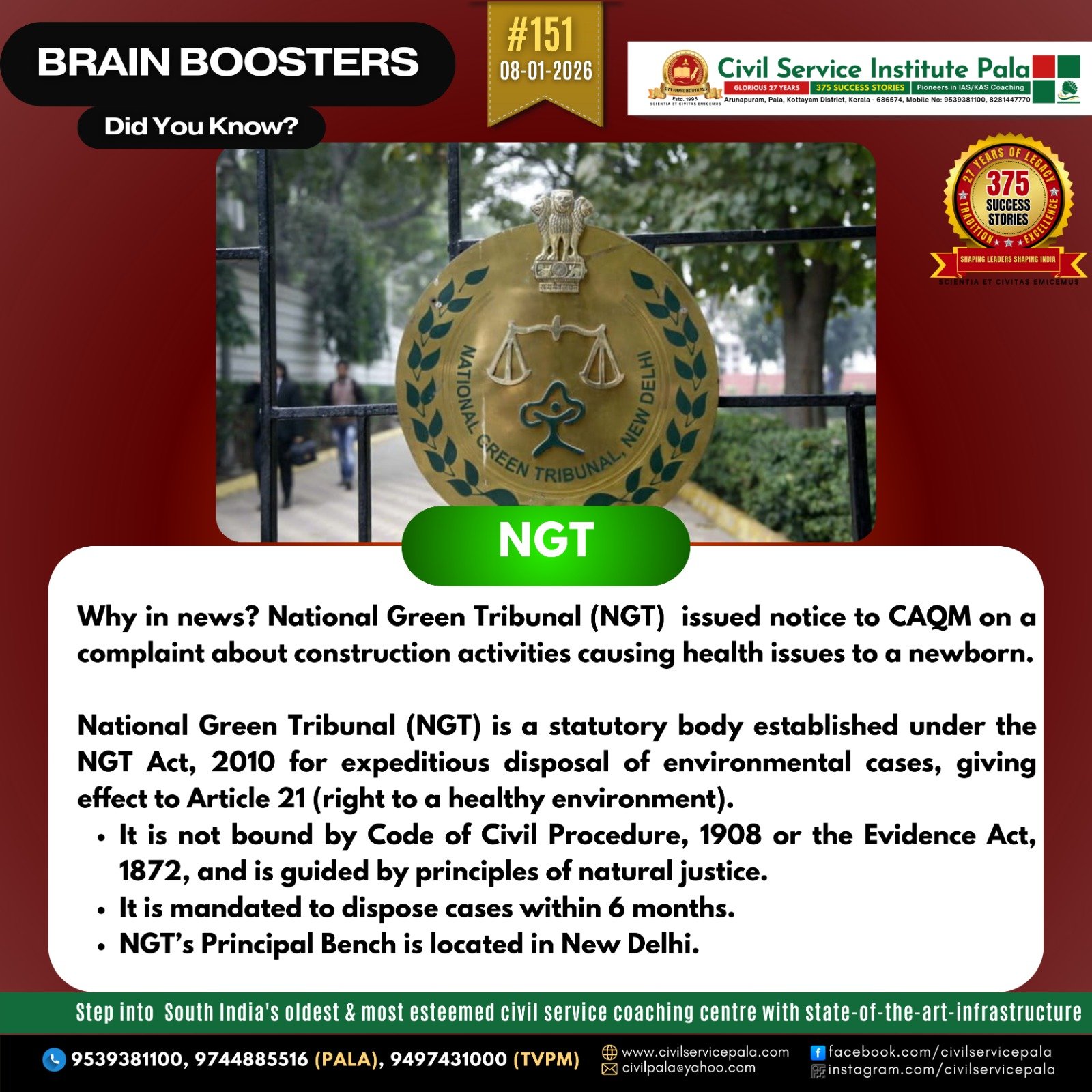
National Green Tribunal
National Green Tribunal
Why in news? NGT issued notice to the Commission for Air Quality Management in the National Capital Region (NCR) and Adjoining Areas(CAQM) on a complaint about construction activities causing health issues to a newborn.
National Green Tribunal (NGT) is a statutory body established under the NGT Act, 2010 for expeditious disposal of environmental cases, giving effect to Article 21 (right to a healthy environment).
It is not bound by the Code of Civil Procedure, 1908 or the Evidence Act, 1872, and is guided by principles of natural justice.
It is mandated to dispose cases within 6 months.
The Principal Bench is located in New Delhi.
Composition
The National Green Tribunal consists of a Chairperson, judicial members, and expert members. The Act allows for up to 20 judicial members and 20 expert members. Every bench of the Tribunal must include at least one judicial member and one expert member. The Chairperson must be a serving or retired Judge of the Supreme Court or a Chief Justice of a High Court, and also functions as a judicial member.
Powers and Jurisdiction
The orders of the Tribunal are binding in nature, and it has the power to award compensation and damages to affected persons. The NGT has jurisdiction over all civil cases relating to environmental issues that arise from the implementation of laws listed in Schedule I of the NGT Act.
Schedule I
Schedule I includes important environmental laws such as :
• The Water (Control of Pollution) Act, 1974;
• The Water (Control of Pollution) Cess Act, 1977
• The Forest (Conservation) Act, 1980
• The Air (Prevention & Control of Pollution) Act, 1981
• The Environment (Protection) Act, 1986
• The Public Liability Insurance Act, 1991
• The Biological Diversity Act, 2002
.
Q. The National Green Tribunal Act, 2010 was enacted in consonance with which of the following provisions of the Constitution of India?
1) Right to healthy environment, construed as a part of part of Right to life under Article 21.
2) Provision of grants for raising the level of administration in the Scheduled Areas for the welfare of Scheduled Tribes under Article 275(1)
Which of the statements given above is/are correct?
a) 1 only
b) 2 only
c) Both 1 and 2
d) Neither 1 nor 2
Answer: a
