



Nanographene-Based Porous Materials for Advanced Gas Storage
Nanographene-Based Porous Materials for Advanced Gas Storage
Why in News?
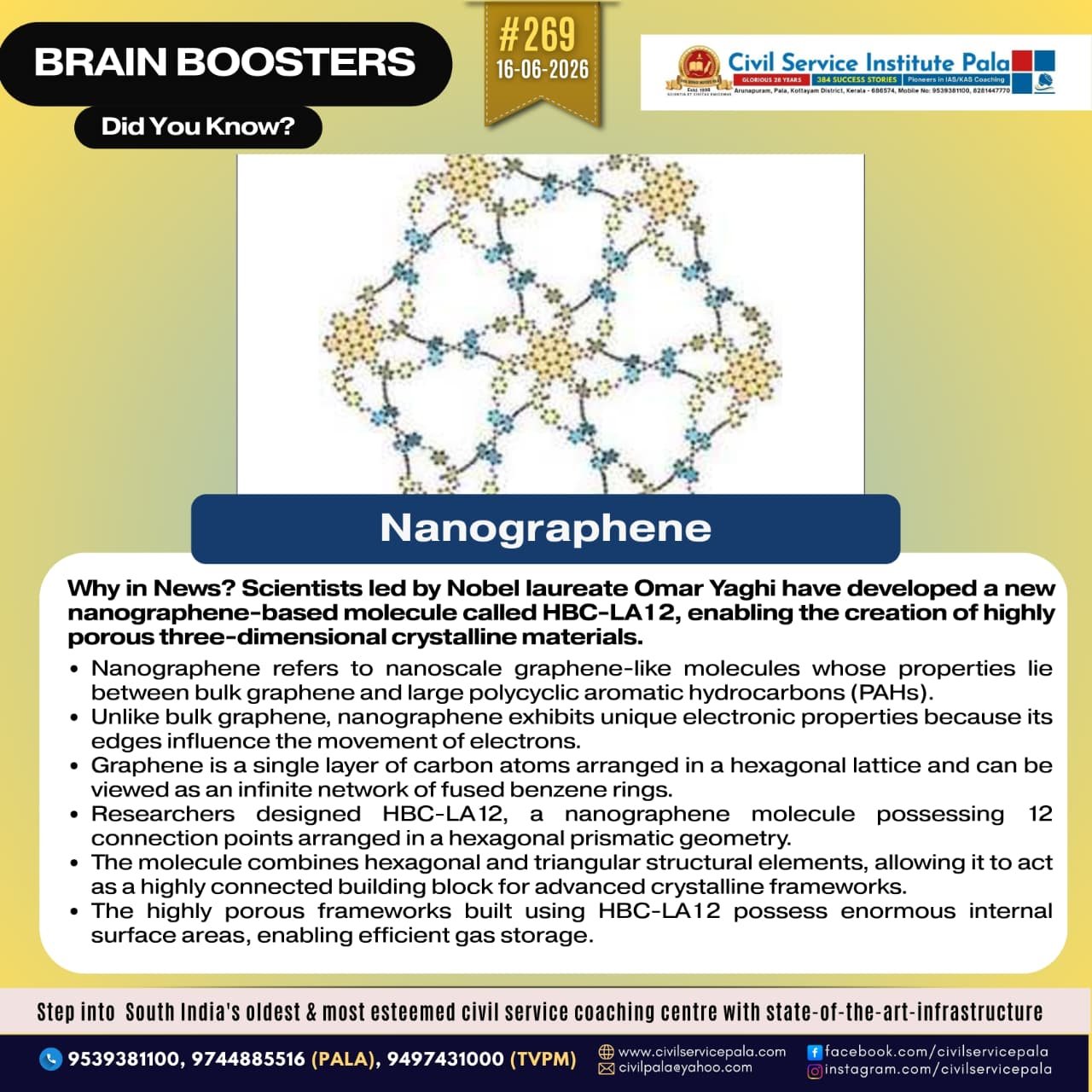
Scientists led by Nobel Laureate Omar Yaghi have developed a new nanographene-based molecule called HBC-LA12, enabling the creation of highly porous three-dimensional crystalline materials.
Using this molecule, researchers synthesized two new framework structures, including one with a record surface area of about 5,000 m² per gram, representing a major advance in reticular chemistry and porous material design.
The development could significantly improve technologies related to gas storage, gas separation, catalysis, sensing, and drug delivery.
Key Concepts and Latest Development
Nanographene refers to nanoscale graphene-like molecules whose properties lie between bulk graphene and large polycyclic aromatic hydrocarbons (PAHs).
Unlike bulk graphene, nanographene exhibits unique electronic properties because its edges influence the movement of electrons.
Graphene is a single layer of carbon atoms arranged in a hexagonal lattice and can be viewed as an infinite network of fused benzene rings.
Researchers designed HBC-LA12, a nanographene molecule possessing 12 connection points arranged in a hexagonal prismatic geometry.
The molecule combines hexagonal and triangular structural elements, allowing it to act as a highly connected building block for advanced crystalline frameworks.
By linking HBC-LA12 with other molecular units, scientists created new three-dimensional porous architectures with precisely controlled geometry.
Reticular Chemistry and Porous Frameworks
Reticular chemistry is the science of assembling molecular building blocks into predetermined crystalline structures through strong chemical bonds.
It enables the rational design of materials with predictable architecture, pore size, and functionality.
Metal-Organic Frameworks (MOFs) are crystalline porous materials formed by linking metal ions with organic molecules.
Covalent Organic Frameworks (COFs) are porous crystalline structures formed entirely through strong covalent bonds between organic building blocks.
The new nanographene linker expands the design possibilities for both MOFs and COFs by introducing highly connected and geometrically precise structures.
Why Highly Porous Materials Matter
Highly porous materials possess enormous internal surface area, enabling them to store large quantities of gases within their pores.
Such materials can adsorb gases efficiently while requiring less space and potentially lower operating pressures.
Their tunable pore structures allow selective capture, separation, and storage of different gases.
Porous materials offer safer and more efficient alternatives to conventional high-pressure gas storage technologies.
Significance for Hydrogen Storage
Hydrogen is considered a clean energy carrier because its combustion produces only water.
Large-scale adoption of hydrogen-based energy systems requires efficient, safe, and economical storage methods.
Current hydrogen storage systems often depend on high-pressure tanks operating at pressures up to 700 bar, which can be expensive and present safety challenges.
Porous materials such as MOFs can store hydrogen through adsorption within their internal pores, reducing dependence on extremely high-pressure storage systems.
Improved hydrogen storage technologies can support the growth of fuel-cell vehicles and broader carbon-neutral energy systems.
Applications and Implications
The development expands the toolkit available for designing next-generation porous materials with tailored structures and functions.
These materials could be used for hydrogen storage, carbon capture, gas separation, chemical sensing, catalysis, and drug delivery.
The ability to precisely control framework geometry opens opportunities for designing materials capable of performing complex and highly specialized tasks.
The breakthrough strengthens the long-term goal of engineering materials atom-by-atom for targeted industrial, environmental, and energy applications.
