



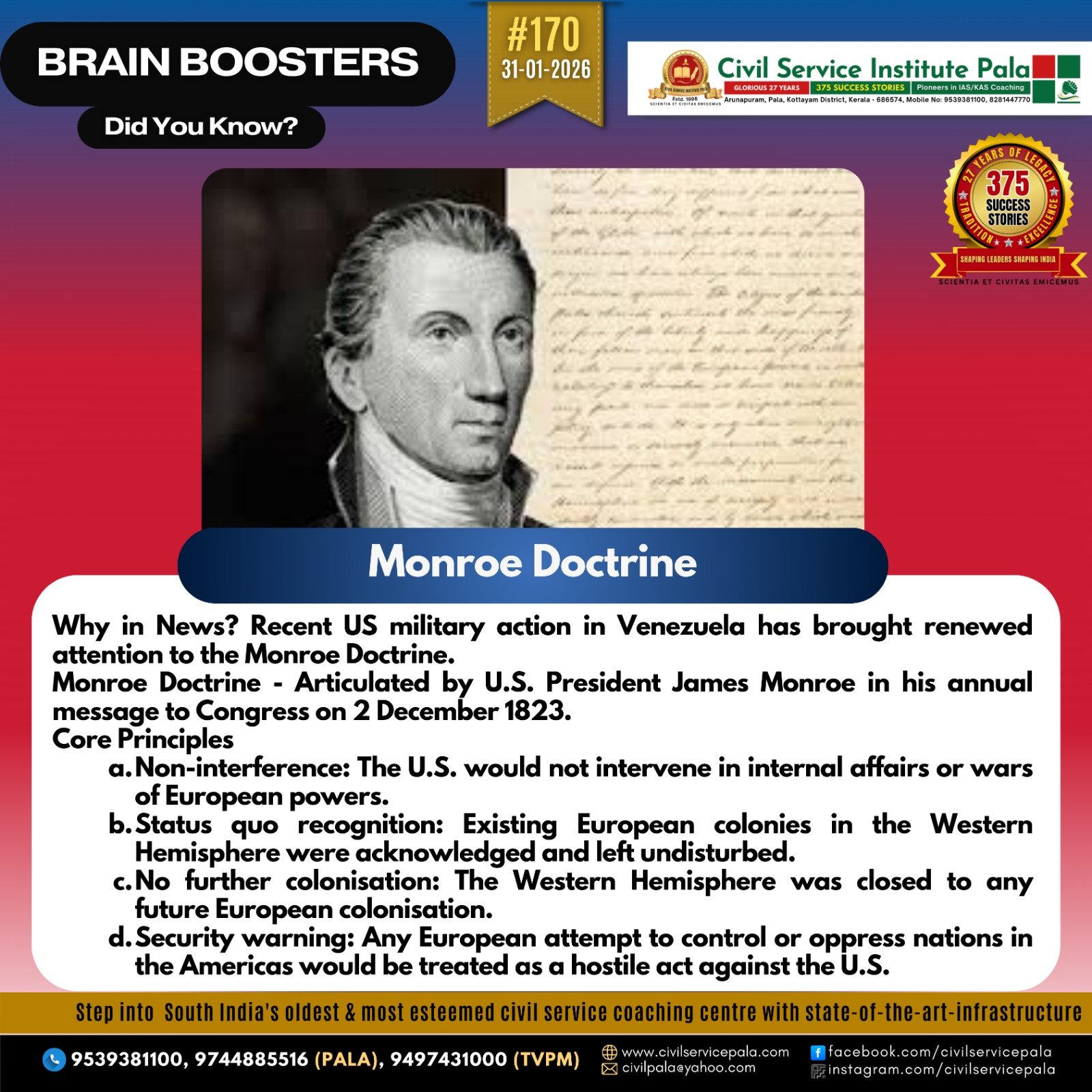
Monroe Doctrine
Why in news? US attack on Venezuela evokes the Monroe Doctrine, laid out in 1823 by then-US president to cement Washington’s sphere of influence in Americas.
Monroe Doctrine (1823) – It is the cornerstone of U.S. foreign policy
• Articulated by U.S. President James Monroe in his annual message to Congress on 2 December 1823.
• Focus area : Asserted a clear distinction between the Old World (Europe) and the New World (Americas) as separate spheres of influence.
• Core Principles
5. Non-interference: The U.S. would not intervene in internal affairs or wars of European powers.
6. Status quo recognition: Existing European colonies in the Western Hemisphere were acknowledged and left undisturbed.
7. No further colonisation: The Western Hemisphere was closed to any future European colonisation.
8. Security warning: Any European attempt to control or oppress nations in the Americas would be treated as a hostile act against the U.S.
Origin of the Monroe Doctrine
• Emerged from shared U.S.–British concerns that European continental powers might restore Spanish control over newly independent Latin American states.
• The United States was additionally wary of Russia’s territorial expansion along the northwest coast of North America.
• In this context, British Foreign Secretary George Canning proposed a joint Anglo-American declaration opposing further European colonisation in Latin America.
• President James Monroe initially supported the proposal; former presidents Thomas Jefferson and James Madison also endorsed it.
• However, Secretary of State John Quincy Adams argued for an independent American declaration, asserting U.S. policy autonomy.
• Adams’ view prevailed, leading to a unilateral articulation of the Monroe Doctrine.
Expansion and Evolution of the Monroe Doctrine
• Post-1870, interpretations of the Monroe Doctrine became increasingly expansive as the United States emerged as a global power.
• The doctrine evolved from a defensive statement into a recognized U.S. sphere of influence in the Western Hemisphere.
Roosevelt Corollary (1904)
• Introduced by President Theodore Roosevelt as an extension of the Monroe Doctrine.
• Asserted that in cases of “flagrant and chronic wrongdoing” by Latin American states, the U.S. had the right to intervene in their internal affairs.
• Though termed a corollary, it represented a significant expansion, effectively granting the U.S. hemispheric police powers.
• Intended to prevent European intervention in Latin America, particularly for debt recovery.
• Context: European blockade of Venezuela (1902) by Britain, Italy, and Germany; countered by U.S. naval pressure.
• A new Latin American Policy was formally articulated in Roosevelt’s annual messages to Congress (1904–05).
• The Roosevelt Corollary became closely associated with Theodore Roosevelt’s Big Stick policy, which legitimised the assertion of U.S. dominance when such intervention was justified as a moral responsibility to maintain order and stability in the Western Hemisphere.
Later Developments
• From Theodore Roosevelt to Franklin D. Roosevelt, the U.S. frequently intervened in Latin America, especially in the Caribbean.
• Since the 1930s, U.S. policy shifted towards consultative engagement, including cooperation through the Organization of American States (OAS).
• Despite this, the U.S. has continued to assert a proprietary role during perceived threats to its national security.
• The Western Hemisphere remains predominantly within U.S. influence.