



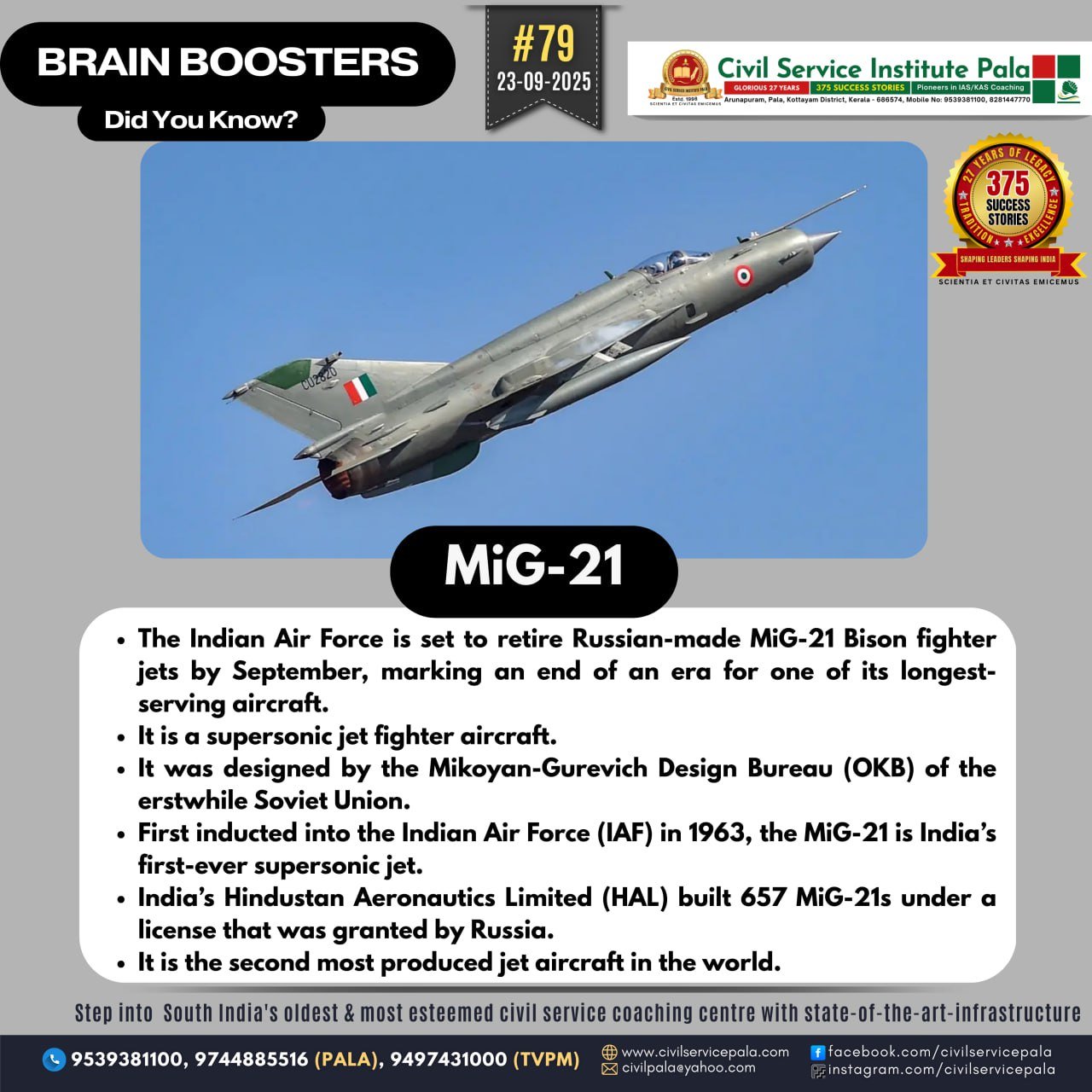
MiG-21
The MiG-21 is a supersonic jet fighter aircraft designed by the Soviet Union’s Mikoyan-Gurevich Design Bureau. First flew in 1956, inducted in 1959, it became one of the most widely produced supersonic aircraft in the world. Nicknamed “Flying Coffin” in India due to its long accident record, but also credited as the backbone of the Indian Air Force (IAF) for decades.
Features Type:
Lightweight, single-engine, supersonic interceptor and fighter aircraft. Speed: Can fly at Mach 2.0 (twice the speed of sound).
Design: Delta-wing configuration. Compact and relatively simple design, making it cheap to produce.
Weapons: Equipped with cannons, air-to-air missiles, bombs, and rockets.
Role: Used for air-to-air combat, ground attack, and reconnaissance. MiG-21 in India Inducted into the Indian Air Force (IAF) in 1963. Served as the mainstay of India’s air combat power for nearly six decades. Played a key role in the 1965, 1971, and 1999 Kargil War (where MiG-21s downed enemy aircraft). India became the largest operator of MiG-21s outside the Soviet Union, with more than 1,200 inducted.
Problems & Criticism
Ageing fleet – many jets over 40 years old. High accident rate – over 400 crashes in India, leading to loss of pilots and aircraft.
Maintenance challenges – spare parts and upgrades became difficult with time. Upgradation India upgraded several versions to MiG-21 Bison standard with: Better avionics, radar, and weaponry. Capability to fire modern air-to-air missiles. Despite upgrades, safety concerns continued. Phase-out The IAF has been gradually phasing out MiG-21s and replacing them with LCA Tejas, Sukhoi Su-30MKI, Rafale, and other modern aircraft. The final squadrons are scheduled to retire by 2025, marking the end of an era. Conclusion: The MiG-21 was once a game-changing supersonic jet and a symbol of India’s air power, but its age, safety record, and technological obsolescence have made it unsuitable for modern warfare, leading to its planned retirement.
