



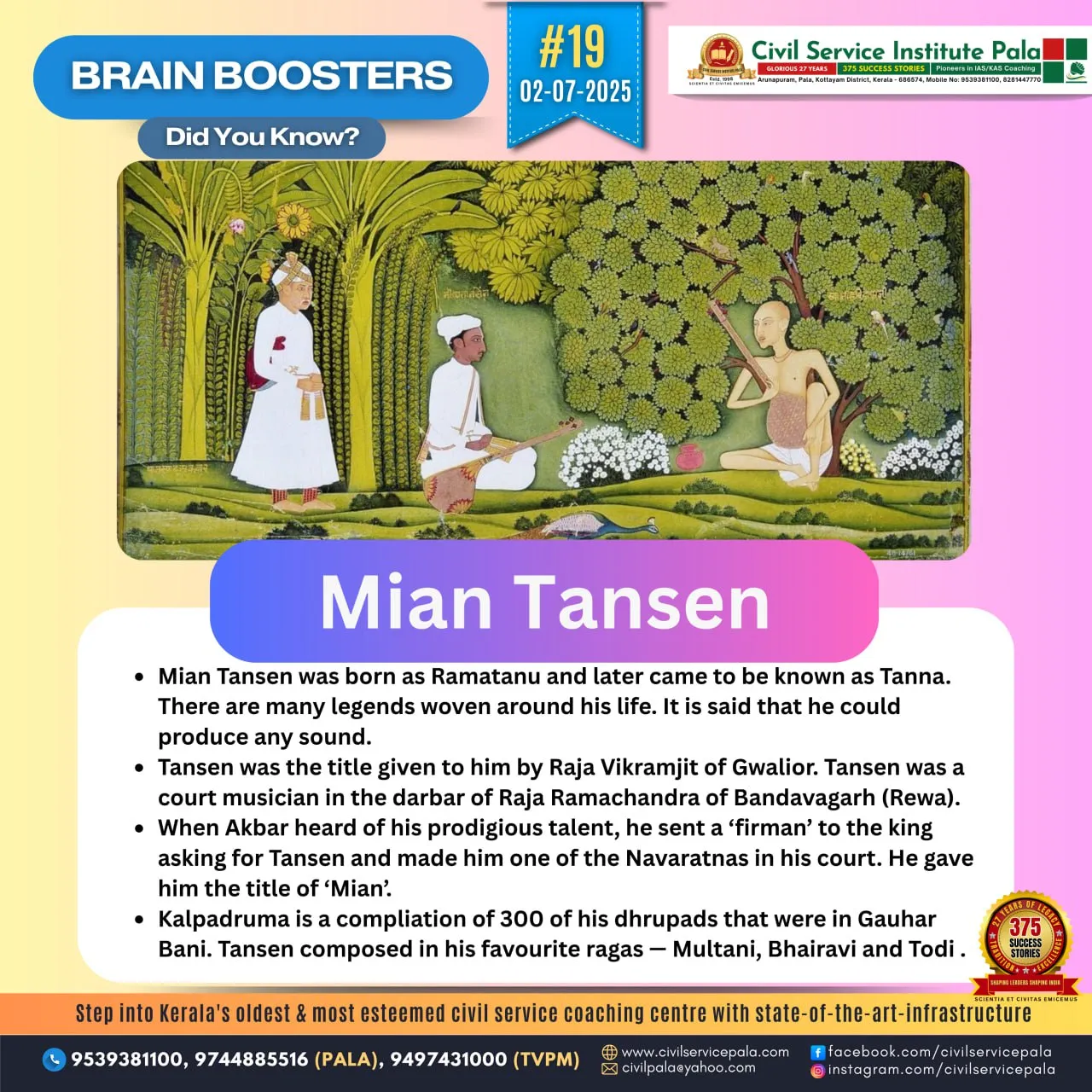
Mian Tansen
Tansen was born as Ramtanu Pandey into a Brahmin family in Behat. He showed extraordinary talent in music from a very young age. His father, Mukund Pandey, was a learned poet and musician himself, who noticed his son’s prodigious gift for melody and ragas.
Tansen’s formal training began under the renowned music guru Swami Haridas, a legendary figure in Indian classical music and a devout Vaishnavite. Under Haridas’ tutelage in Vrindavan, Tansen was deeply influenced by dhrupad, the oldest existing form of Hindustani classical music. Swami Haridas also taught another famous disciple: the Hindu deity Krishna is said to have been spiritually present in his compositions, showing the level of devotion and mysticism involved.
Spiritual Transformation and Patronage
Tansen was also associated with the Sufi mystic Muhammad Ghaus of Gwalior, who is believed to have influenced his spiritual and musical journey. It was under Ghaus that Tansen is said to have embraced Islam, although historical accounts vary and he is often seen as a bridge between Hindu and Muslim cultural traditions.
Initially, Tansen served as a court musician in the court of the Raja of Rewa (Ramchandra Singh), where his fame grew immensely. Hearing of his talent, Emperor Akbar summoned him to his court around 1562 CE.
At the Mughal Court
Tansen became one of the Navaratnas (Nine Gems) in Akbar’s royal court and earned the honorific title “Mian” from the emperor, a title of respect. At the court, he composed, performed, and even created new ragas, enriching the Hindustani classical tradition.
His music had legendary qualities, and many folktales and historical anecdotes describe Tansen’s superhuman musical abilities.
Legends Surrounding Tansen
While many of these are part of folklore, they have contributed to Tansen’s mythic stature:
Raga Deepak: Said to generate heat and light lamps. According to legend, Tansen once sang this raga and it created such intense heat that he had to be cooled by another raga, Megh Malhar, sung by his daughter Saraswati and a disciple to save him.
Raga Megh Malhar: Believed to cause rainfall when sung correctly.
Taming wild animals: His music was said to tame wild animals and even calm rampaging elephants.
Though these accounts are likely exaggerated, they reflect the depth of his influence on music and culture.
Musical Contributions
Tansen is credited with:
Composing several dhrupad compositions that remain central to Indian classical music.
Creating new ragas such as Miyan ki Todi, Miyan ki Malhar, Darbari Kanada, and Miyan ki Sarang.
Reviving and systematizing various elements of Hindustani classical music.
His compositions often reflected a blend of devotional bhakti themes and courtly sophistication, making him a pioneer of integrating spiritual and aesthetic aspects of music.
Death and Legacy
Tansen passed away in 1586 CE, in Agra. His tomb is located near the tomb of his spiritual teacher Muhammad Ghaus in Gwalior, and it remains a site of pilgrimage for music lovers.
Every year, the Tansen Samaroh, a national music festival, is held in Gwalior in his honor, where musicians from across India gather to perform and pay tribute.
Legacy
Mian Tansen remains a towering figure in Indian musical history:
Seen as the father of Hindustani classical music.
His disciples went on to form different gharanas (schools) of music.
Revered in both Hindu and Muslim traditions, symbolizing the syncretic culture of medieval India.
His contributions laid the foundation for the Dhrupad and Khayal traditions in North India.
Source : https://www.thehindu.com/entertainment/music/the-legend-of-mian-tansen/article22893454.ece
