



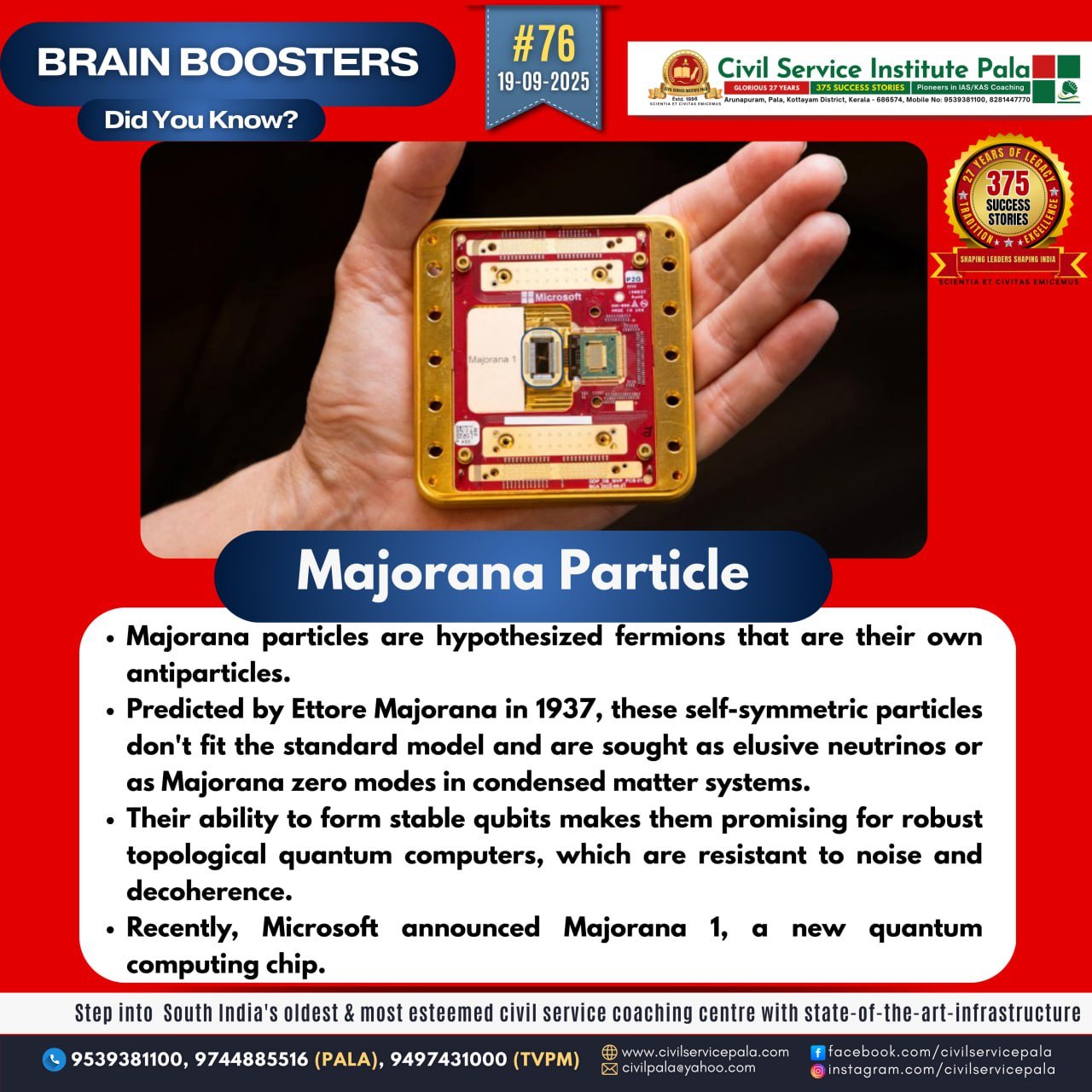
Majorana Particle
What is a Majorana Particle?
A Majorana particle is a fermion (a particle with half-integer spin) that is its own antiparticle. This is different from most known particles: Dirac fermions (like electrons, quarks) have distinct antiparticles. Majorana fermions would have no distinction between particle and antiparticle.
Theoretical Importance
Proposed as a possible explanation for the nature of neutrinos. If neutrinos are Majorana particles, it would mean they and their antiparticles are identical. Would violate lepton number conservation (a principle in particle physics).
Key Implications
Neutrinoless Double Beta Decay If neutrinos are Majorana particles, a rare process called neutrinoless double beta decay could occur.
Detecting this decay would prove that neutrinos are Majorana in nature. Matter–Antimatter Asymmetry Majorana neutrinos could help explain why the universe is made mostly of matter and not equal amounts of antimatter.
Applications in Quantum Computing
Majorana fermions (as quasiparticles in condensed matter systems) are being studied for use in topological quantum computers, which would be highly resistant to errors. Current Status Not yet confirmed experimentally. Hints of Majorana-like behavior have been observed in condensed matter systems (such as superconductors), but no fundamental Majorana particle has been conclusively detected in nature. Experiments worldwide (like GERDA, KamLAND-Zen, and EXO-200) are searching for neutrinoless double beta decay as the key test.
