



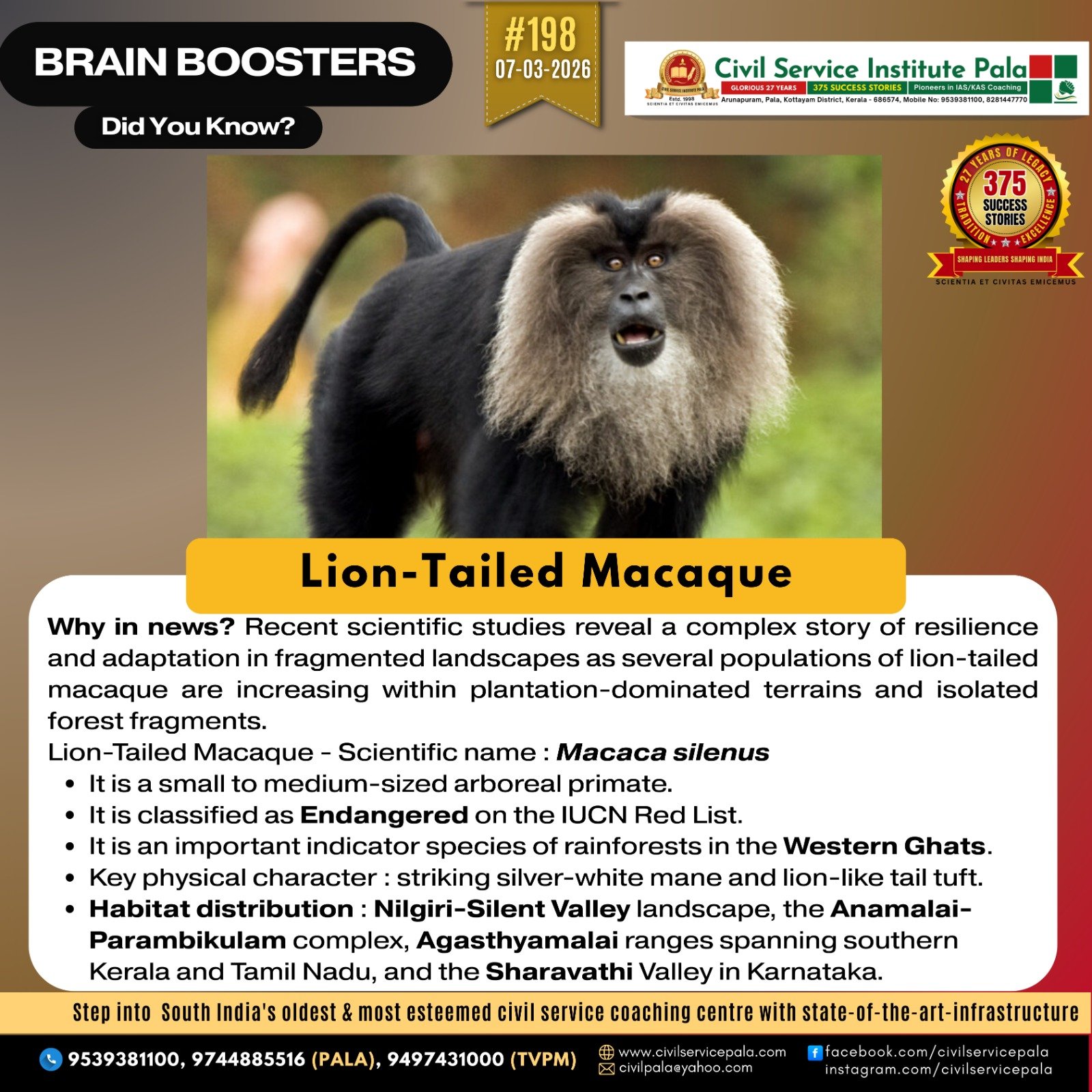
Lion-tailed Macaque
The Lion-tailed Macaque (Macaca silenus) is one of India’s most distinctive primates and an important indicator species of rainforest health in the Western Ghats. Known for its striking silver-white mane and lion-like tail tuft, the species has long been considered highly vulnerable to habitat loss.
Taxonomy and Identification
The lion-tailed macaque belongs to the Old World monkey family (Cercopithecidae). It is a small to medium-sized arboreal primate with a glossy black coat and a distinctive silver-white mane surrounding the face, giving it a lion-like appearance. Its long tail ends in a tuft resembling that of a lion, which gives the species its common name.
Endemism and Geographic Distribution
The species is endemic to the Western Ghats. Its distribution stretches across several rainforest landscapes including:
• Silent Valley National Park (Kerala)
• The Anamalai Hills (Tamil Nadu)
• Sharavathi Valley (Karnataka)
• The Agasthyamalai Hills spanning Kerala and Tamil Nadu
A major geographic feature shaping its distribution is the Palghat Gap, a natural mountain pass that separates northern and southern populations of many Western Ghats species.
Habitat and Ecological Niche
Lion-tailed macaques are rainforest specialists that depend heavily on tropical evergreen forests. They are highly arboreal, spending most of their time in the upper forest canopy, where they move between trees in search of food and shelter.
Key habitat features include:
• Dense evergreen rainforest canopy
• Presence of native fruiting trees
• Continuous canopy connectivity for movement
The species typically occurs at elevations between 100 and 1300 metres, although most populations are associated with intact rainforest systems.
Behaviour and Ecological Role
Lion-tailed macaques are diurnal primates, active during the day and resting at night in the forest canopy. Their diet is primarily frugivorous, consisting of fruits, seeds, insects and occasionally small vertebrates.
Because they consume and disperse seeds across large areas of forest, they play a crucial role in rainforest regeneration and ecosystem stability. In this way, they function as an important seed disperser, helping maintain the biodiversity of Western Ghats forests.
Conservation Status
The species is currently listed as Endangered on the global conservation scale, with only a few thousand individuals estimated to survive in the wild. Historically, conservation scientists believed that the survival of the lion-tailed macaque depended almost entirely on large, continuous tracts of undisturbed rainforest.
However, recent long-term studies in plantation landscapes have revealed unexpected patterns of persistence.
Adaptation to Fragmented Landscapes
A recent study conducted in the Valparai Plateau within the Anamalai Hills has shown that some populations of lion-tailed macaques are surviving within small rainforest fragments surrounded by tea and coffee plantations.
In certain areas, troops have persisted for more than four decades, challenging earlier assumptions that fragmentation would quickly lead to population collapse.
Scientists attribute this persistence to several factors:
• Behavioural flexibility, allowing macaques to adjust movement and foraging patterns
• Presence of remnant native trees that provide food resources
• Occasional canopy connectivity between forest patches
• Conservation interventions such as canopy bridges across roads
These findings suggest that fragmented habitats can sometimes function as temporary refuges, though they cannot fully replace intact forests.
