



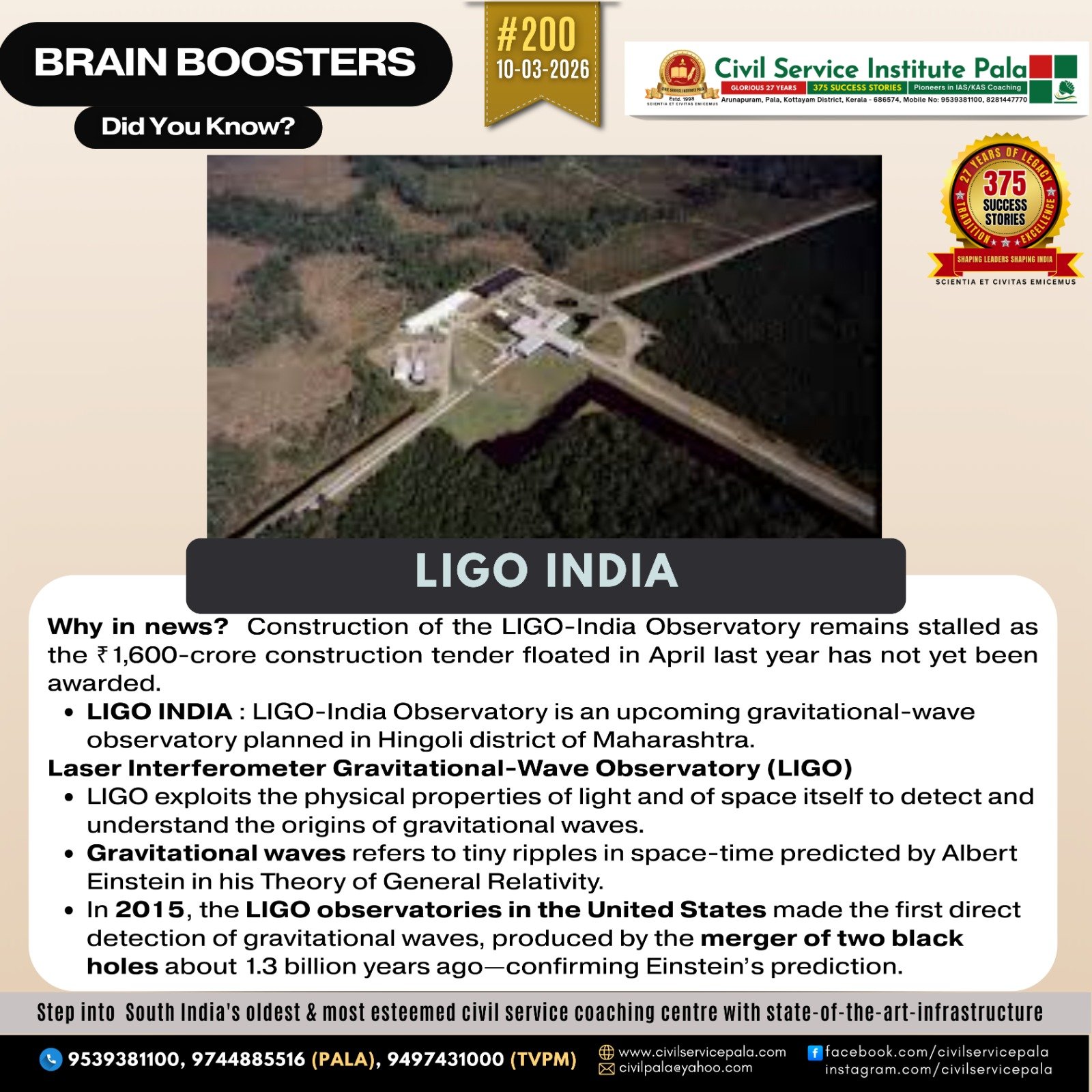
LIGO-India
Why in news? Construction of the LIGO-India Observatory remains stalled as the ₹1,600-crore construction tender floated in April last year has not yet been awarded.
Laser Interferometer Gravitational-Wave Observatory (LIGO) is the world’s largest observatory dedicated to detecting gravitational waves (GW)—tiny ripples in spacetime predicted by Albert Einstein in the Theory of General Relativity.
The project is fully supported by the U.S. National Science Foundation and consists of two massive detectors located about 3,000 km apart in the United States.
Working Principle
• Each LIGO observatory has two arms of 4 km length placed at 90° to each other.
• These arms are ultra-high vacuum tubes with mirrors at the ends.
• Laser beams travel through these arms and reflect back.
• When a gravitational wave passes, it causes extremely tiny changes in arm length, which are detected using laser interference.
LIGO-India
LIGO-India is a collaboration between the U.S. National Science Foundation Laser Interferometer Gravitational-wave Observatory (NSF LIGO) Laboratory.
It is a joint India–US collaboration between:
United States Partners
• National Science Foundation
• LIGO Laboratory
• California Institute of Technology
• Massachusetts Institute of Technology
Indian Partner Institutions
• Raja Ramanna Centre for Advanced Technology
• Institute for Plasma Research
• Inter-University Centre for Astronomy and Astrophysics
Role of LIGO-India in the Global Detector Network
Gravitational-wave detection requires a network of observatories located far apart across the globe.
Existing major detectors include:
• LIGO detectors (USA)
• Virgo Interferometer (European Gravitational Observatory (EGO))
• KAGRA Observatory (Japan)
• GEO600 (Germany)
LIGO-India will become the fifth major detector in the global network.
Why LIGO-India is Important
1. Better Source Localization - With multiple detectors across continents, scientists can triangulate the origin of gravitational waves more accurately.
2. Improved Polarization Measurement - More detectors help determine the polarization properties of gravitational waves, which reveal details about their sources.
3. Higher Detection Reliability - Two detectors can confirm a signal, but three or more detectors significantly improve accuracy and confidence.
4. Increased Observation Time - With more detectors operating globally, the probability that at least four observatories are functioning simultaneously increases, improving detection rates.
Advances in Astrophysics and Cosmology
LIGO-India will help study:
• Black hole mergers
• Neutron star collisions
• Extreme cosmic phenomena
These observations provide crucial insights into gravity, space-time, and the evolution of the universe.
Significance for India
• Positions India at the frontier of gravitational-wave astronomy
• Boosts high-precision engineering and advanced instrumentation
• Encourages international scientific collaboration
• Develops expertise in astronomy, physics, and data science.
