



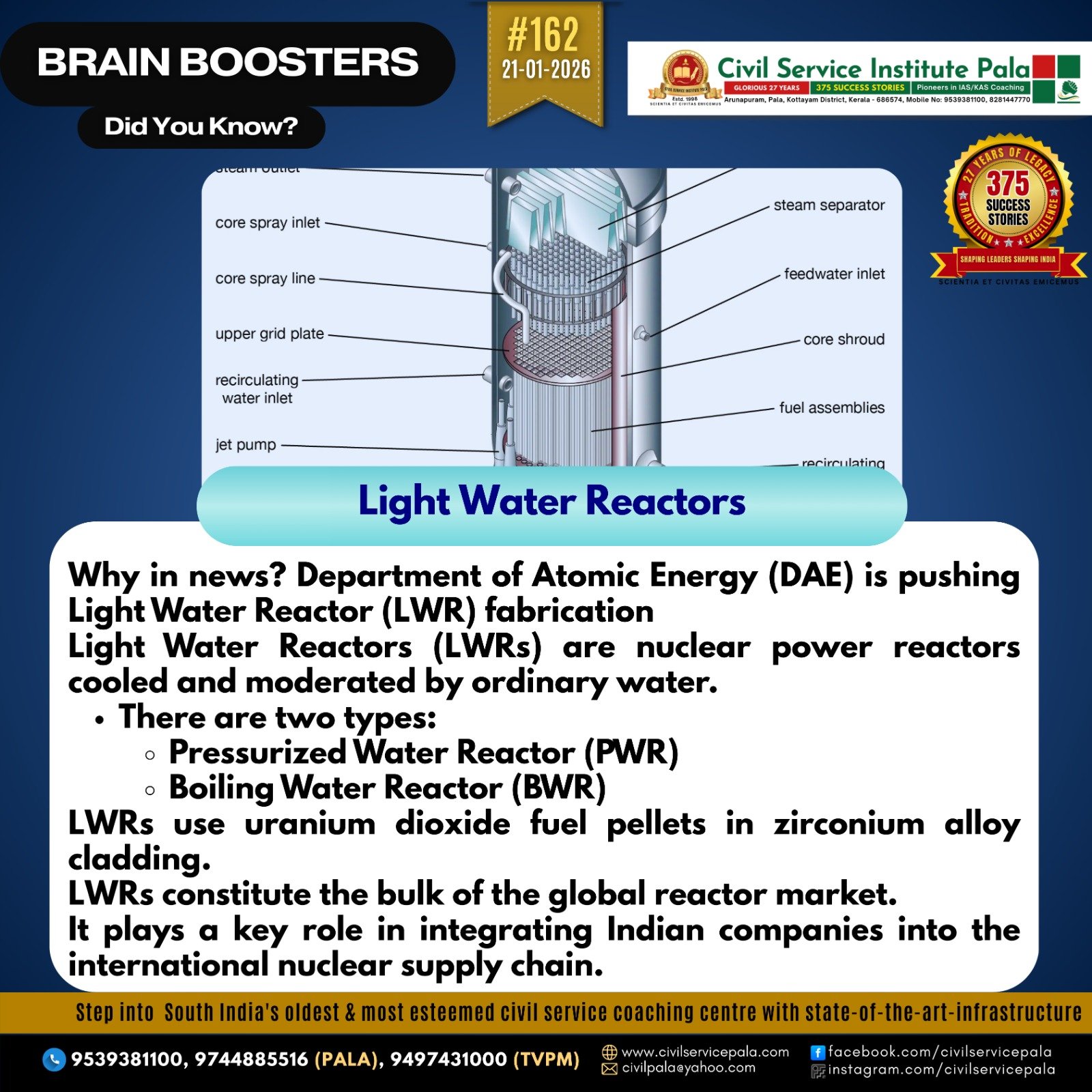
Light Water Reactors
Light Water Reactors (LWRs) are nuclear power reactors cooled and moderated by ordinary water.
• There are two types:
o Pressurized Water Reactor (PWR)
o Boiling Water Reactor (BWR)
Pressurized Water Reactor (PWR) : Water in the primary loop is kept at high pressure and temperature. This water does not boil and carries heat from the core to a steam generator. Heat is transferred to a secondary water loop at lower pressure. Water in the secondary loop boils to form steam. This steam runs the steam turbine.
Boiling Water Reactor (BWR) – it works on a direct cycle. Here, water passing through the core is allowed to boil. The steam produced in the core itself is sent to the turbine. Steam passes through separators and dryers inside the reactor vessel before reaching the turbine.
Key Design Differences
• BWR:
o Fewer components in steam cycle
o More complex internal systems
o No steam generators (which makes the plant smaller in comparison to PWR).
o Lower pressure and temperature which leads to lower efficiency
o Larger but thinner pressure vessel
• PWR:
o Simpler internal vessel design
o Uses very large steam generators (usually four)
o Operates at higher pressure and temperature
o Higher power density through thicker pressure vessel
Fuel and Control Rods
• Both use uranium dioxide fuel pellets in zirconium alloy cladding.
• BWR fuel is slightly less enriched.
• PWR fuel produces more energy before discharge.
• Control rods:
o PWR: inserted from top
o BWR: inserted from bottom
LWRs constitute the bulk of the global reactor market and play a key role in integrating Indian companies into the international nuclear supply chain.
