



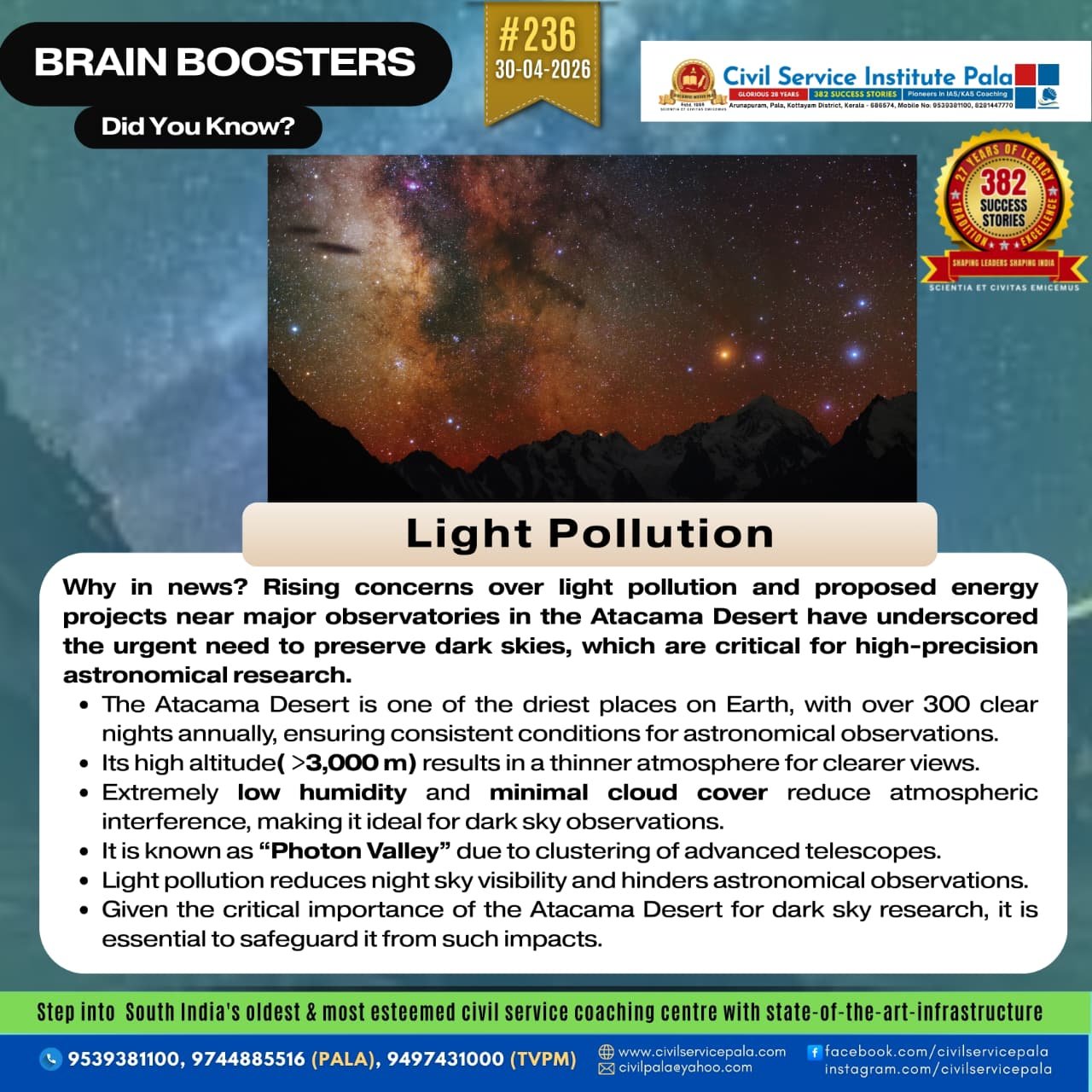
Light Pollution
Why in news?
• Rising concerns over light pollution and proposed energy projects near major observatories in the Atacama Desert have underscored the urgent need to preserve dark skies, which are critical for high-precision astronomical research.
• • The Atacama Desert is one of the driest places on Earth, with over 300 clear nights annually, ensuring highly consistent conditions for astronomical observations.
* Its high altitude (above 3,000 m) results in a thinner atmosphere, enabling clearer views of celestial objects.
* Extremely low humidity and minimal cloud cover reduce atmospheric interference, making it ideal for dark sky observations.
* It is often referred to as “Photon Valley” due to the dense clustering of advanced telescopes.
* It hosts world-class facilities operated by the European Southern Observatory.
* It is the site of the upcoming Extremely Large Telescope (ELT), a $1.5 billion project scheduled for completion by 2030.
* The region attracts scientists globally, and Chile hosts a significant share of the world’s ground-based astronomical infrastructure.
What is Light Pollution?
• It refers to excessive or misdirected artificial light that scatters in the atmosphere.
• Light pollution reduces visibility of celestial objects by brightening the night sky.
• Even minimal light interference can disrupt high-precision astronomical observations.
Challenges
1. Rising Light Pollution: Expanding urbanisation, mining, and energy projects are increasing artificial lighting, and even low-intensity light can disrupt sensitive astronomical instruments.
2. Development vs Science Conflict: Proposed green energy projects near observatories have triggered opposition, highlighting the trade-off between economic growth and the preservation of scientific research environments.
3. Regulatory Gaps: Existing sky protection laws are outdated and unclear, with weak enforcement mechanisms to address emerging threats such as light pollution.
4. Environmental Sensitivity: Dark skies are a non-renewable scientific resource, and the loss of natural darkness directly undermines long-term astronomical research capabilities.
Way Forward
Light pollution, caused by the scattering of artificial lighting in the atmosphere, reduces night sky visibility and undermines astronomical observations. Given the critical importance of the Atacama Desert for dark sky research, it is essential to safeguard it from such impacts.
* Strengthen light pollution regulations and implement strict zoning laws around observatories.
* Promote the development of dark-sky reserves and adoption of sustainable lighting technologies.
* Balance infrastructure expansion with scientific and ecological priorities.
* Encourage global cooperation to protect critical astronomical sites.
